Global specialty awards: Qollab x IonQ Hackathon 2026
Six awards: the best of each theme, the most novel, the most impact and the best documentation.
Six projects won the global specialty awards of the Qollab x IonQ Hackathon 2026:
- Best of Quantum Impact: FairPass (Dartmouth College)
- Best of Quantum Playground: The Last Call (Carnegie Mellon University)
- Best of Quantum Unlocked: Syndrome (Institut quantique, Université de Sherbrooke)
- Most novel / creative: Motus aberrans (Universidad del Valle-QuanTIC)
- Most impact: FloodSight Q (I-HUB Quantum Technology Foundation)
- Best documentation: Quantum MagNav (UCLA)
Three awards go to the best project in each theme. Quantum Impact is for solving real-world problems with quantum and classical computing, and Quantum Playground for using quantum to build something playful, artistic or unexpected. Quantum Unlocked is for projects that "make the hardest ideas in quantum computing click". The other three go to the most novel or creative project, the project with the most impact and the best documentation.
Best of Quantum Impact: FairPass
FairPass won the Dartmouth College node.
FairPass coordinates satellite ground stations. Its data comes from SatNOGS, an open-source global network of ground stations, where each station picks which satellite to listen to. FairPass decides which satellite talks to which antenna, to get the most data down while cutting the number of satellites left without a turn.
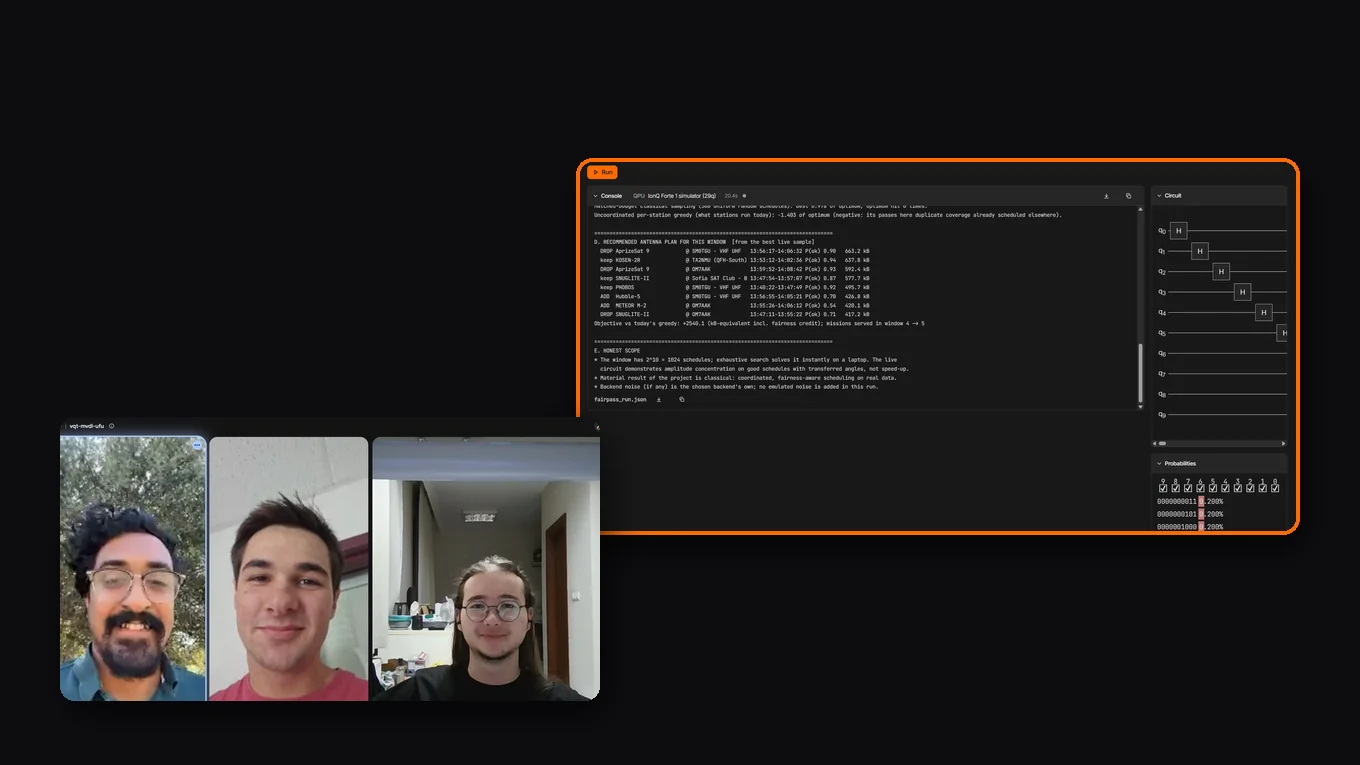
Team Superpositioned entered FairPass. Sezer Aptourachman, the team lead, is a third-year informatics and telematics student at Harokopio University of Athens. Hirmay Bharatkumar Sandesara is a master's student in computational science and engineering at the Technical University of Munich. Nicholas Gould is a senior at the University of Lynchburg. Ramachandran Sekanipuram Srikanthan is a hardware engineer. Sezer and Nicholas were teammates at MIT's iQuHACK 2025, and Hirmay joined after Sezer found him on the iQuHACK 2026 Discord server.
Space is no longer only for big agencies. Students and small teams around the world now build satellites, but they rely on volunteer ground stations to hear from them, and a satellite nobody listens to is a lost mission.
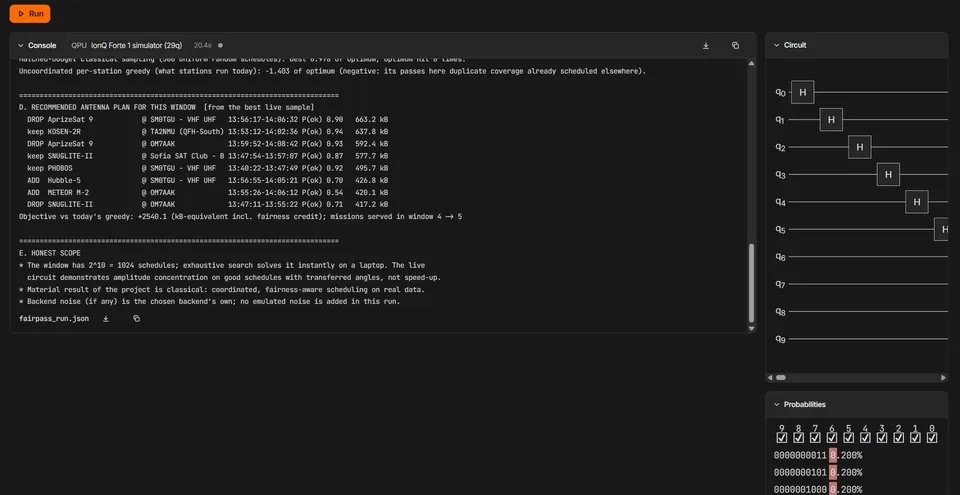 FairPass: fairness-aware contact scheduling for open ground-station networksA scheduler for satellite-to-ground-station communication, using both QAOA and a classical greedy algorithm.
Best of Quantum Playground: The Last Call
The Last Call took 1st place at the Carnegie Mellon University node.
In The Last Call, your little sister Mira's voice comes through two doors at once, and something outside imitates her. The two halves of the call cancel or reinforce at different dial settings, and you tell Mira from the impostor by that pattern. Checking which door she is at wipes the pattern out, so you choose what to learn before the line goes dead. The team's goal: "If you come away a little scared and a little more curious about quantum, it worked."
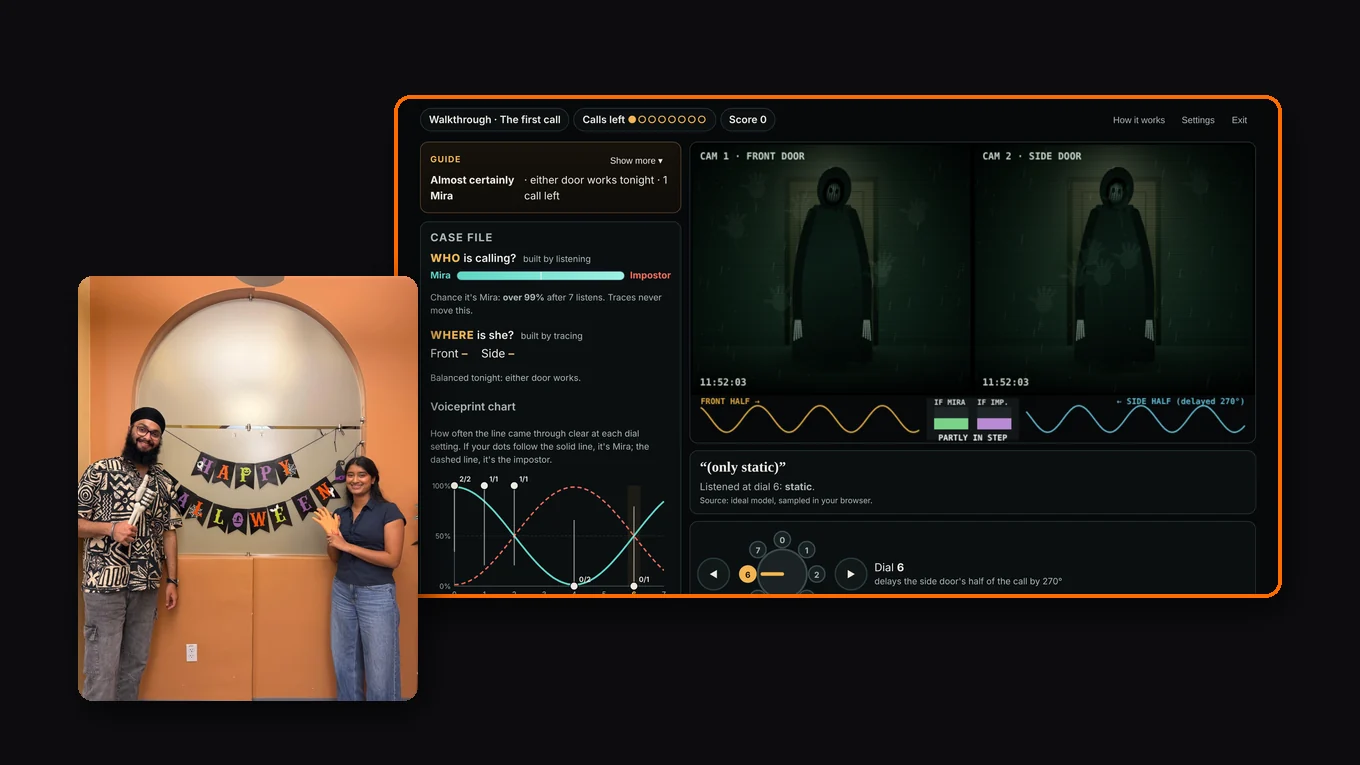
Tanish Singh Rajpal and Abhinaya Nagalla were working on a class project together when they decided to team up on the game outside class. Both are master's students in information security at Carnegie Mellon. Tanish worked on the game's quantum mechanics as quantum lead, and Abhinaya designed its concept as creative lead. Picking the idea was the hardest part. They went through a memory game and a build-your-own-story game before settling on horror, a genre they both love.
I thought quantum computing was not beginner-friendly, but now I feel that even if I don't know quantum mechanics in absolute depth, I can still make interesting things with it.
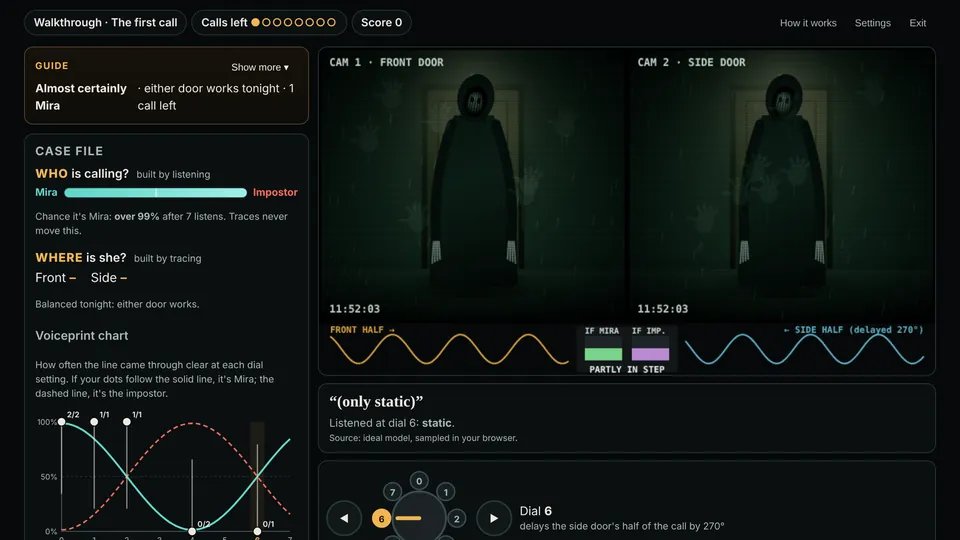 The Last CallA quantum horror game played with three tools: Listen, Trace and Erase.
Best of Quantum Unlocked: Syndrome
Syndrome took 1st place at the Institut quantique, Université de Sherbrooke node.
In Syndrome, players find flipped qubits without peeking at them, using only the syndrome lamps. Every lamp is a Qiskit circuit. Professor Bloch, the game's mentor, stands for the Bloch sphere, Detective Ancilla for the ancilla qubits that read the syndrome, and Deco for decoherence.
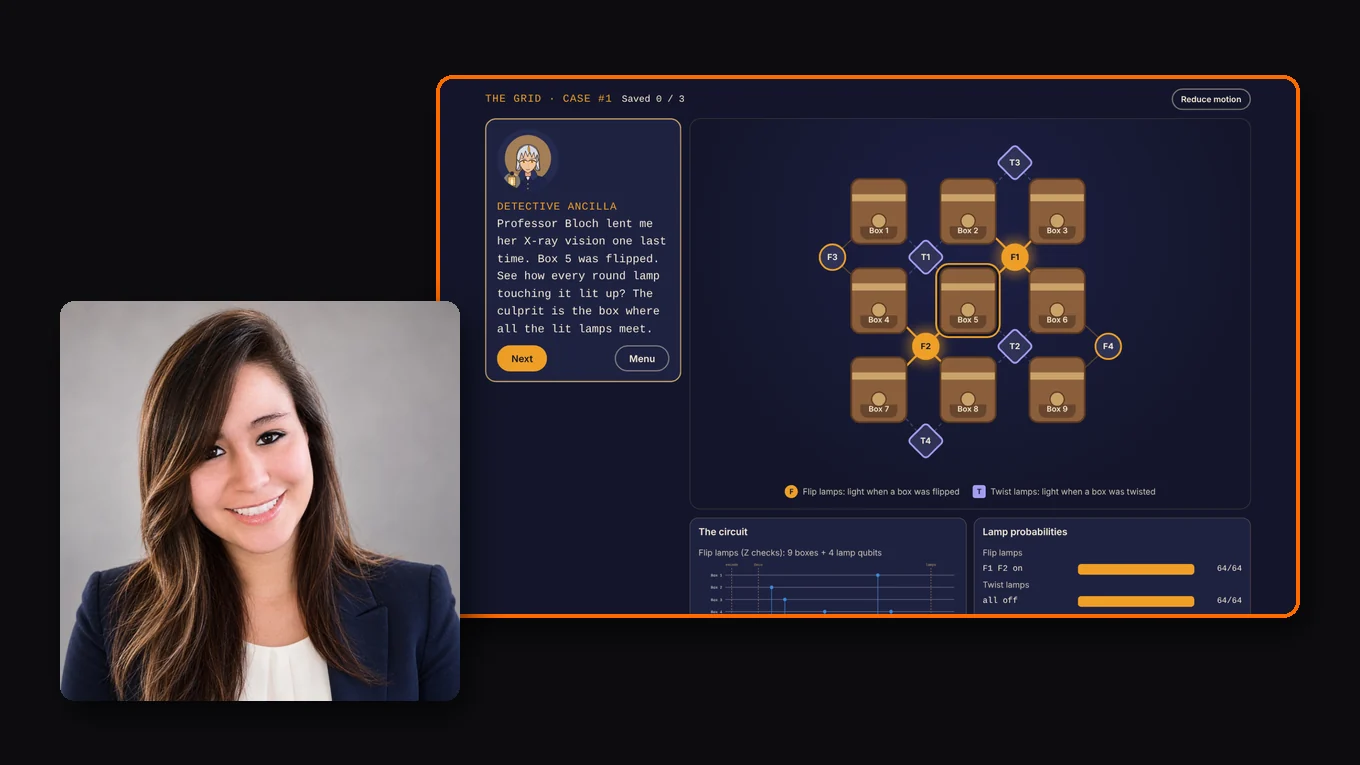
Maria Alejandra Boada Rodriguez built the game on her own and based Professor Bloch on her avatar. She is a Colombian software engineer completing a master's in data analytics at the University of Niagara Falls Canada. Quantum error correction confused her until Google's 2021 Nature paper on repetition codes helped her grasp it. She then combined her two degrees, in engineering and psychology, to teach the idea to herself as a game.
Before this weekend, I thought quantum computing was a field only physicists could truly understand. Now I know that if you can turn an idea into a game, anyone can learn it.
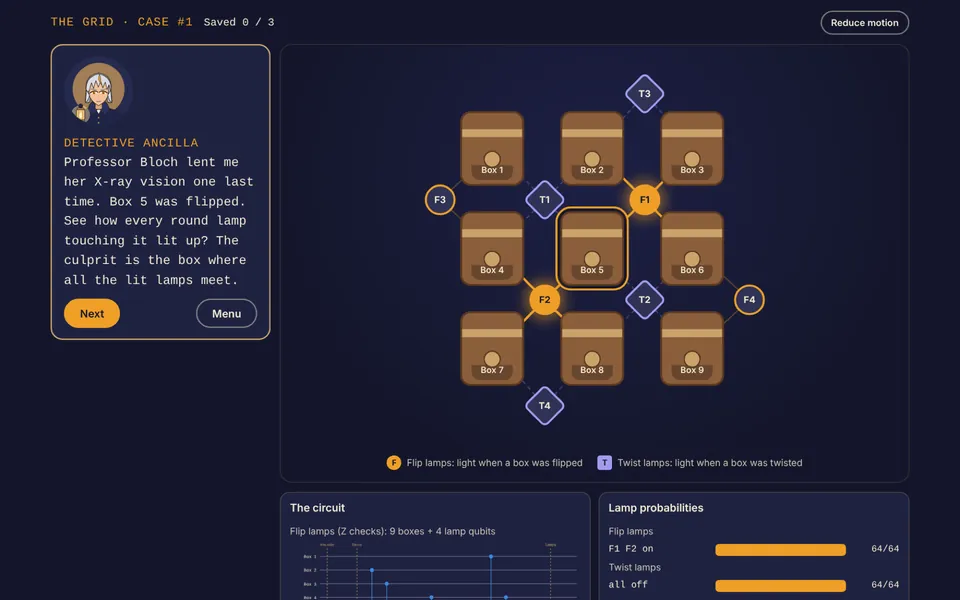 SyndromeA detective game about quantum error correction, from a 3-qubit repetition code to a 17-qubit surface code.
Most novel / creative: Motus aberrans
Motus aberrans won the Universidad del Valle-QuanTIC node.
Motus aberrans is a pixel-art role-playing game in three stages, set in real places in Cali. Jhon Esteban Peña Molina and Juan David Cuartas, team SquirBits, built the game. They are fifth-semester physics students at Universidad del Valle and met in a Physics II class.
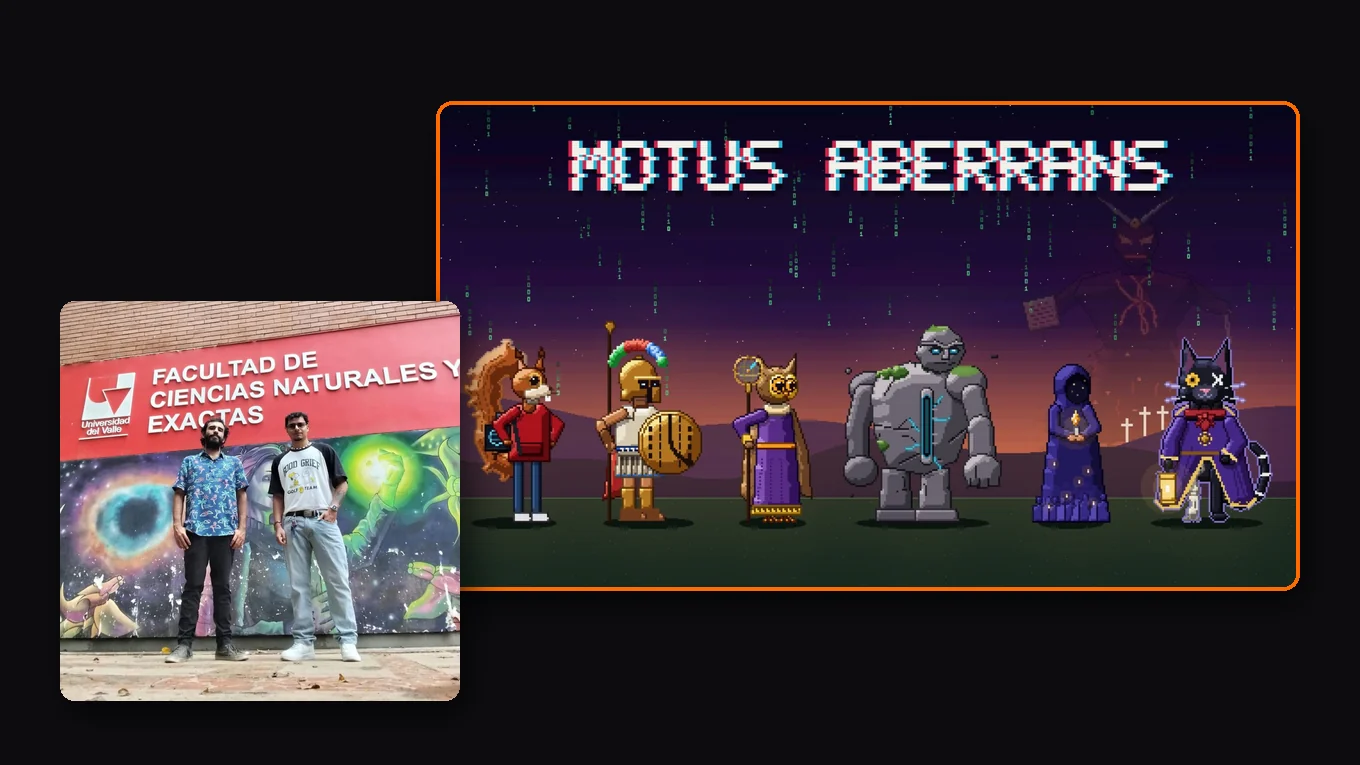
SquirBits' hardest problem was randomness, which the game needs everywhere. To supply it, Motus aberrans runs its 159 circuits once at start-up and keeps the results as a measurement bank. In battles, a hit lands only if your circuit gives the same distribution as the target. A shot from the measurement bank then settles the hit, so noise can deflect it. The final boss is noise itself, built on the error rates IonQ publishes.
"Physics without cheats." Nothing quantum is fake. The direction of the paddle actually comes from a quantum Fourier transform. The entangled foxes come from Bell states, and in IonQ's noisy simulator, you can see their correlation drop.
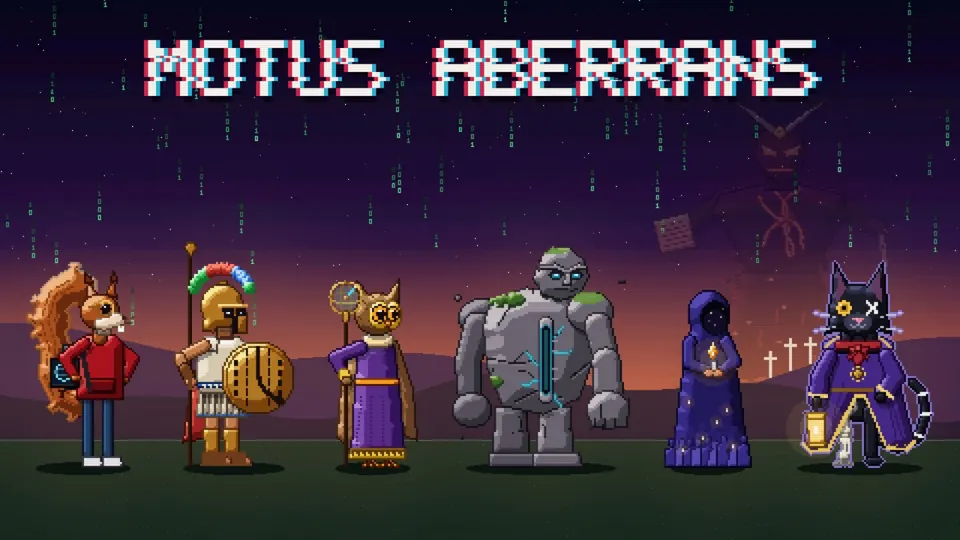 Motus aberransA game in Spanish and English that teaches superposition, entanglement and noise through circuits.
Most impact: FloodSight Q
FloodSight Q took 3rd place at the I-HUB Quantum Technology Foundation node.
FloodSight Q decides which flooded areas radar satellites should image first. Radar sees through monsoon cloud, but satellite passes are few. Durga Pritam Suggisetti and Rama Soujanya Chatti entered FloodSight Q as team QBITS.
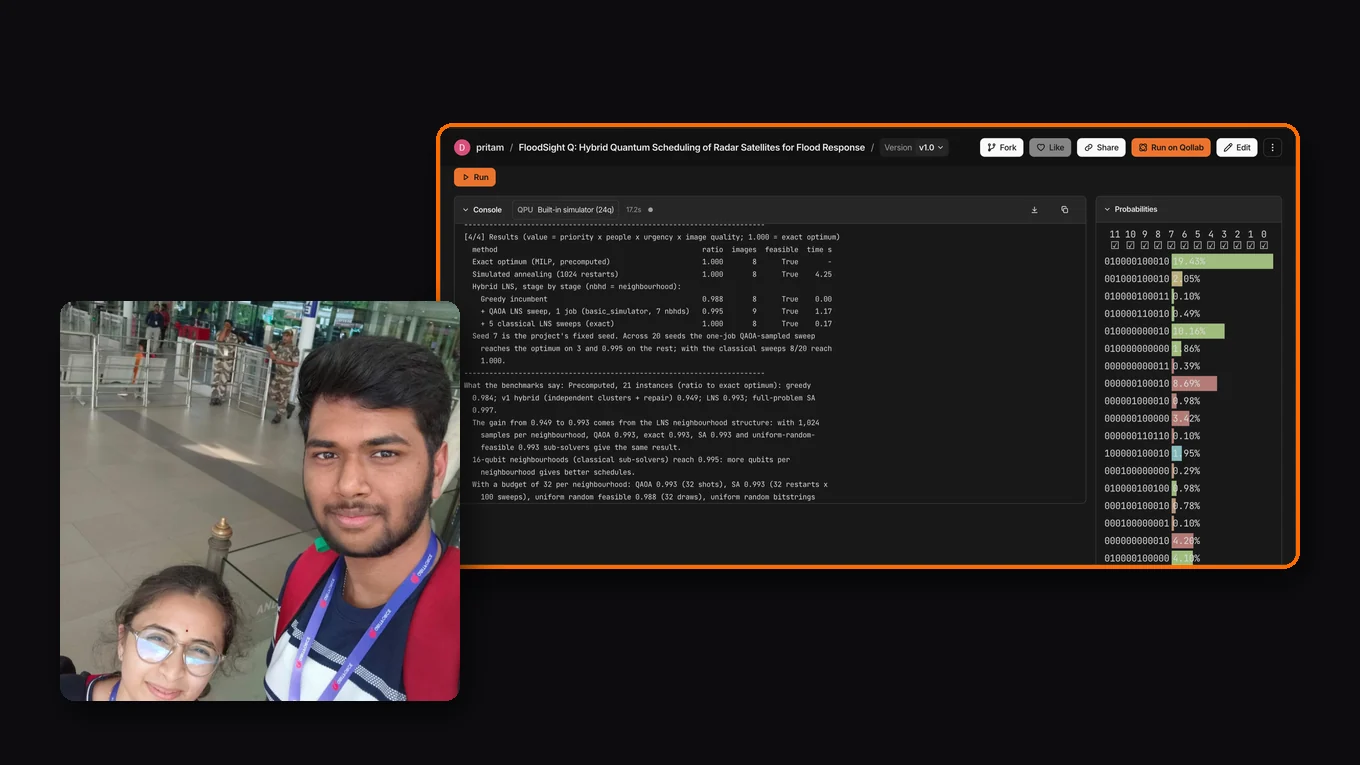
FloodSight Q's scheduler pairs warm-start QAOA with classical search and is tested against greedy, annealing and exact solvers. Its inputs are real satellite orbits and data from Assam's 2022 floods. It runs on Qollab's built-in simulator and IonQ's Aria 1 noise-model simulator.
The first version scored worse than the simple greedy method, even though QAOA solved every piece perfectly. The loss came from how Durga and Rama split the problem. With the pieces rebuilt around the current schedule, the hybrid reached 99.3% of the optimum, up from 94.9%, and beat greedy. Next, they want to connect FloodSight Q to live flood alerts, so it can suggest a schedule as a disaster unfolds.
The first time we pressed Run on Qollab and saw the whole pipeline print a results table and draw a map of Assam in under 30 seconds, it finally felt like a real tool rather than a set of scripts.
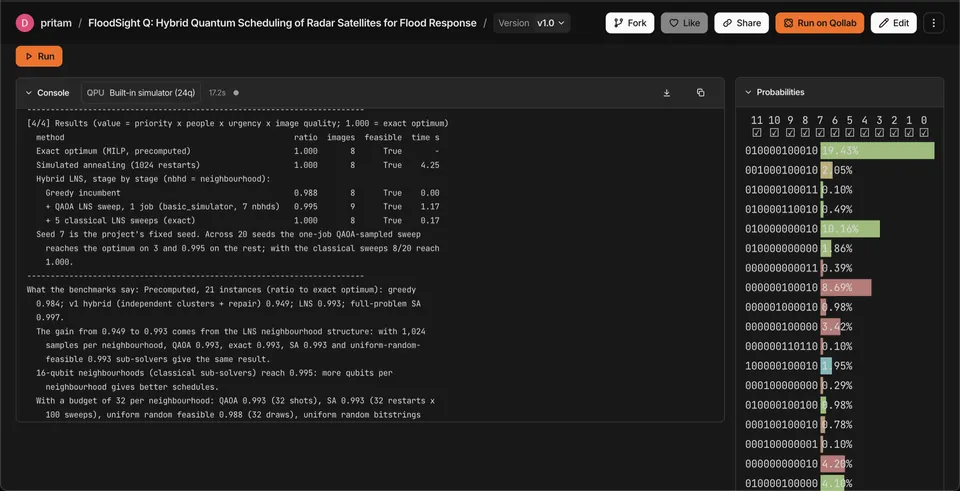 FloodSight Q: Hybrid Quantum Scheduling of Radar Satellites for Flood ResponseA hybrid quantum-classical scheduler, compared with greedy, annealing and exact solvers on real orbit data.
Best documentation: Quantum MagNav
Quantum MagNav won the UCLA node.
Quantum MagNav lets a drone find its position when GPS is jammed, by matching the magnetic field its sensor measures against a crustal anomaly map. Eason Ha, a first-year physics student at UCLA, was the physics lead on QCLA, a team of two physics majors and two computer science majors. The four were new friends at UCLA, and their idea came from quantum sensing startups such as SandboxAQ and SBQuantum.
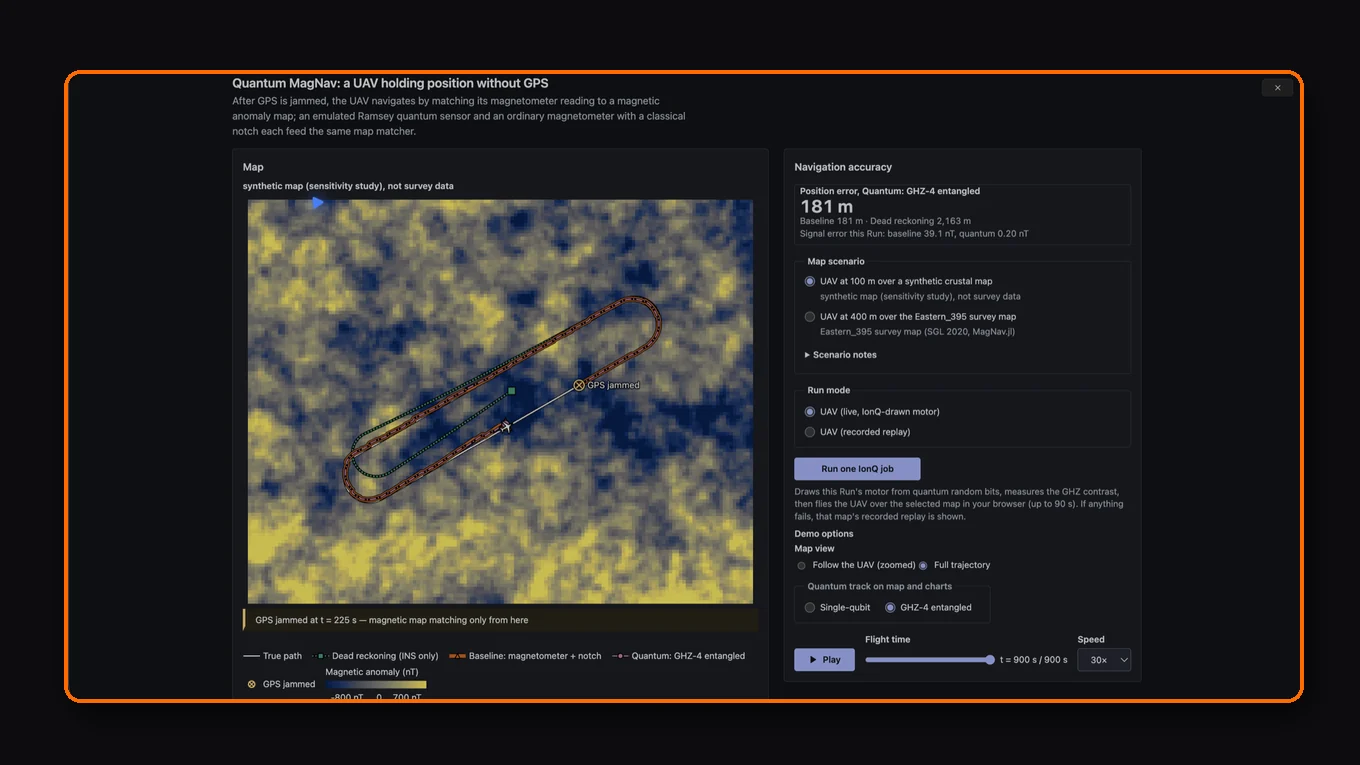
QCLA's first design used a quantum circuit as a machine-learning denoiser for the sensor's signal, but nothing physical motivated it. At best it could tie a classical model. So the team emulated the quantum sensor itself and ran its measurement protocol as a circuit. The emulated sensor is based on Ramsey interferometry and runs on IonQ's Forte 1 remote simulator.
Before, I was passionate about physics and mathematics, but I was unsure of exactly which field I wanted to specialise in. Now, I think the hackathon has sparked a passion for quantum sensors, especially in how quantum computing can aid the rapid innovation of complex quantum hardware.
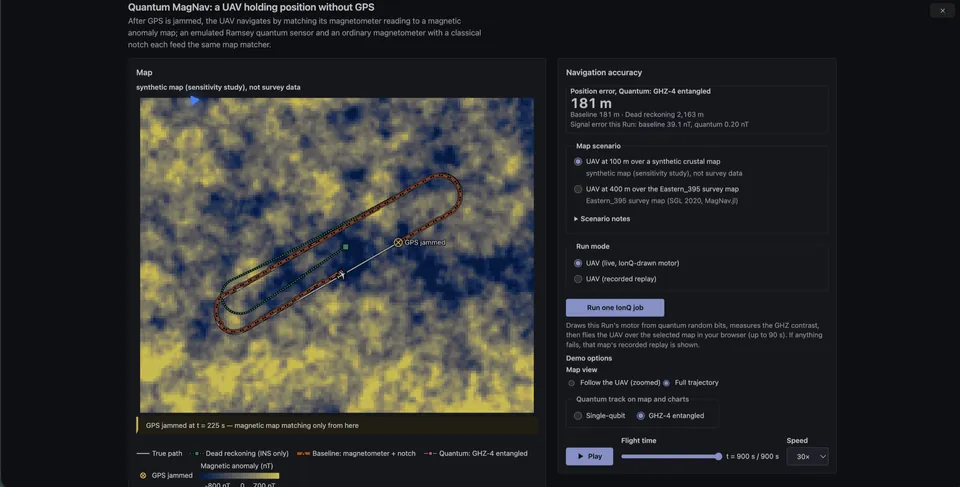 Quantum MagNav: UAV Navigation using an Emulated Quantum Magnetometer in a GPS-jammed RegionAn emulated quantum magnetometer that cancels a drone motor's noise inside each measurement.
What's next
The global winners were announced on Thu Oct 29.
Browse the projects by theme: Quantum Impact, Quantum Playground and Quantum Unlocked. See the local winners at all 22 nodes.
Stay in the loop.
Get the latest tutorials, demos, and project showcases straight to your inbox. No noise, just the good stuff.
Enable JavaScript to sign up.
Qollab updates only. Unsubscribe any time. Privacy Policy.