I-HUB Quantum Technology Foundation winners: Qollab x IonQ Hackathon 2026
Three winning projects from 53 entered at the I-HUB Quantum Technology Foundation node.
At the I-HUB Quantum Technology Foundation (I-HUB QTF) node of the Qollab x IonQ Hackathon 2026, 87 teams signed up, 52 of them solo. Of the 87, 57 were on the student track and 30 on the professional track. The online build weekend ran from 7 PM ET on October 9 to 7 PM ET on October 11. In that time, 32 of the 87 teams entered 53 projects.
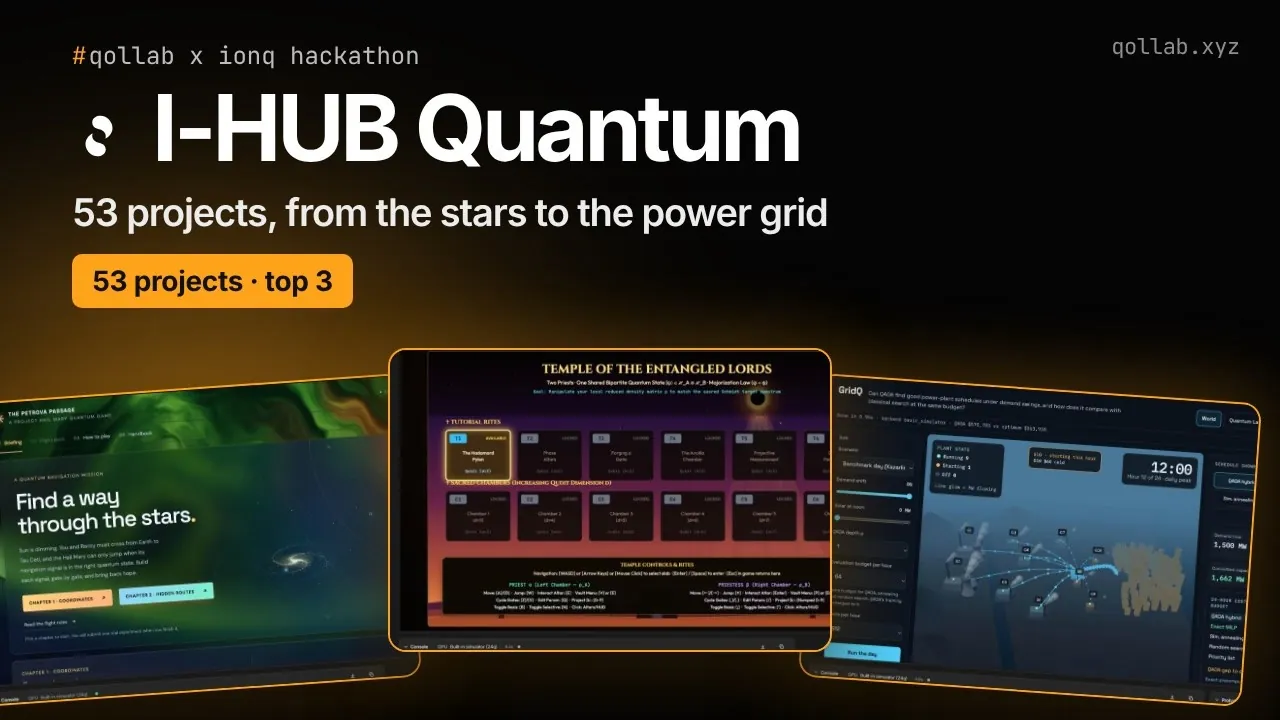
The projects range from ambulance dispatch and deforestation detection to a deckbuilder roguelike, a temple escape room and music composed from Bell-state measurements. Every one of them is open source on Qollab.
The I-HUB Quantum Technology Foundation node
I-HUB QTF is hosted by IISER Pune and funded by India's Department of Science and Technology. The foundation joined as a node in September. Charul Sarode led the node with chief executive officer Dr. Kunj Tandon.
I-HUB QTF's Chanakya Fellowships support quantum research by students from undergraduates to postdocs, at institutes across India. The foundation also runs an online Introductory Course on Quantum Computing that is open all year.
Ten judges scored the projects on novelty, technical execution, impact and documentation. They were Archana Chaudhari, Yogesh Kulkarni, Shreenivas Chetlapalli, Amit Agarwal, Sarita Sapkal, Swarupa Deshpande, Anagha Karne, Sreekuttan L S, Charul Sarode and Dr. Kunj Tandon.
1st place: SABRE-Q
SABRE-Q predicts how well SABRE, a technique that makes MRI signals brighter, will work for a drug. SABRE could let hospitals make MRI tracers cheaply on site, at room temperature. Rajat Shetty, a B.Tech student in mathematics and computing at Manipal Institute of Technology, entered SABRE-Q on his own, as team Fault Tolerant.
Rajat simulates the full 14-spin iridium and drug complex with a Trotterised Qiskit circuit. The simple 3-, 4- and 8-spin models used to design SABRE predict 9.2%, 5.9% and 5.6% polarisation for the drug's nitrogen. The full molecule gives 3.5%. On Qollab's built-in simulator, the console shows the quantum estimate next to the exact answer.
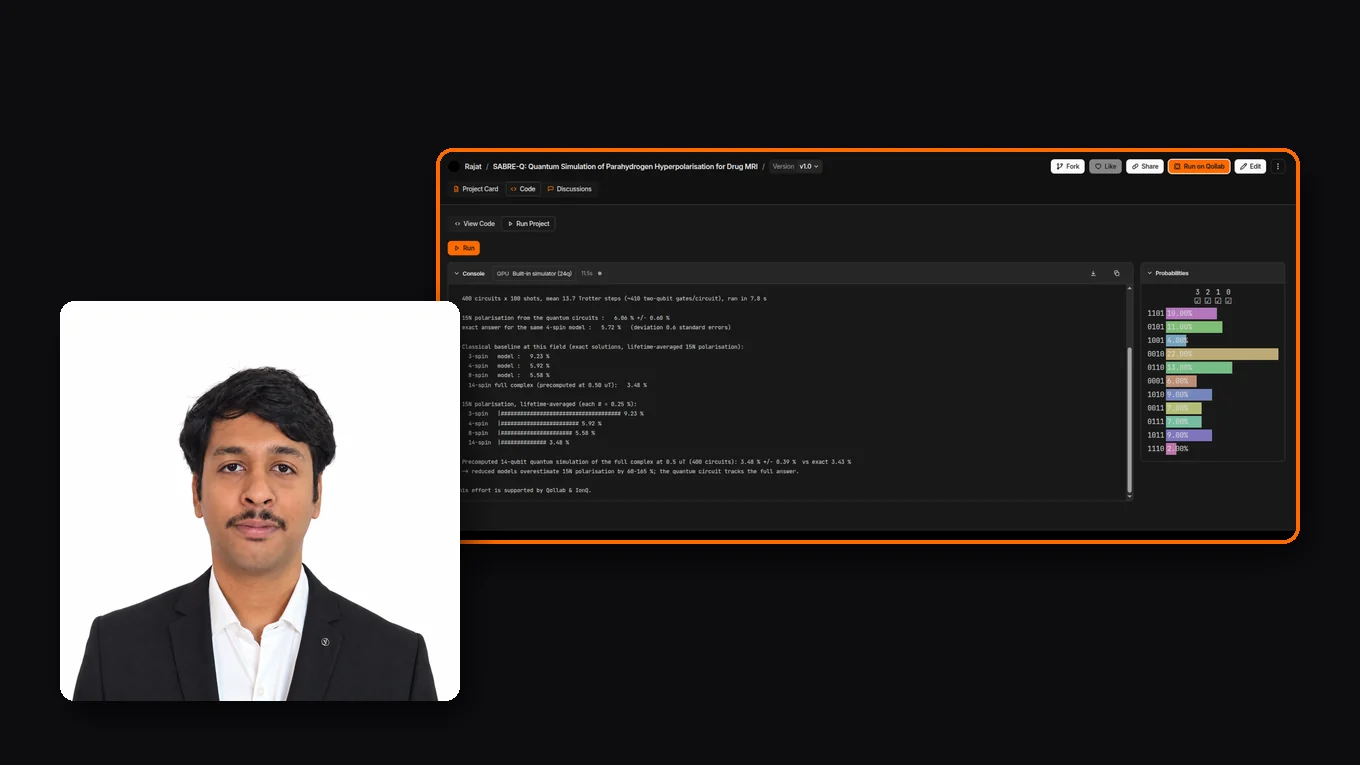
Rajat is proudest of how he samples the drug's unpolarised starting state. He uses random X and Y qubit states instead of random 0s and 1s. On average the answer is the same, but each circuit starts with zero polarisation, which cuts the noise a lot.
Rajat first spent over a day on a different problem, then found that a cheap classical method reached the same answer, and dropped it. At 14 spins a laptop can still solve SABRE-Q's problem exactly, so he claims no quantum advantage. Next he plans to test SABRE-Q against published SABRE experiments and scale it to 20 to 30 spins, where exact classical simulation stops working. Rajat also entered The Guard.
Before this weekend, I thought quantum computing was mainly a tool for physicists, a way to simulate exotic quantum systems to understand the underlying physics, with any real world uses decades away. Now I see that the same kind of simulation can answer practical questions in the near future.
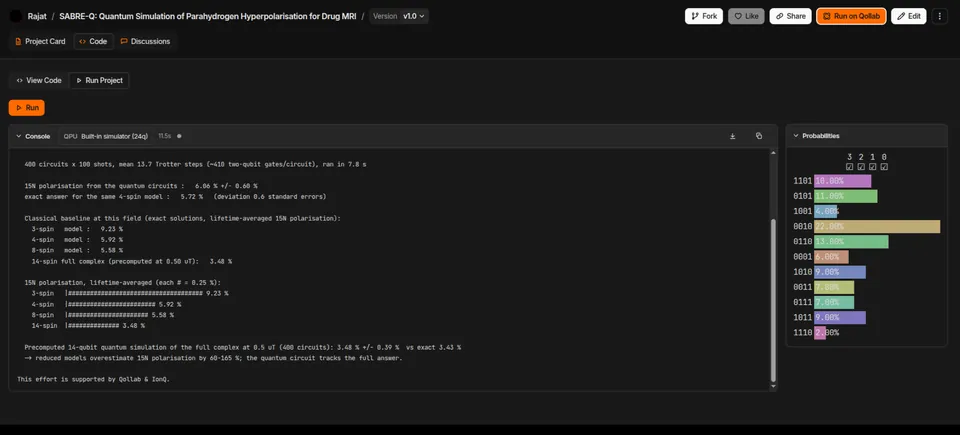 SABRE-Q: Quantum Simulation of Parahydrogen Hyperpolarisation for Drug MRIShows how far the simple spin models used to design SABRE mispredict a drug's polarisation.
2nd place: Signal to Syndrome
In Signal to Syndrome, an error-correction lab that compares trapped-ion and superconducting qubit readout, you play the decoder. Sahil Prabhudesai and Soumyajit Pal entered it as team quantics. Sahil is a quantum scientist at Applied Quantum (AQ Forge). Soumyajit interns at Qbit Force Quantum and is an incoming PhD student at the Mathematical Institute of the Slovak Academy of Sciences.
Level 1 shows which detectors lit up on a small repetition code, and you pair them to guess where the error was. The matching decoder then shows its own answer. A later level turns qubit readout time into a slider, and the logical error responds as you drag it. The data come from circuits run on IonQ's simulator with the Forte 1 noise model.
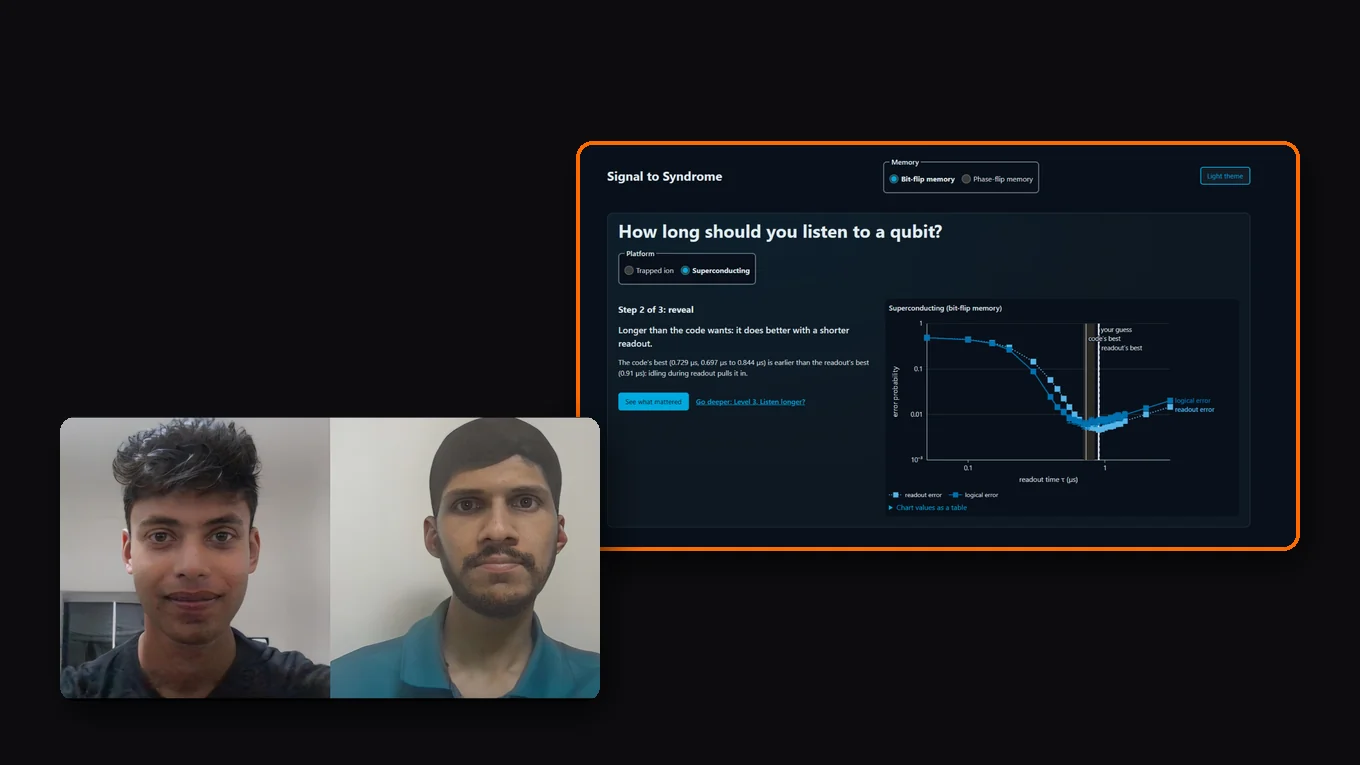
Sahil and Soumyajit pre-registered their conclusions. The data did not bear out one of their own headline hypotheses, that the superconducting optimum shifts earlier. They published that result.
Sahil built the decoder and the interface, and Soumyajit the noise models and statistics. Adding soft decoding, which weighs how confident each readout was, first made the team's ion results worse. They assumed a bug. The simulator was in fact producing an error their decoding graph lacked. A fault between a data qubit's two gates lights a diagonal pair of detectors. Once they added those edges and learned one error rate per edge class, soft decoding never did worse than hard.
We met in 2023 at the Harish-Chandra Research Institute (HRI), Prayagraj, during the final year of our BS-MS programmes: Soumyajit from IISER Berhampur and Sahil from IISER Pune. We had both been selected for master’s theses in HRI’s Quantum Computation and Information Group. Soumyajit worked on open quantum systems under Prof. Ujjwal Sen, and Sahil worked on time crystals under Dr. Debraj Rakshit. We also lived in neighbouring rooms in the same hostel. Our days were spent helping each other through thesis problems, and our evenings went to movie nights and food outings around Prayagraj. We have stayed in close touch since then. This hackathon was our first chance to build something together.
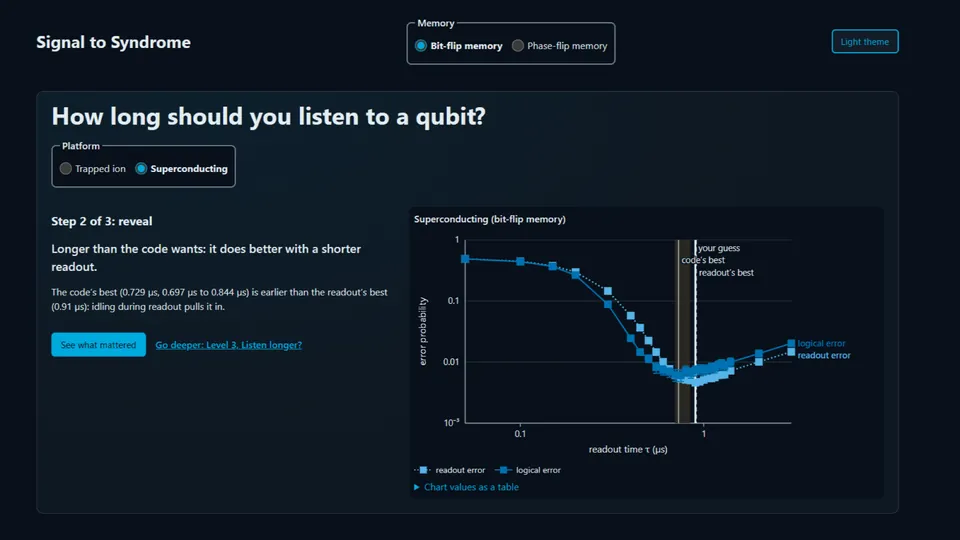 Signal to SyndromeShows that the cleanest qubit readout is not always the one that best protects the data.
3rd place: FloodSight Q
FloodSight Q decides which flooded areas radar satellites should image first. Radar sees through monsoon cloud, but satellite passes are few. Durga Pritam Suggisetti and Rama Soujanya Chatti entered FloodSight Q as team QBITS.
Durga is the founding engineer of Qbit Force Quantum, a quantum infrastructure startup, and studies computer science at BITS Pilani, Dubai Campus. Rama is a quantum control software engineer at the same startup. With Soumyajit Pal on team quantics, Qbit Force has people on two of the node's three winning teams. Durga and Rama met there in June, and their first task was to fix the temperature monitor on the startup's 10 mK dilution refrigerator. "We learned one thing that day: Factory reset always works. Oh, and also became best friends."
FloodSight Q's scheduler pairs warm-start QAOA with classical search and is tested against greedy, annealing and exact solvers. Its inputs are real satellite orbits and data from Assam's 2022 floods. It runs on Qollab's built-in simulator and IonQ's Aria 1 noise-model simulator.
The first version scored worse than the simple greedy method, even though QAOA solved every piece perfectly. The loss came from how Durga and Rama split the problem. With the pieces rebuilt around the current schedule, the hybrid reached 99.3% of the optimum, up from 94.9%, and beat greedy. Next, they want to connect FloodSight Q to live flood alerts, so it can suggest a schedule as a disaster unfolds. Durga also entered Quantum Twin.
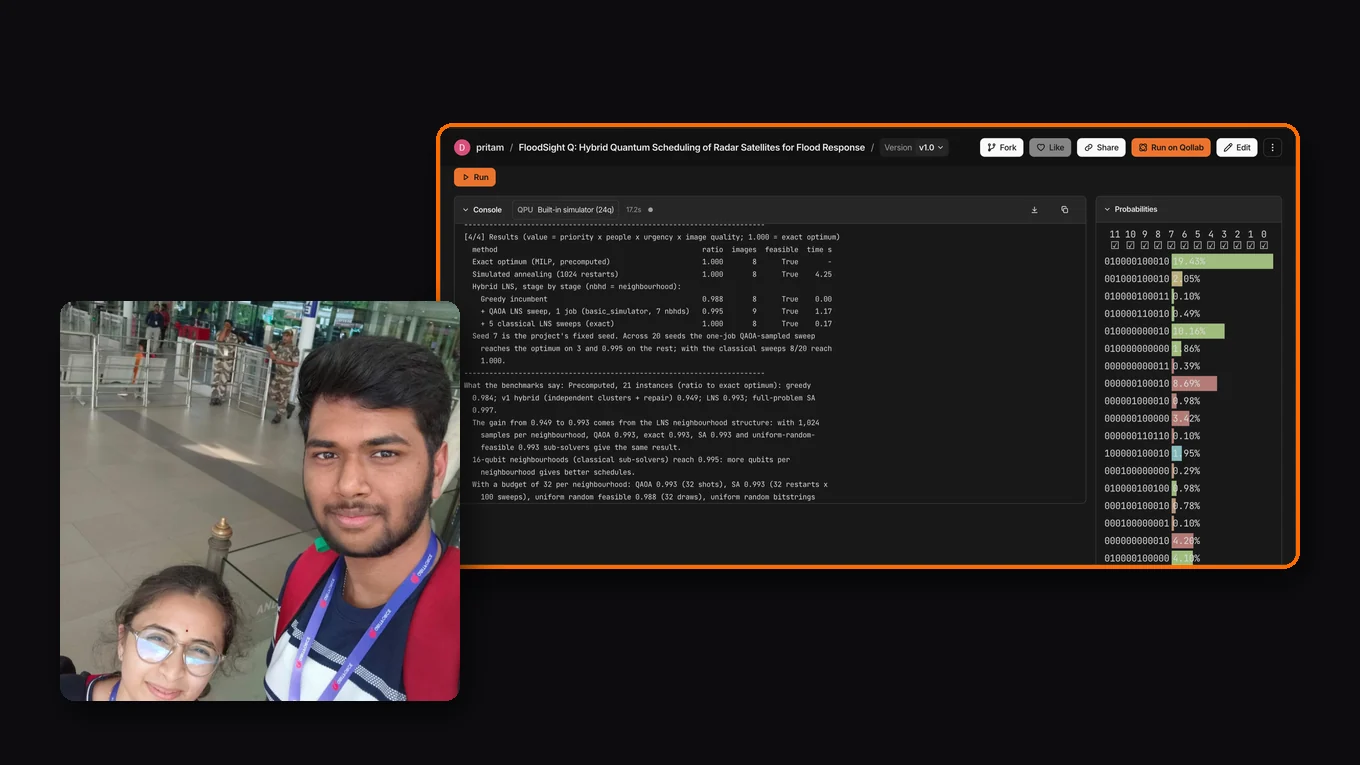
The first time we pressed Run on Qollab and saw the whole pipeline print a results table and draw a map of Assam in under 30 seconds, it finally felt like a real tool rather than a set of scripts.
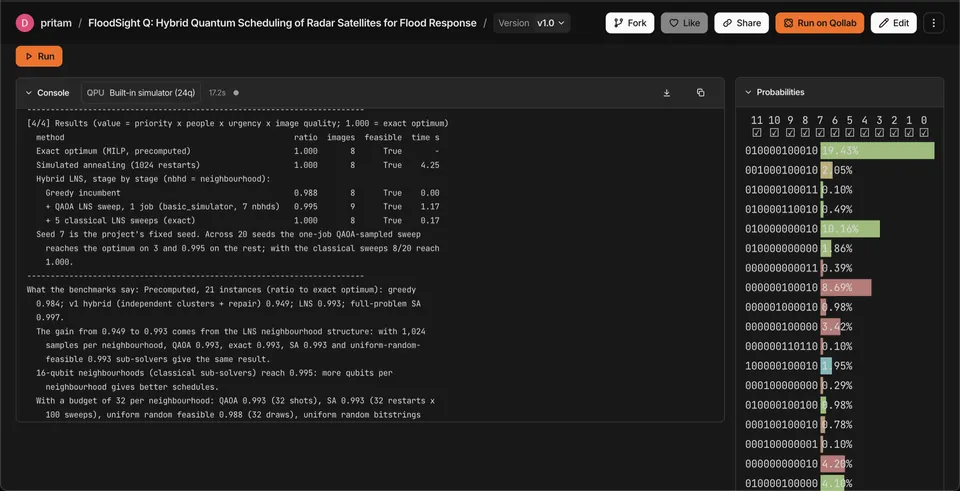 FloodSight Q: Hybrid Quantum Scheduling of Radar Satellites for Flood ResponseA hybrid quantum-classical scheduler, compared with greedy, annealing and exact solvers on real orbit data.
Every other project from I-HUB Quantum Technology Foundation
Quantum error correction came up in several of the other projects, among them Below threshold, QEC Workbench and Q-Regen. Twin Signal, No Signal and Quantum-Magic-Square are games built on entanglement.
Some teams entered more than once: Q-Supreme and Vimarsha entered five projects each, and Feynman Prodigies and Quanta World three each.
The other 50 projects entered at the node, A to Z, by title.
- [C]Not Today
- Bell Test and Randomness Lab
- Bell-Test Lab: one CHSH experiment, a ladder of certificates
- Below threshold
- BioQuantum Transport Lab: Quantum Energy Transfer Copy
- Codon Optimization
- Entangled Compass: is a GHZ sensor really √N better?
- Entangled Orchestra
- Ghost Trains
- GridQ: Quantum-Hybrid Power Grid Scheduling
- Interference Lab
- Landfall
- No Signal
- Occupancy-Driven Adaptive SQD (OD-SQD) for Li₂FeSiO₄
- One-Circuit-10-Machines
- Preconditioned Hybrid VQLS for Scalable Quantum Acceleration of CFD Linear Algebra
- Project DART: Gridlock Encodings
- Q-EMS
- Q-Regen: Quantum Computer That Heals Itself
- QContactFold
- QEC Lab: Watch Quantum Error Correction Work
- QEC Workbench
- QFIM-Guided Variational Quantum Classification for Circuit Diagnostics
- QForest: Quantum-Enhanced Deforestation Detection
- Quantum batlefield: Plant vs Zombie quantum version
- Quantum Battery Lab: Exploring Collective Charging
- Quantum Calculator
- Quantum Circuit for Ground Water level measurement
- Quantum circuit which detect the primordial black hole having an input of gamma rays and x rays
- Quantum Circuit which predicts flood like situation at a very early stage
- Quantum Gates maze - Entanglers
- Quantum Loom
- Quantum Phase Detective
- Quantum Phase Transitions
- Quantum Spire
- Quantum Starry Night
- Quantum Twin
- Quantum-Globe-Navigator
- Quantum-Hybrid Infection Spread Simulator
- Quantum-Magic-Square
- QubitGuard
- RydbergMIS Lab: Quantum Graph Optimization
- Schrödinger’s Heist
- SQD Lens: Symmetry-Aware Recovery from Few Quantum Samples
- The Guard: Build, Break and Decode a Quantum Code
- The Petrova Passage
- Twin Signal: Quantum Espionage Game
- UnLOCC
- Vibronic Spectra on Few Qubits: Franck-Condon, Explained
- Where Does Amplitude Estimation’s Quantum Advantage Break? A Noise Study on Tail-Risk Probabilities
I-HUB Quantum Technology Foundation on Qollab
Specialty awards follow on Wed Oct 28 and global winners on Thu Oct 29, and the Hackathon 2026 results page links to every node's post.
Open any project on I-HUB Quantum Technology Foundation's node page on Qollab to read its code, run it and fork it. You can also follow the node there. The page shows the node's numbers, its members and node team, and all 53 hackathon projects.

Stay in the loop.
Get the latest tutorials, demos, and project showcases straight to your inbox. No noise, just the good stuff.
Enable JavaScript to sign up.
Qollab updates only. Unsubscribe any time. Privacy Policy.