Institut quantique, Université de Sherbrooke winners: Qollab x IonQ Hackathon 2026
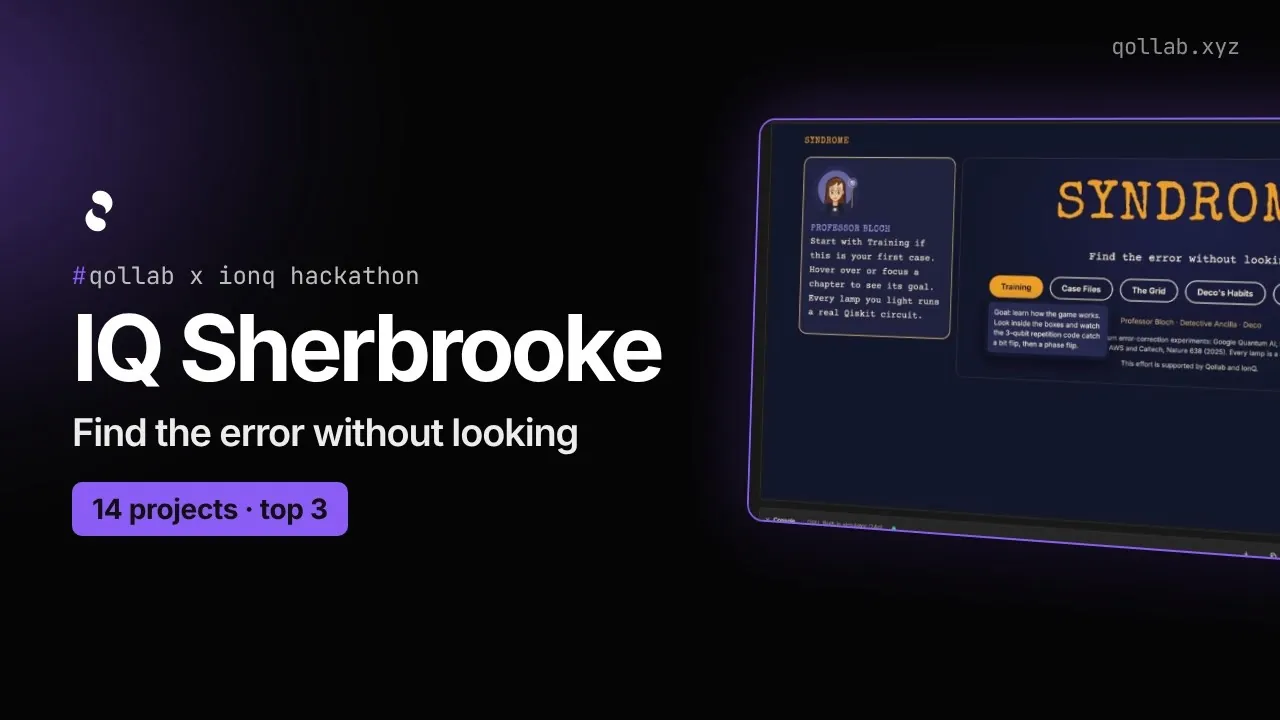
Three winning projects from 14 entered at the Institut quantique, Université de Sherbrooke node.
At the Institut quantique, Université de Sherbrooke node of the Qollab x IonQ Hackathon 2026, 19 teams signed up, 9 of them solo. Most were on the student track. The online build weekend ran from 7 PM ET on October 9 to 7 PM ET on October 11. In that time, 10 of the 19 teams entered 14 projects.
The projects range from a quantum version of Chrome's Dino Runner and a music synthesizer to road-maintenance scheduling and a tool that picks error-mitigation settings. Every one of them is open source on Qollab.
The Institut quantique, Université de Sherbrooke node
The Institut quantique is the Université de Sherbrooke's research centre for quantum science and technology. The institute signed on in September as the only node in Quebec. Tania Belabbas led the node with Tom Mallah. Tania is partnerships manager and a quantum software developer at AlgoLab, the institute's quantum computing platform. Tom is the institute's community development coordinator.
On campus, students run QuantUS, the university's quantum computing club, which holds programming workshops. The university also offers a bachelor's degree in quantum information science.
The institute organizes SherHack, a quantum hackathon for teams from companies and government bodies, and co-organizes iQuCodeFest for students. Tania taught the introduction to quantum programming at the third SherHack in March.
Three judges from the Université de Sherbrooke scored the projects on novelty, technical execution, impact and documentation. They were Jean-Frédéric Laprade, Maxime Dion and Olivier Nahman-Lévesque.
1st place: Syndrome
In Syndrome, players find flipped qubits without peeking at them, using only the syndrome lamps. Every lamp is a Qiskit circuit. Professor Bloch, the game's mentor, stands for the Bloch sphere, Detective Ancilla for the ancilla qubits that read the syndrome, and Deco for decoherence.
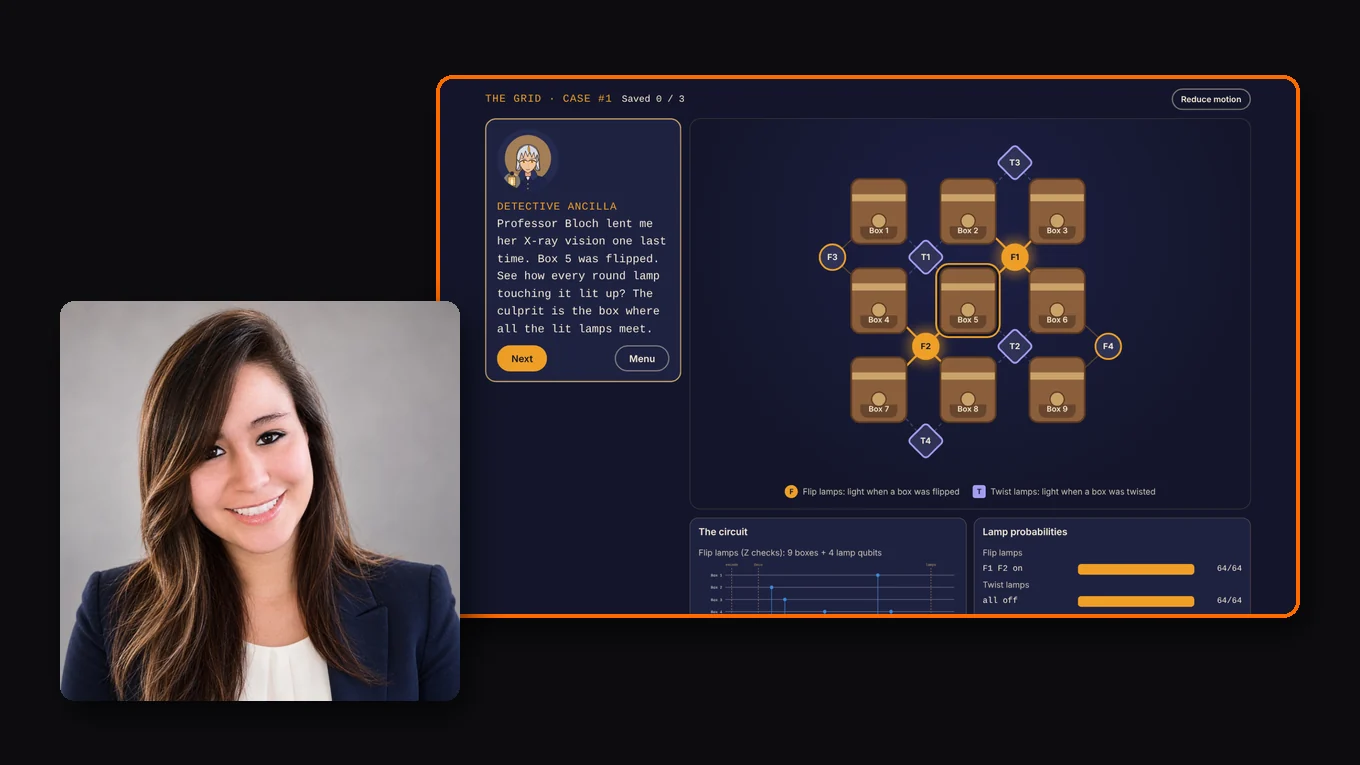
Maria Alejandra Boada Rodriguez built the game on her own and based Professor Bloch on her avatar. She is a Colombian software engineer completing a master's in data analytics at the University of Niagara Falls Canada. Quantum error correction confused her until Google's 2021 Nature paper on repetition codes helped her grasp it. She then combined her two degrees, in engineering and psychology, to teach the idea to herself as a game.
On Saturday night, the final case, which sends a circuit to IonQ's cloud, kept failing with a vague "Failed to fetch" error. A tiny test project Maria had built at the start showed her that the connection to IonQ stays open only while the program runs. She kept the game's run open until the final case got its answer, and the results came back from IonQ's Forte Enterprise 1 noise model.
Next, Maria wants to turn Syndrome into a free classroom tool with a teacher mode, the Shor and Steane codes, and Spanish and French versions.
Before this weekend, I thought quantum computing was a field only physicists could truly understand. Now I know that if you can turn an idea into a game, anyone can learn it.
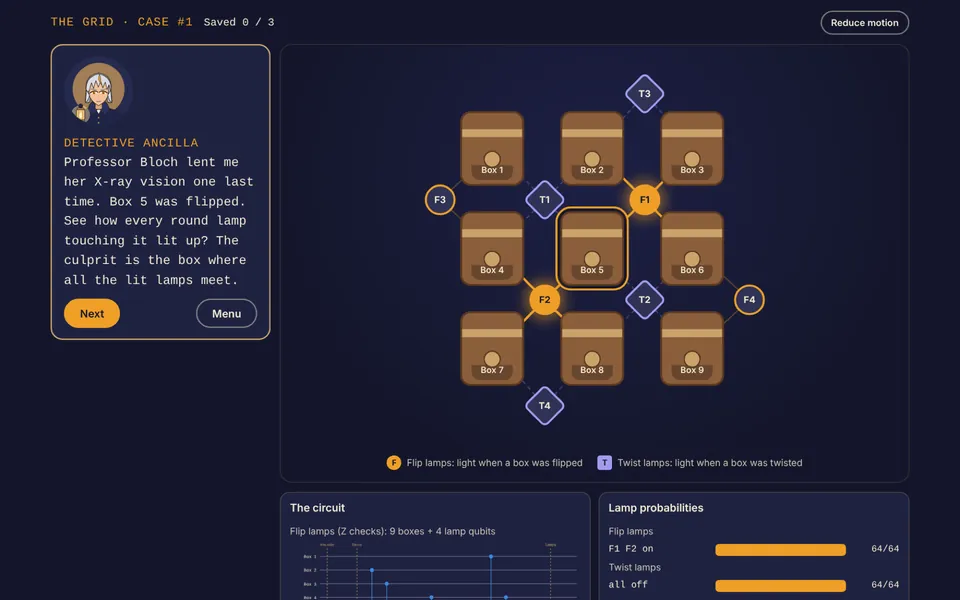 SyndromeA detective game about quantum error correction, from a 3-qubit repetition code to a 17-qubit surface code.
2nd place: Phase Shift
Phase Shift, the team's name for its quantum interference game, uses one rule. Every path carries an arrow, and where paths meet, the arrows add head to tail. In Level 1, Invisible Ink, the phase has no visible effect. Once the player switches on a second Hadamard gate, the result jumps from 50/50 to 100%.
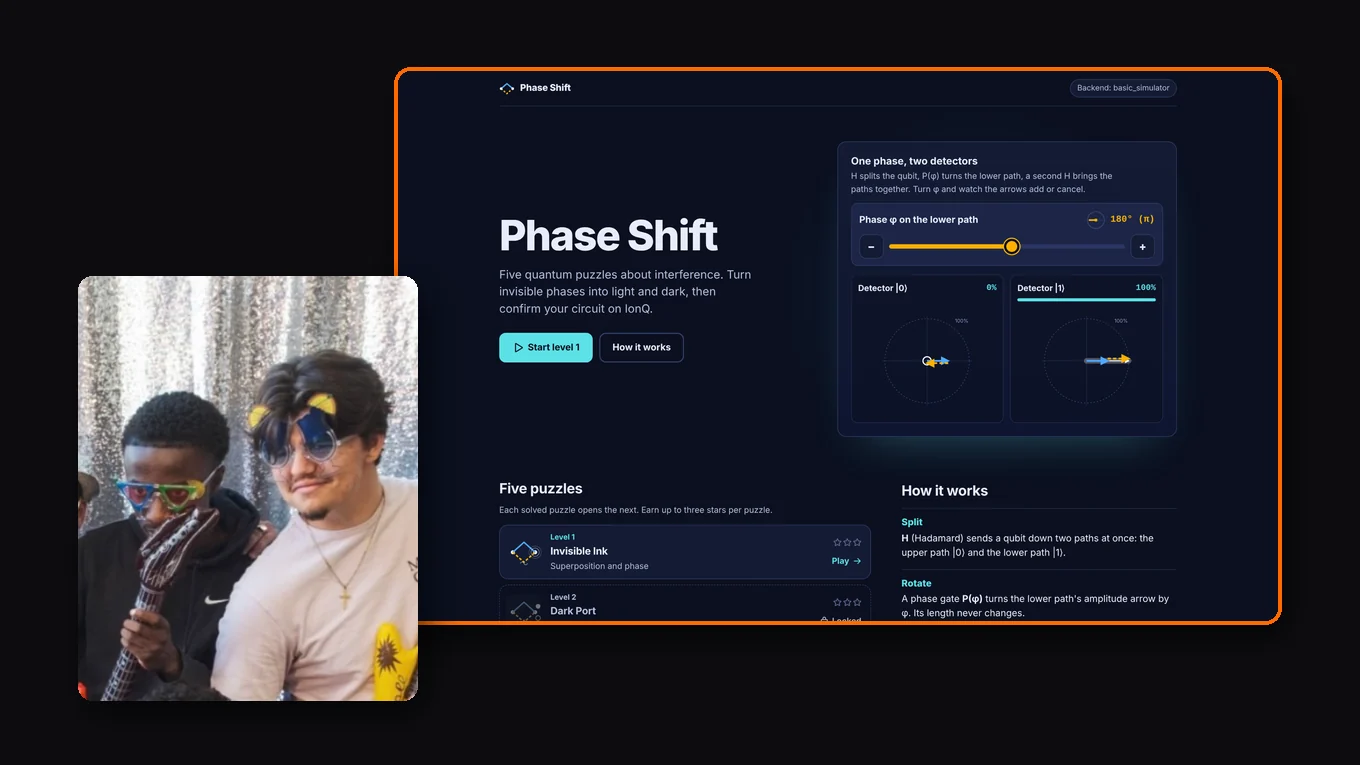
Francisco Tuozzo and Emmanuel Kouassi, team cat in a box, met at cégep and now study computer science at the Université de Sherbrooke. They enter hackathons as a team, and this one was their first step into quantum. Francisco was the quantum lead and Emmanuel the full-stack developer. Their aha moment came in Level 1. "Watching the math we'd been reading about actually happen on screen was incredibly satisfying."
After every run, a "Follow the arrows" panel draws the paths through the player's own circuit. The panel shows the classical prediction, the quantum result and the difference, which is interference.
Qollab allows one IonQ job per Run, so players practise as often as they like on a Qiskit simulator in the browser. A "Confirm on IonQ" button then sends the same circuit to IonQ's simulator as a single job and earns a star. The team compiles with optimization_level=0, so the transpiler cannot simplify away the player's gates.
Early on, we both realised at the same moment that we didn't really understand quantum computing at all. Somehow that was both terrifying and funny. Instead of shrinking the idea, we went all in on research and kept digging until the concepts clicked. The "arrows" picture that runs the whole game came out of that deep dive.
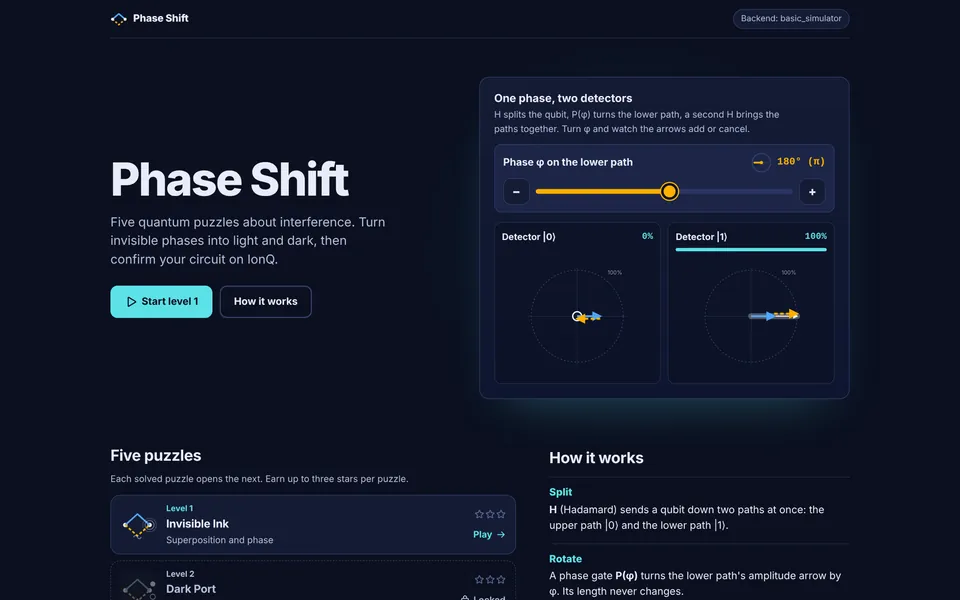 quantum interference gameA puzzle game where you steer invisible quantum phases until a qubit's paths add up or cancel out.
3rd place: Quantum Engine
Quantum Engine is a visual lab where players guess what quantum particles will do and then see what happens. They predict where 100 electrons will land and see four bright spots, and switching on "Watch its path" makes the spots vanish. On IonQ's Aria 1 and Forte 1 noisy simulators, every electron that lands where the ideal wave cannot reach shows up as a red cross.
Maverick Messier, a quantum information science student at the Université de Sherbrooke, built Quantum Engine. "I am sadly the only member of my team. Only Neve was with me (My plushy)." He had already built a "stellar engine" that simulates astrophysics in Unity for an earlier hackathon. The idea came from frustration: you cannot see the quantum world with your own eyes, which makes it hard to picture.
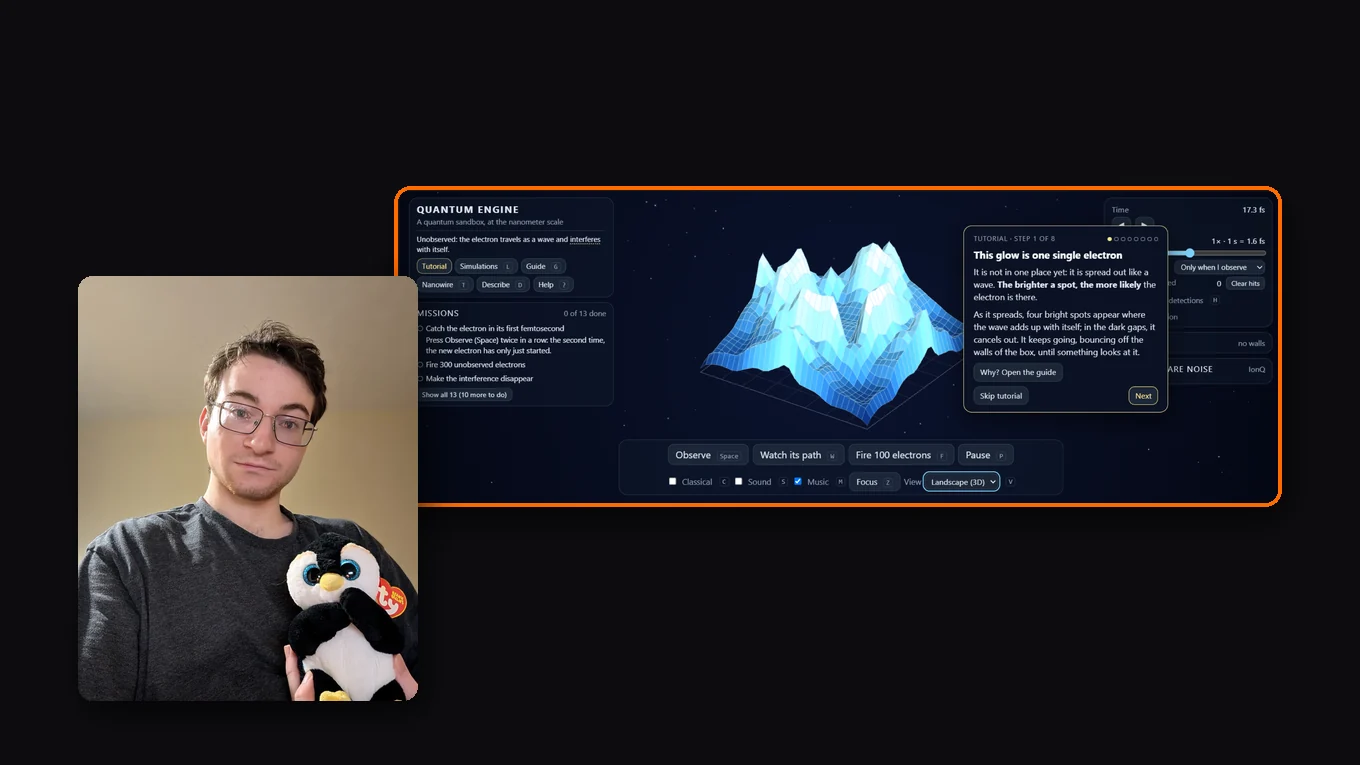
The hardest part to design was quantum minigolf, where players guide a wave so its probability gathers near the hole. While coding it, Maverick laughed at how unrefined it looked.
Next, he would like to make Quantum Engine almost entirely 3D, a world you can move around in and run tests on.
My advice to anyone who has never touched quantum is to start by asking yourself: how does it work, and what does it mean? Be curious, watch videos (YouTube, etc.), and wonder at how fundamentally beautiful it is.
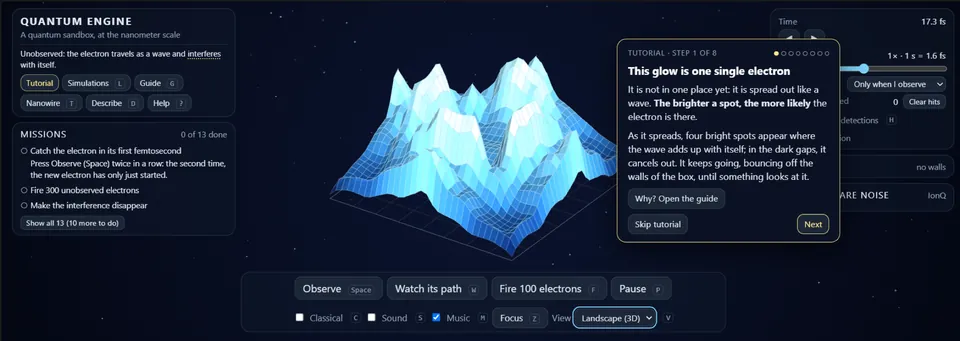 Quantum EngineA beginner-friendly quantum engine with a tutorial, missions and a glossary.
Every other project from Institut quantique
Finance came up in four of the node's other projects: two QAOA portfolio optimizers, an S&P 500 volatility forecaster and a corporate bankruptcy predictor.
Team QuanTech entered four projects: Coherence Runner, Fragile Entanglement, QAOA Portfolio Optimization and Quantum reservoirs for volatility forecasting.
The other 11 projects entered at the node, A to Z.
- Coherence Runner: Quantum version of Chrome's Dino Runner.
- Constrained portfolio risk optimization with QAOA
- Fragile Entanglement: Interactive visualization built with Qiskit to understand entanglement and to understand how noise can make it worse.
- Hybrid quantum-classical model that predicts corporate bankruptcy
- Q-Beats: Quantum Music: A hybrid quantum-classical synthesizer using true Qiskit entropy to procedurally generate 5-lane polyphonic music.
- QAOA Portfolio Optimization: Cardinality-constrained portfolio optimization with QAOA in Qiskit (Qollab x IonQ Hackathon 2026, Quantum Impact).
- Quantum Automitigation: AutoMitigate picks your error-mitigation settings for you.
- Quantum Hangman: A simulation of quantum communication between two devices.
- Quantum reservoirs for volatility forecasting: A hybrid quantum-classical forecaster for S&P 500 volatility, benchmarked fairly against classical models and made to work under device noise on IonQ's Forte 1 simulator.
- Quantum Veil: A fun interactive game for general education about applications of quantum networking.
- Road-Maintenance Scheduling with QAOA: A complete workflow from OpenStreetMap road networks to quantum optimization.
Institut quantique on Qollab
Specialty awards follow on Wed Oct 28 and global winners on Thu Oct 29, and the Hackathon 2026 results page links to every node's post.
Open any project on Institut quantique's node page on Qollab to read its code, run it and fork it. You can also follow the node there. The page shows the node's numbers, its members, and all 14 hackathon projects.

Stay in the loop.
Get the latest tutorials, demos, and project showcases straight to your inbox. No noise, just the good stuff.
Enable JavaScript to sign up.
Qollab updates only. Unsubscribe any time. Privacy Policy.