UCLA winners: Qollab x IonQ Hackathon 2026
The winning project from seven entered at the UCLA node.
At the UCLA node of the Qollab x IonQ Hackathon 2026, 18 teams signed up, 11 of them solo. Of the 18, 12 were on the student track and 6 on the professional track. The online build weekend ran from 7 PM ET on October 9 to 7 PM ET on October 11. In that time, four of the 18 teams entered seven projects.
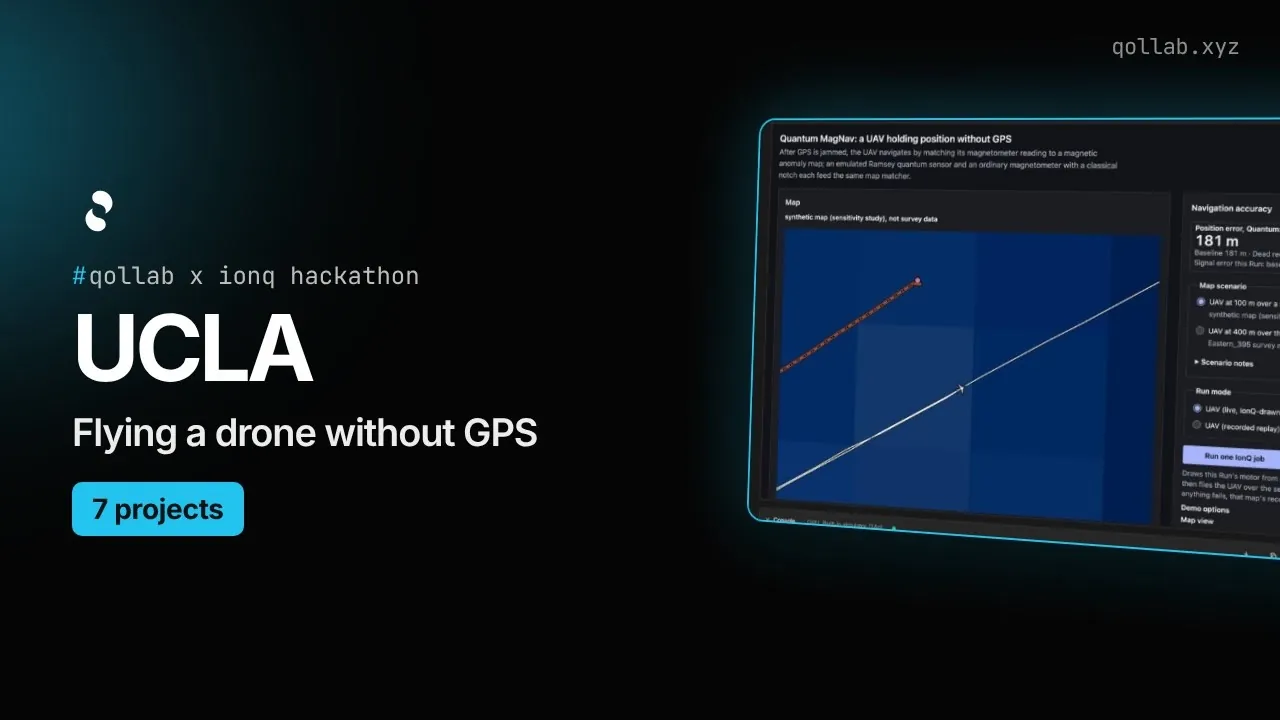
The projects range from drone navigation and astronomy to blood flow in the brain, control engineering and a Werewolf game. Every one of them is open source on Qollab.
The UCLA node
The Quantum Computing Student Association at UCLA (QCSA) hosted the node, and Nachiket Joshi led it. He studies physics and materials engineering and is part of QCSA's research team.
QCSA is a combined undergraduate and graduate student group under UCLA's Center for Quantum Science and Engineering. With Caltech, QCSA runs EntangleTalks LA, a monthly seminar series that opened with a talk by John Preskill in April 2025.
UCLA also offers a one-year Master of Quantum Science and Technology.
The projects were scored on novelty, technical execution, impact and documentation. The node's judging panel was Victor Yu, Alden Santoso and Connor Engel.
Node winner: Quantum MagNav
Quantum MagNav lets a drone find its position when GPS is jammed, by matching the magnetic field its sensor measures against a crustal anomaly map. Eason Ha, a first-year physics student at UCLA, was the physics lead on QCLA, a team of two physics majors and two computer science majors. The four were new friends at UCLA, and their idea came from quantum sensing startups such as SandboxAQ and SBQuantum.
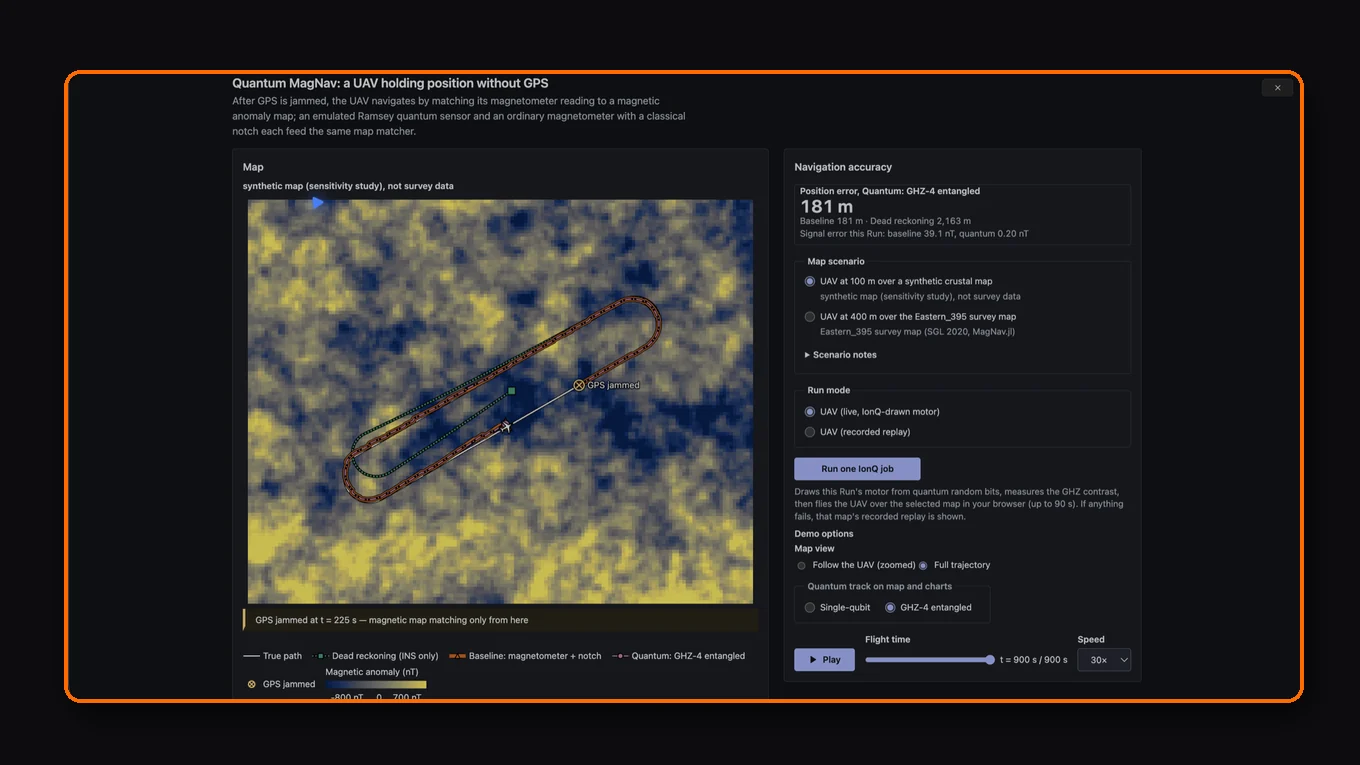
QCLA's first design used a quantum circuit as a machine-learning denoiser for the sensor's signal, but nothing physical motivated it. At best it could tie a classical model. So the team emulated the quantum sensor itself and ran its measurement protocol as a circuit. The emulated sensor is based on Ramsey interferometry and runs on IonQ's Forte 1 remote simulator.
The drone's own motor adds magnetic noise in tones at its RPM harmonics. Each measurement window is set from the motor's RPM, so those tones fall on the sensor's nulls and cancel before any data exists.
On a real survey map, the quantum sensor lost none of its 62 map matches. An ordinary magnetometer with a classical notch filter, run through the same navigation chain, lost 10. The method depends on knowing the motor's RPM. When the team withheld it, position error jumped from about 150 m to 7.7 km.
Next, the team would simulate sensors placed at several points on the airframe and entangled across it, to measure the Earth's magnetic field more accurately.
Team QCLA also entered Quantum Anomaly Scoring for Telescope Catalogues, Quantum Neutron Transport and Transpile Lens.
Before, I was passionate about physics and mathematics, but I was unsure of exactly which field I wanted to specialise in. Now, I think the hackathon has sparked a passion for quantum sensors, especially in how quantum computing can aid the rapid innovation of complex quantum hardware.
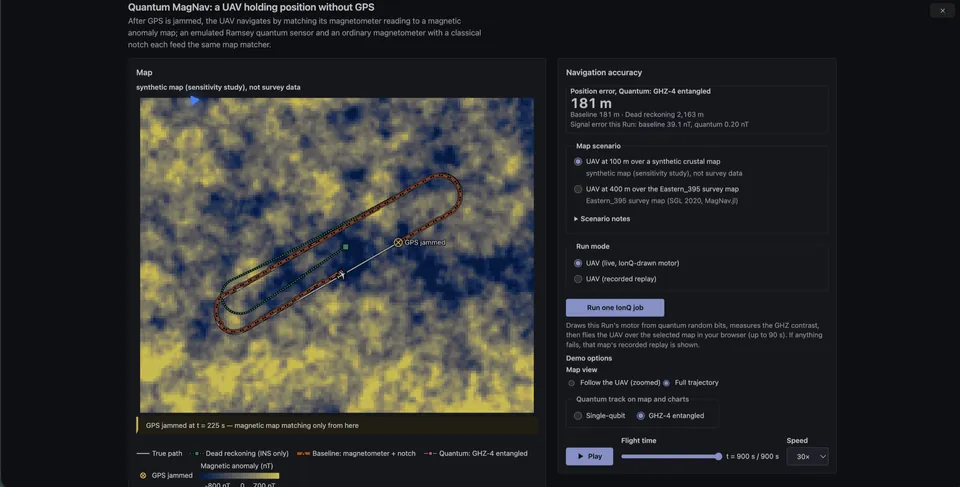 Quantum MagNav: UAV Navigation using an Emulated Quantum Magnetometer in a GPS-jammed RegionAn emulated quantum magnetometer that cancels a drone motor's noise inside each measurement.
Every other project from UCLA
Most of the node's other projects apply quantum methods to science and engineering, from telescope catalogues to a brain-monitoring model that uses Qiskit QAOA.
The other 6 projects entered at the node, A to Z.
- Moonlight Detective: Werewolf Inference Lab, English: A six-player Werewolf sandbox with isolated player viewpoints, classical role probabilities, and interactive Qiskit phase and interference experiments.
- NeuroChronos - Q: NeuroChronos-Q aims to enable earlier brain monitoring.
- Quantum Anomaly Scoring for Telescope Catalogues Running 6 Comparisons in One Circuit: Scores a telescope object as ordinary or unusual by comparing it with six prototypes of normal in one 24-qubit circuit on the IonQ simulator, benchmarked against classical anomaly detectors on Sloan Digital Sky Survey data.
- Quantum Neutron Transport: SPARC First Wall
- Quantum PID v2: Using quantum kernels for gp for pid tuning.
- Transpile Lens: See what the Qiskit transpiler did to your circuit, pass by pass, and where the extra depth came from.
UCLA on Qollab
Specialty awards follow on Wed Oct 28 and global winners on Thu Oct 29, and the Hackathon 2026 results page links to every node's post.
Open any project on UCLA's node page on Qollab to read its code, run it and fork it. You can also follow the node there. The page shows the node's numbers, its members, and all 7 hackathon projects.

Stay in the loop.
Get the latest tutorials, demos, and project showcases straight to your inbox. No noise, just the good stuff.
Enable JavaScript to sign up.
Qollab updates only. Unsubscribe any time. Privacy Policy.