Global winners: Qollab x IonQ Hackathon 2026
The global top three, from the top projects at 22 local nodes.
Three projects took the global placement awards of the Qollab x IonQ Hackathon 2026:
- 1st place: Quantrain (Aalto University node)
- 2nd place: SABRE-Q (I-HUB Quantum Technology Foundation node)
- 3rd place: Optogenetic Quantum Brain (Córdoba node)
Together with IonQ, we ran a record-breaking global quantum hackathon: 327 open-source projects in 48 hours, the most ever, all open on Qollab to run and fork. More than 1,000 people from 37 countries and 80+ universities on five continents signed up, contributing over a million lines of code, data and docs.
The hackathon was built for people new to quantum, and they showed up: 57% of builders had less than a year of quantum experience, and only 1 in 10 works in quantum today. At the UNICEN node in Argentina, avionics software engineer Santiago Carlos, with no quantum background, took 1st place. He spent the first hours in Qollab's courses, then built Memory Wall: lessons that show where a laptop can no longer simulate a quantum computer. And they're not stopping: nearly all plan to start, fork or keep building projects on Qollab in the months to come.
More than 60 university professors, emerging researchers and industry professionals combed through every entry at the 22 local nodes, on novelty, technical execution, impact and documentation. A global panel of experts then selected the top three.
The global top three teams receive cash and compute-credit awards. Each team also gets three one-to-one sessions with IonQ engineers in the 12 months after the hackathon.
1st place: Quantrain
Quantrain won the Aalto University node.
Quantrain is a puzzle game on a metro map, in the style of Mini Metro. Tomáš Roch, Wiktor Dowgiałło, Stefan Bia and Benjamin Voelkert built it as team Give me a QIS. In an early brainstorm, they pictured a runner game like Subway Surfers, with the player as a photon. Then came the idea of a quantum metro, and the team built the game around trains.
The train is a single photon, and interference delivers every passenger. Each track is a qubit. A beam splitter mixes two tracks, and a station works as a which-path detector. The train rides a single rail and rotates around it, which makes a qubit's phase something a player can see. Players can also make their own puzzles and share them by link or QR code.
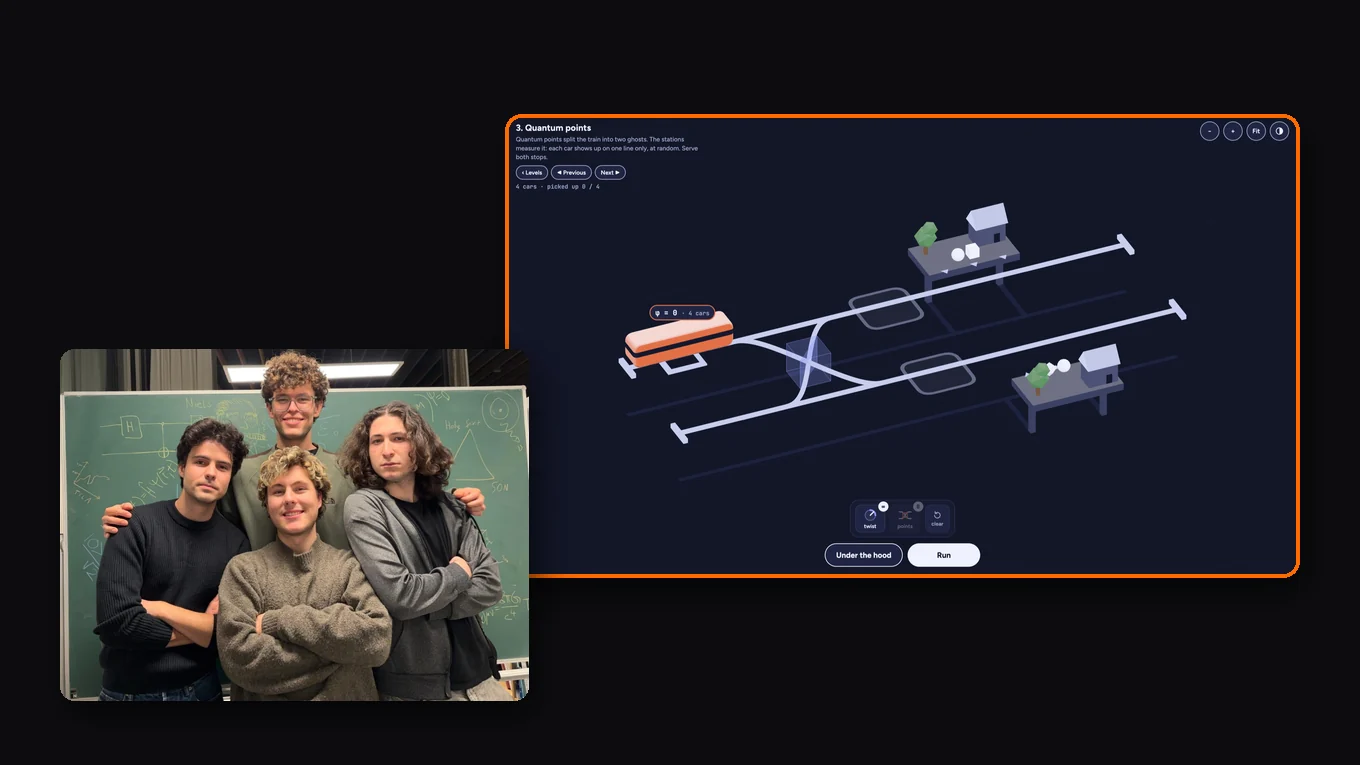
Every map is a Qiskit circuit. A run sends its shots as one job to the backend the player picks in Qollab. The game's Python engine has a JavaScript version for the browser, and the two agree gate for gate on 262 circuits.
All four builders are first-year master's students in quantum information science at the University of Copenhagen, friends since their first days in the programme. Teams picked a node when they signed up or let the Qollab team place them. Tomáš, the team's full stack developer, spent a year at SAP before moving to Copenhagen. Wiktor is a data scientist, Stefan specialises in quantum error correction and compilation, and Benjamin's background is in physics and photonic quantum computing.
Their most intense moment of the weekend was playing Swords and Sandals, a gladiator fighting game, to clear their heads. Next, they want more levels on harder topics, more languages, and releases on the App Store, Steam and Google Play.
We think quantum information is very unintuitive and therefore it is important to make it accessible for more people.
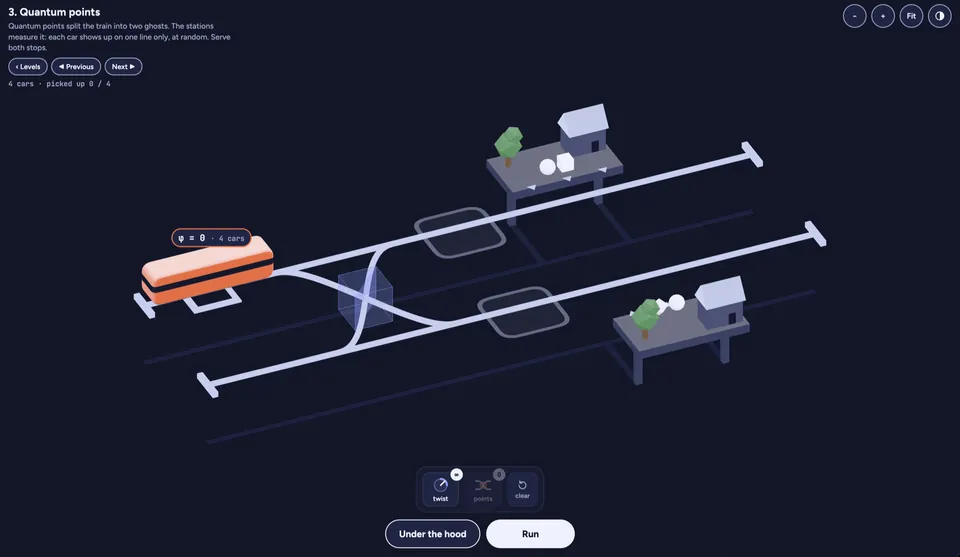 QuantrainA metro puzzle game where the train is a photon and each map is a Qiskit circuit.
2nd place: SABRE-Q
SABRE-Q took 1st place at the I-HUB Quantum Technology Foundation node.
SABRE-Q predicts how well SABRE, a technique that makes MRI signals brighter, will work for a drug. SABRE could let hospitals make MRI tracers cheaply on site, at room temperature. Rajat Shetty, a B.Tech student in mathematics and computing at Manipal Institute of Technology, entered SABRE-Q on his own, as team Fault Tolerant.
Rajat simulates the full 14-spin iridium and drug complex with a Trotterised Qiskit circuit. The simple 3-, 4- and 8-spin models used to design SABRE predict 9.2%, 5.9% and 5.6% polarisation for the drug's nitrogen. The full molecule gives 3.5%. On Qollab's built-in simulator, the console shows the quantum estimate next to the exact answer.
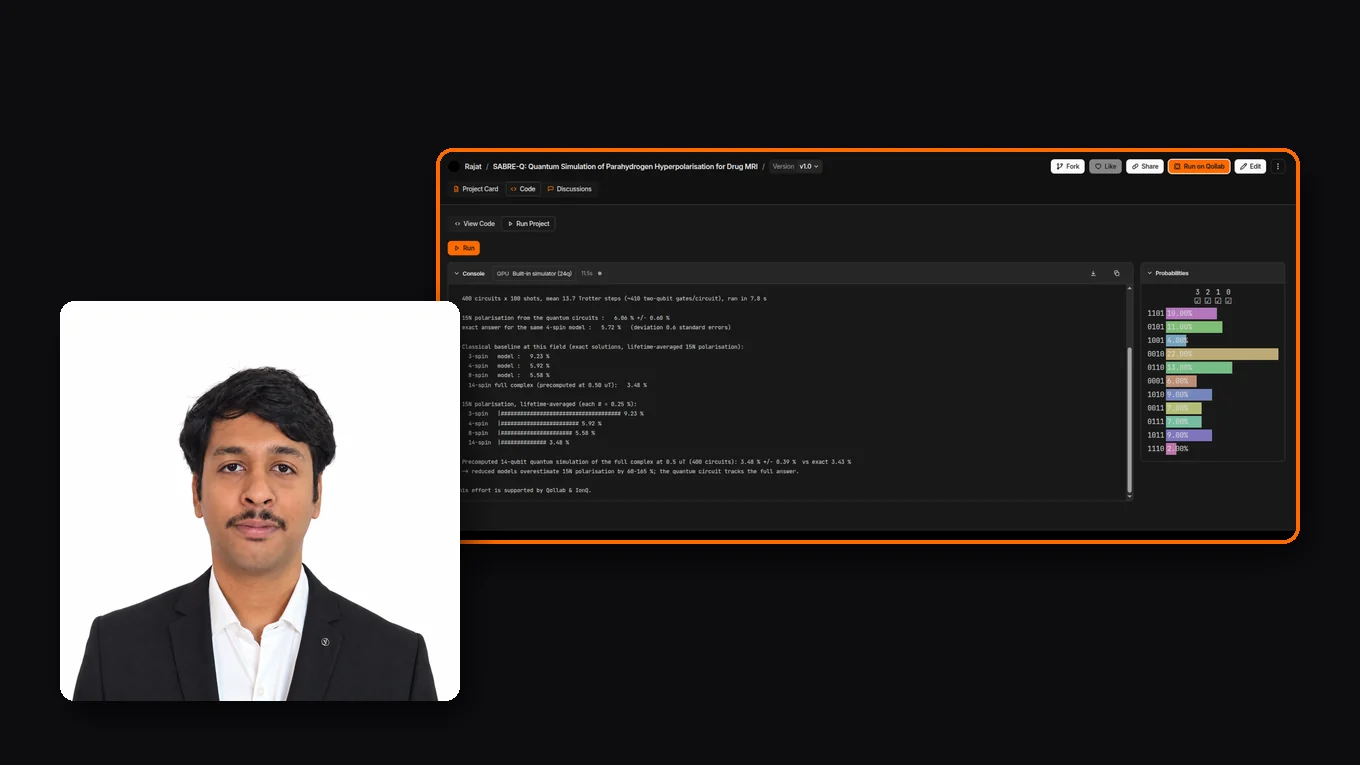
Rajat is proudest of how he samples the drug's unpolarised starting state. He uses random X and Y qubit states instead of random 0s and 1s. On average the answer is the same, but each circuit starts with zero polarisation, which cuts the noise a lot.
Rajat first spent over a day on a different problem, then found that a cheap classical method reached the same answer, and dropped it. At 14 spins a laptop can still solve SABRE-Q's problem exactly, so he claims no quantum advantage. Next he plans to test SABRE-Q against published SABRE experiments and scale it to 20 to 30 spins, where exact classical simulation stops working.
Before this weekend, I thought quantum computing was mainly a tool for physicists, a way to simulate exotic quantum systems to understand the underlying physics, with any real world uses decades away. Now I see that the same kind of simulation can answer practical questions in the near future.
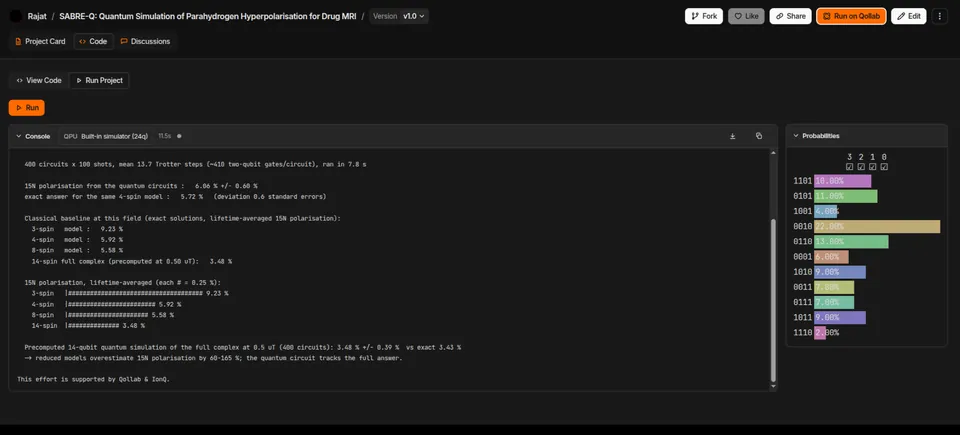 SABRE-Q: Quantum Simulation of Parahydrogen Hyperpolarisation for Drug MRIShows how far the simple spin models used to design SABRE mispredict a drug's polarisation.
3rd place: Optogenetic Quantum Brain
Optogenetic Quantum Brain took 1st place at the Córdoba node in Colombia.
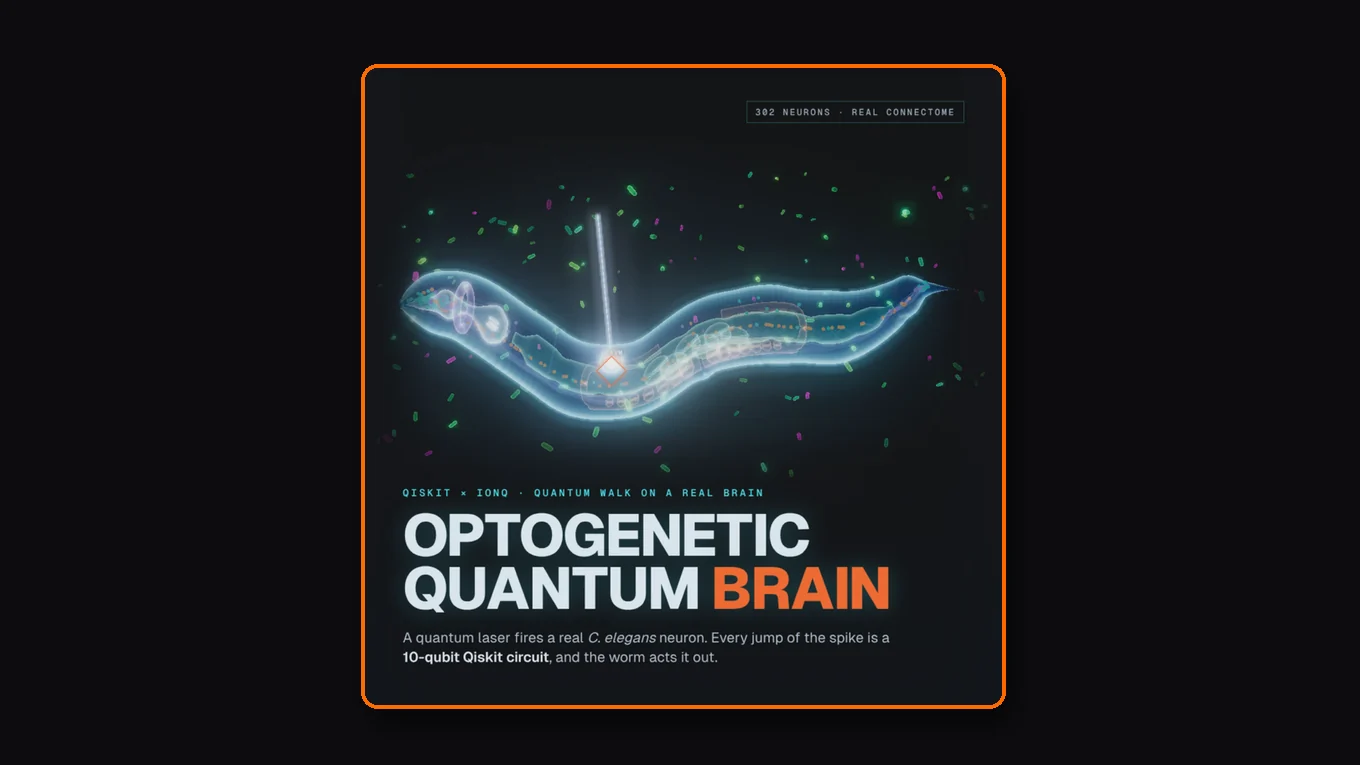
Optogenetic Quantum Brain combines optogenetics, which uses light to control neurons, with quantum walks. A laser, modelled as a qubit rotation, excites one neuron of the C. elegans connectome, the wiring map of the worm's 302 neurons. A cascade of 10-qubit Qiskit circuits then carries the spike through the connectome, one circuit for each jump.
On October 5, four days before the build weekend, the 2026 Nobel Prize in Physiology or Medicine honoured optogenetics. The team read about it during their brainstorm and decided to combine optogenetics with quantum walks. Instead of fitting all 302 neurons into one circuit, the team followed the spike. Each step's circuit holds only the 10-neuron window around the spike.
Joaquín Molina, Herbert Díaz, Julián Stiefkens and Iñaki Bermeo built it as team Quantum Rangers. Joaquín and Herbert are physicists from Pontificia Universidad Católica de Chile. Julián is a computer engineer from the University of Buenos Aires who now studies physics. Iñaki is a final-year astrophysics student at Universidad Técnica Federico Santa María. Herbert and Joaquín know each other from university, and both met Julián at hackathons and events. Iñaki joined on a professor's recommendation.
Visitors pick a neuron, fire the laser and watch the spike spread until the worm reacts. Next, the team wants to fire several lasers at once. The team also plans more apps that make hard science easier to grasp.
Before this weekend, we thought quantum computing was something you study in equations and textbooks. All four of us had learned it in a very academic, formal way. Now we see it as a tool you can build with, play with and even use to explain biology.
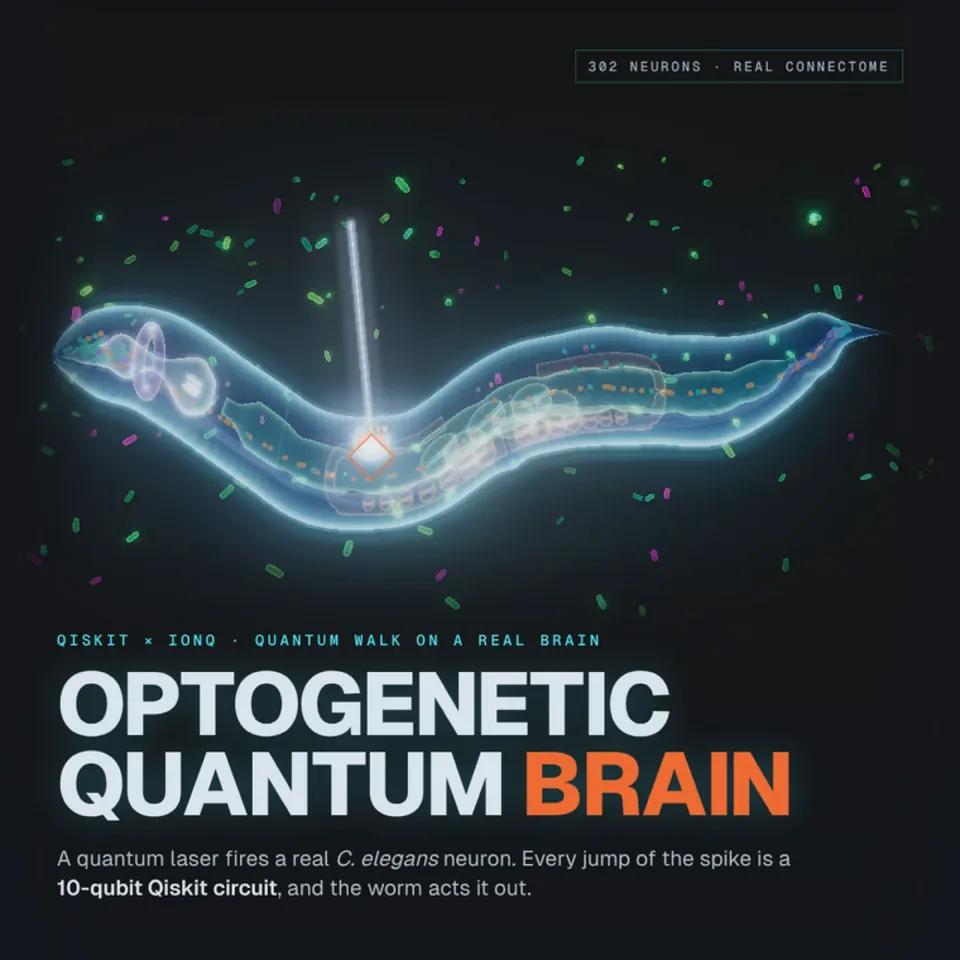 Optogenetic Quantum BrainA quantum walk carries a laser-fired spike through a worm's nervous system.
More from the hackathon
The six global specialty awards were announced on Wed Oct 28. See the local winners at all 22 nodes, or browse all 327 projects. Open any project on Qollab to read its code, run it and fork it.
Thank you to everyone who joined the build weekend, and to the local organizers, mentors and judges.
Stay in the loop.
Get the latest tutorials, demos, and project showcases straight to your inbox. No noise, just the good stuff.
Enable JavaScript to sign up.
Qollab updates only. Unsubscribe any time. Privacy Policy.