What are quantum computers used for today?
Each use with its status in October 2026 and what comes next. Most come with a project on Qollab that runs the method at small scale, free in a browser tab.

Today, quantum computers run chemistry and optimization methods at small scale, along with experiments in cryptography, randomness and physics. People also use them for teaching and creative work.
Two uses lead the researchers' lists cited below: simulating molecules and materials, and breaking RSA and elliptic-curve keys. Both become possible on large machines that correct their own errors. Several hardware makers target error-corrected machines for 2028 to 2030, a step toward the scale these uses need. DARPA is testing whether any approach can reach economic utility by 2033.
Where each use stands today
Most uses on this page run today, at small scale. A chemist can model a hydrogen molecule, a developer can factor 15 with Shor's algorithm, and a student can watch error correction work. The versions a chemist or a bank would pay for need much larger machines that correct their own errors. Hardware makers are building toward them.
Error correction groups many physical qubits into one more reliable logical qubit and fixes errors during the run. Machines that do this at scale are called fault-tolerant.
| Use | What runs today | What comes next |
|---|---|---|
| Chemistry and materials | Molecules such as H2 and LiH, a few qubits | Fault-tolerant machines; some chemistry benchmarks need millions of physical qubits |
| Breaking public-key cryptography | Factoring 15 or 21 | A large fault-tolerant machine |
| Optimization and logistics | Problems of 16 to 25 variables | Testing whether a speedup holds up in practice |
| Finance | Option pricing on a few qubits | The same speedup test as optimization |
| Machine learning | Small classifiers that match classical ones | Testing for an edge on real data |
| Physics experiments | Advantage experiments under public test | Independent checks and better qubits |
| Music | Circuits turned into sound | Bigger pieces as the hardware matures |
| Art | Artworks driven by measurements and entanglement | Already running |
| Teaching | Tools that make superposition and entanglement visible | Already running |
The projects run in a recent Chrome, Edge or Opera, or in Firefox 153 or later. Run the projects covers sign-in and limits.
Chemistry and materials
Molecules are quantum systems, so a quantum computer is a natural tool for modelling them. Chemistry and materials top Hoefler, Häner and Troyer's 2023 analysis of likely uses. The input is small, and the speedup could be exponential.
The classic test case is nitrogenase, the enzyme some bacteria use to turn nitrogen from the air into ammonia. It works at room temperature and normal pressure. Chemists would like to understand it well enough to engineer better versions. Simulating its metal core, FeMoco, became the standard benchmark for chemistry on quantum computers.
That simulation would take 4.5 million physical qubits running for 8.6 hours, Low and colleagues estimated in 2025. It assumes a 0.1% physical error rate and 1 µs error-correction cycles. In 2026 a classical method reached chemical accuracy on the same benchmark model, as Garnet Chan describes. Chan also notes that a better enzyme would take much more than knowing these energies.
Preskill (2025) expects materials to come first, on machines of about 100 logical qubits. He also writes that he "can't promise" commercial applications. A 2025 preprint led by MIT FutureTech projects economic advantage in the mid-2030s, for one class of chemistry algorithms. Several of its co-authors are from Accenture, which sells quantum consulting.
Run it: facumrb's project estimates the lowest energy of small textbook models of H2 (2 qubits) and LiH (4 qubits). It uses the variational quantum eigensolver (VQE). VQE adjusts a circuit's settings to bring its measured average energy as low as it can. Pick the built-in simulator: the project's IonQ path does not run on Qollab.
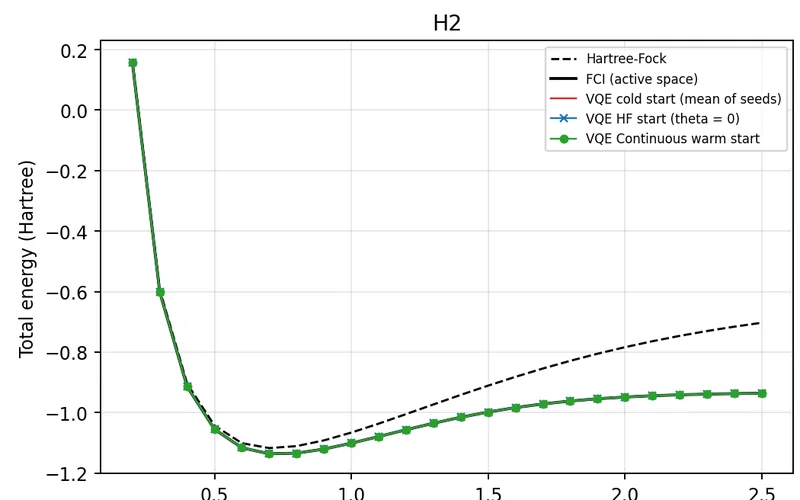 Continuous parameter initialization in molecular dissociation with VQEPress Run and it re-measures one stored H2 answer. Our 8-second run read −1.1383 hartree against an exact −1.1362, a gap close to the shot noise it reports. Its README sweeps 24 bond lengths. Starting each from the last answer needed at least 60.6% fewer energy evaluations for LiH than random starts.
Cryptography
RSA and elliptic-curve keys help protect today's networks. Shor's algorithm could recover the private key behind one of these public keys, given a large enough fault-tolerant machine. Agencies call the risk "harvest now, decrypt later": traffic recorded today could be decrypted once such a machine exists.
A machine with under a million noisy qubits could factor a 2048-bit RSA key in under a week, Gidney estimated in 2025. His 2019 estimate, with Ekerå, was 20 million qubits. Today's demonstrations of Shor's algorithm factor numbers like 15.
Governments have set or proposed deadlines for moving to post-quantum cryptography (PQC), new algorithms that resist Shor's algorithm. The migration deadlines fall between 2030 and 2035, with planning milestones earlier. The sources are NIST's November 2024 draft, US Executive Order 14412, the UK's NCSC guidance and the EU's coordinated roadmap. None of these deadlines forecasts when RSA breaks.
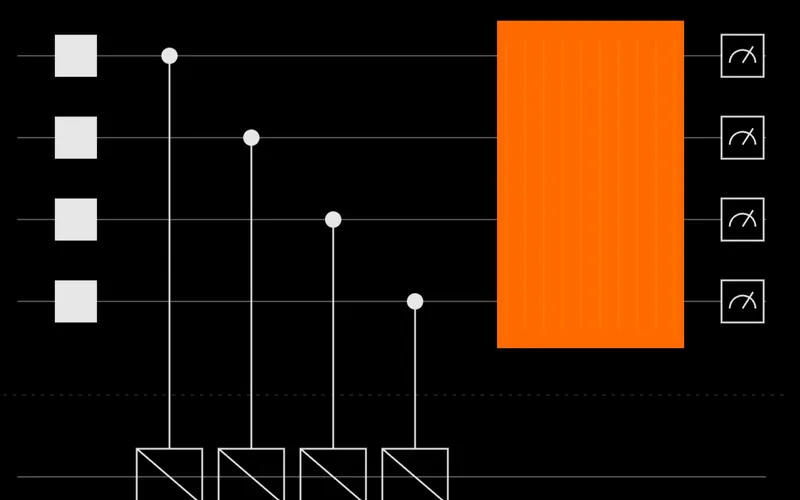 Shor's Semiprime FactorizationPress Run and it factors 15 into 3 × 5 in about 12 seconds. Each run draws a random base, and some bases give no factors. The sample sends a single 12-qubit circuit. Signed in, you can also send it to IonQ's Forte quantum computers for credits.
Two related uses work today, and neither breaks codes. The first is certified randomness: random bits for cryptographic use that a quantum computer generates and classical computers then check. In 2025, JPMorgan Chase, Quantinuum and US Department of Energy labs made about 70,000 of them on Quantinuum's 56-qubit machine. Supercomputers including Frontier and Summit checked them. It is "not yet good enough for high-stakes cryptographic applications", writes Aaronson, a co-author.
The second is quantum key distribution, where an eavesdropper leaves a measurable trace. The BB84 and E91 Protocol project below runs a page called Catch Eve. It builds on work by Laura Ruiz-Arango and Nestor Mendoza-Rueda.
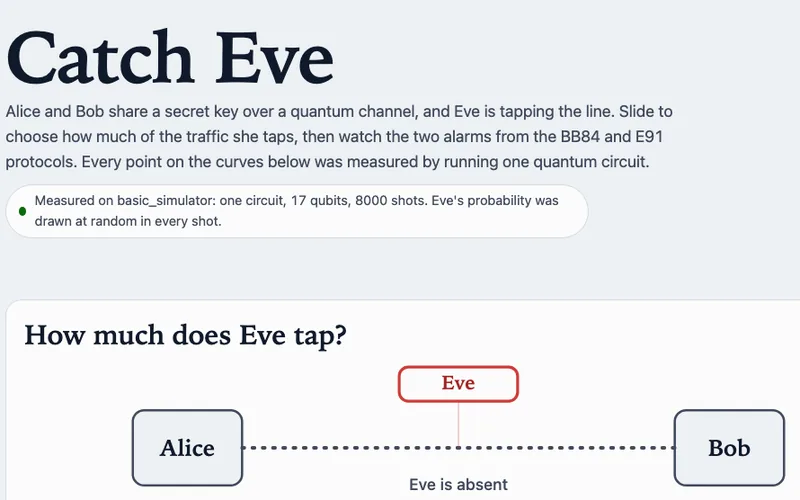 BB84 and E91 ProtocolPress Run and one 17-qubit circuit tests BB84 error detection and an E91-style Bell test. Eve taps a varying share of the shots. In our 10-second run neither alarm tripped with Eve absent; the BB84 alarm trips when the error rate passes 11%.
Optimization and logistics
Optimization means choosing the best of a huge number of options, such as schedules. A bus depot has to charge its fleet overnight, while the grid's carbon intensity and price change hour by hour. A road authority has to finish a backlog of repairs without closing two roads that together force a long detour. Problems like these attract many quantum proposals, and researchers are testing whether a quantum speedup holds up in practice.
Some quantum optimization algorithms offer a quadratic speedup in theory, for some problems. A search that takes a million steps classically would take about a thousand. That gain may not be enough. Hoefler, Häner and Troyer compared an optimistic future quantum computer with a single classical chip. With only a quadratic speedup, the quantum computer needed months of running to come out ahead.
Run it: kerem's project plans one night of charging for three model electric vehicles, in six two-hour blocks, on grid data measured in the Netherlands. It uses QAOA, a circuit whose settings are trained so that it samples good schedules more often. The charging plan is a 16-qubit problem with 500 valid schedules. The project then plans a 100-bus depot with a classical solver.
 Carbon-Aware Charging for an Electric Bus Depot with QAOAPress Run and the project simulates its circuits in its own code; our run took 36 seconds. The trained circuit sampled near-optimal schedules 2.8 times as often as its untrained start. Its best sample matched the exact optimum.
sergey_gris's project schedules ten road-maintenance jobs for two crews to finish as fast as possible. Some pairs of jobs cannot run together. Closing both roads would cut off a trip from a bridge to a hospital, or slow its fastest route by more than 20%.
The problem, built from a real OpenStreetMap road network, has 25 variables. Only 1,216 of its roughly 33.6 million possible answers are valid schedules. About 1% of ideal QAOA samples land on one.
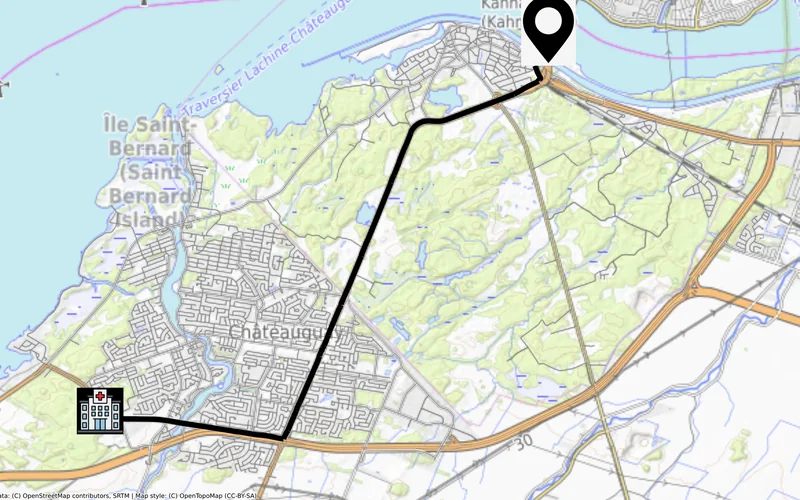 Road-Maintenance Scheduling with QAOAWritten for Qollab's IonQ simulators. Our run on the IonQ Forte 1 noise-model simulator took about 23 minutes for 5,000 shots, the longest here. Of its samples, 0.52% were valid schedules, about half the ideal rate. Signed out, the dialog marks the IonQ simulator rows “Credits apply”, but the run costs nothing.
Finance
Banks price many options by Monte Carlo. They simulate thousands of possible futures under a pricing model and average the discounted payoff. In theory, amplitude estimation reaches the same precision with quadratically fewer samples.
Banks have published research demos of option pricing and other finance tasks. Those methods face the same speedup test as optimization. What quantum computing can do in finance collects them.
Amplitude estimation makes its estimate more precise by repeating a circuit block called a Grover step. Without noise, The Quadratic Bet's README reports, it becomes more precise than Monte Carlo after about 900 evaluations. With the noise of an IBM device model, the signal fades with each step until the modelled advantage disappears. The README puts the bar at about 98.8% of the signal kept per circuit call. Above that, amplitude estimation beats Monte Carlo at about 52,000 evaluations.
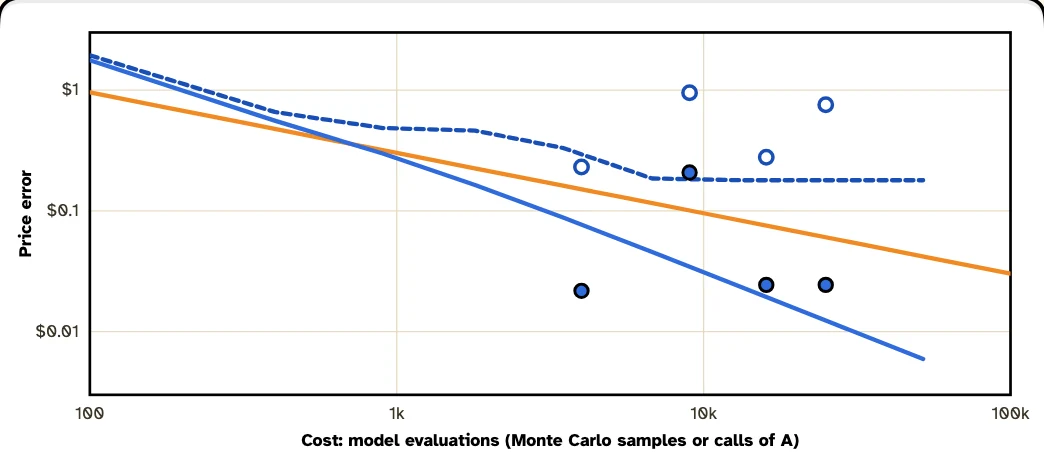
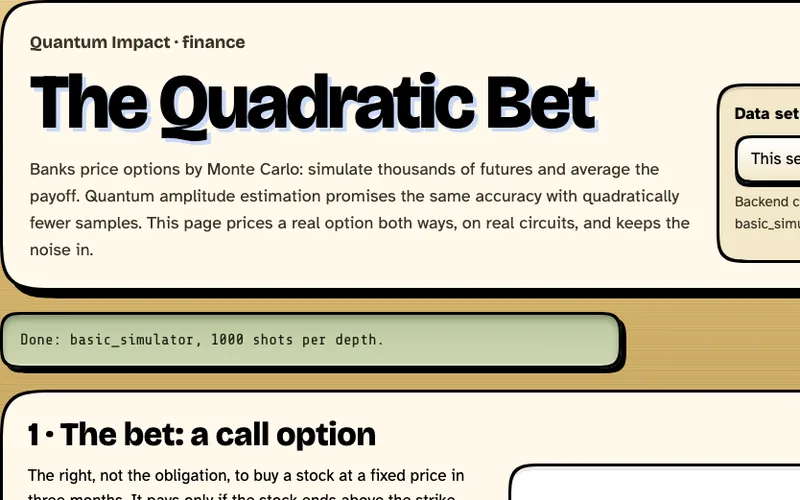 The Quadratic Bet: Quantum Option Pricing, Noise IncludedPress Run and it prices a three-month option two ways: classical Monte Carlo, and amplitude estimation on 4-qubit circuits. Our run finished in 10 seconds.
Machine learning
Quantum computers suit big computations on small data sets, because loading data into one is slow, as the same 2023 analysis argues. Aaronson (2025) expects "eventually ... some modest benefits" from machine learning and optimization.
Zhor Benhafid and Mounira Chaiani tested whether quantum machine learning can screen voice recordings for a voice disorder. Their project, QDysphonia, uses a quantum kernel. The kernel scores how alike two recordings are once each is encoded as a quantum state, one circuit per pair.
Across 10 folds of 1,569 recordings, its 9-qubit kernel classifier scored an AUC of 0.820 against 0.818 for a tuned classical one. On the AUC scale, 0.5 means guessing and 1 means perfect. The project's own test finds no significant difference (p = 0.49).
On a quantum computer, each kernel entry becomes an estimate from measured shots, as in the project's live step. The open question is whether quantum kernels beat classical ones on real data.
 QDysphoniaPress Run and it prints the saved 10-fold results, then measures 390 kernel circuits live. In our 16-second run they matched the exact kernel with a correlation of 0.992.
Physics experiments
A claim of quantum advantage says that a quantum computer beat every classical method on a task. Recent claims include physics experiments and circuit benchmarks. They are scientific experiments. In early 2025, Preskill noted that no commercial application of today's machines had yet shown a quantum advantage. These three are being tested in public:
- Google Quantum Echoes (October 2025): no classical reproduction yet. Aaronson called it a strong candidate in July 2026. A preprint by Hagar that month questions how it was validated.
- IBM's advantage tracker (a 2025 circuit benchmark): by February 2026, in IBM's own words, "new classical methods dramatically changed the picture".
- D-Wave (March 2025, magnetic materials): a May 2026 Science paper matched its lattice results classically, which D-Wave disputes. A September 2026 preprint matched one of its biclique instances.
Error correction
A bigger error-correcting code corrects more errors, as long as each qubit's error rate stays below a threshold. Above it, the extra qubits add more errors than they fix. Every fault-tolerance target in The next few years depends on physical error rates below the threshold of its code.
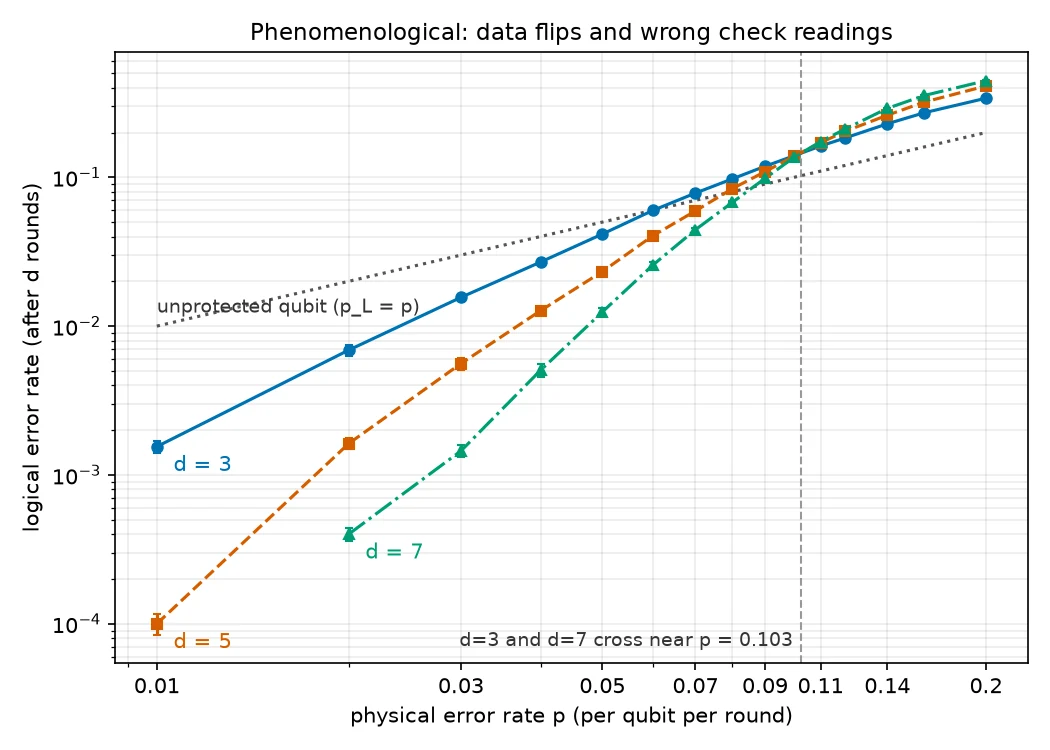
Run it: aelhalwagi's Below Threshold includes a game where you try to out-decode its decoder. It uses bit-flip repetition codes of distance 3, 5 and 7. In its simulations, under one noise model, adding qubits helps below a physical error rate of about 10.3% and hurts above it. Repetition codes do not protect against phase errors.
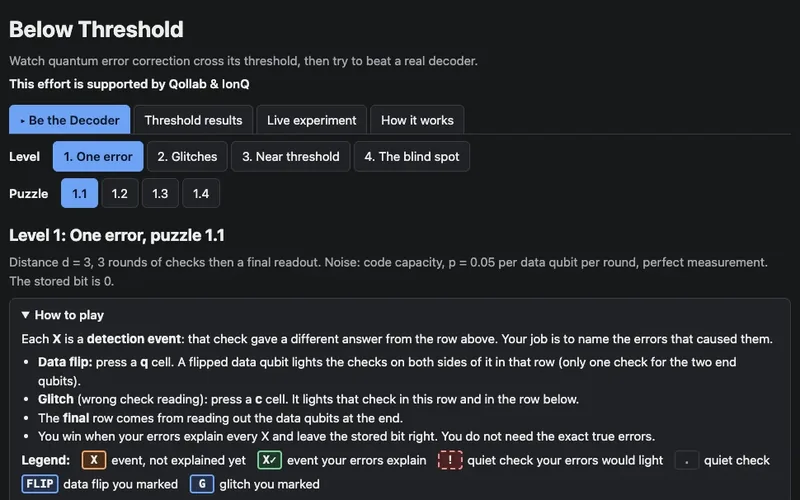 Below ThresholdWritten for the built-in simulator. Its live experiment compares distances 3 and 5 at error rates of 3% and 20%. In our 37-second run, the distance-5 code beat distance 3 at 3% and lost to it at 20%. Both margins were about three standard errors.
Music
Quantum computer music turns a circuit's output into sound. People are good at hearing structure, so a change in a circuit becomes something you notice by ear.
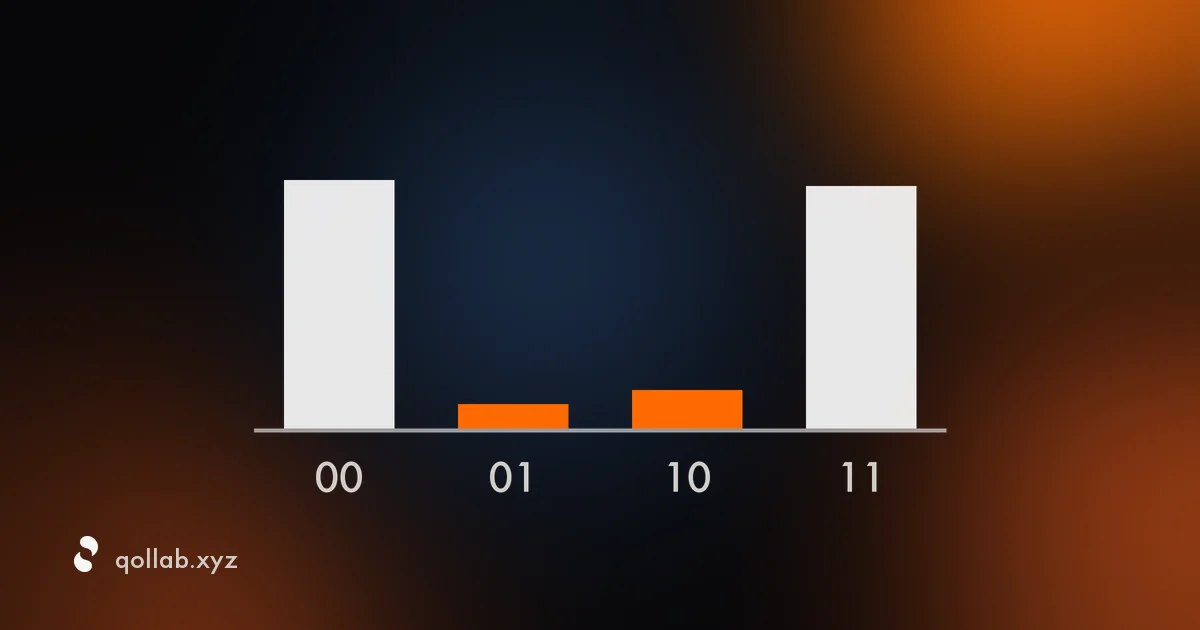
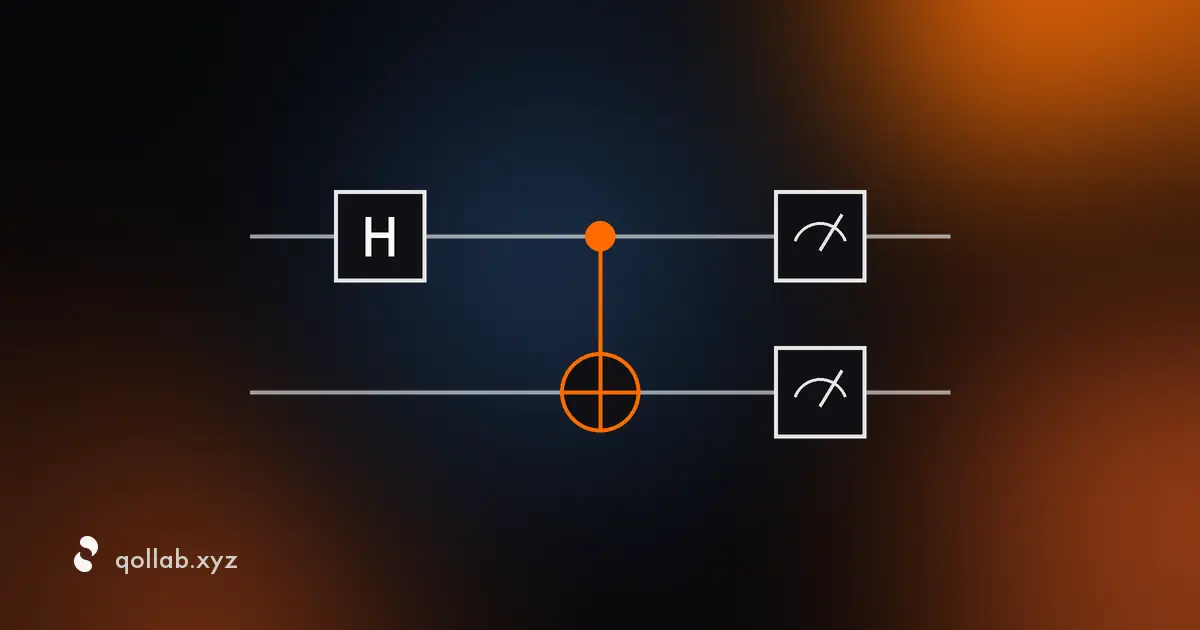
Musiq, a browser studio by Tomoya Hatanaka and Emmanuella Adams, shows how with the simplest entangled circuit, a Bell state. A Hadamard gate puts the first qubit in superposition. A CNOT then entangles the second qubit with it. Ideally the two always agree when measured: the pair comes out 00 or 11, about half the time each.
Musiq maps each outcome to a note, and how often it appears to that note's strength. Amplitudes set loudness, and phases set how the tones interfere. A Bell state's sound is built from two tones of about equal strength. Other circuits sound different: interference-heavy circuits give dense, irregular textures, and quantum walks drift through slowly changing tones.
With noise, a few 01 and 10 outcomes appear too. The project drops any outcome at or under 5% of the shots before it becomes sound. You can try the studio in a browser, or read the showcase.
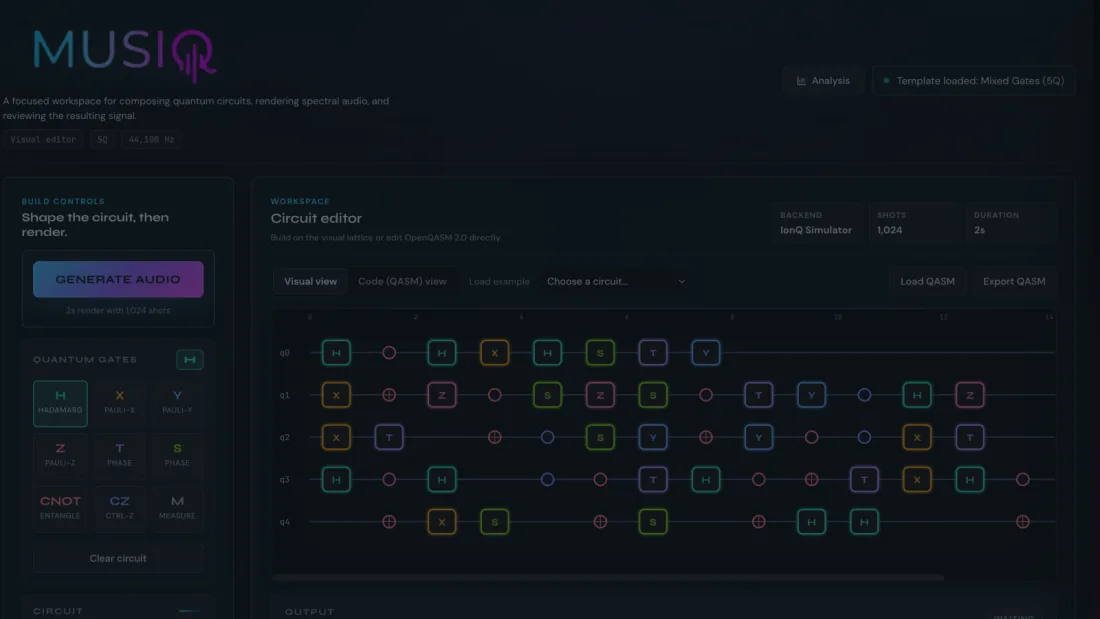 MusiqIts Qollab project runs the Bell circuit whose counts Musiq turns into sound. Pick an IonQ simulator: on the built-in one it stops at an IonQ-only call. Our run on the IonQ Forte 1 noise model took about 1 minute 40 seconds. Of 100 shots, 52 read 00 and 47 read 11.
What does a quantum computer sound like? covers two more projects: live-coded patterns and a playable sequencer.
Art
Quantum art is art made with a quantum computer. The machine runs a circuit, and what the circuit returns decides what you see.
Xinyi Zhang's Quantum Butterfly Field stages a result called the anti-butterfly effect. In a classical chaotic system, small damage cascades: a butterfly flaps its wings and a tornado follows. In a quantum system, information scrambled across many qubits lives in their correlations, so local damage can be undone. Yan and Sinitsyn described the effect in 2020.
The artwork turns it into a field of five butterflies, one per qubit, in four steps:
- Start: every butterfly but one begins in superposition.
- Scramble: three layers of random rotations and CNOTs spread each butterfly's state across the field.
- Damage: one butterfly is entangled with a spare qubit, which is then thrown away.
- Heal: the scramble runs backward, and the damaged butterfly's state becomes much purer again.
Every visual is a real quantum quantity, computed from the circuit. Purity sets how sharp a butterfly's wings are. Mutual information draws the threads between butterflies. Fidelity sets how brightly the damaged one glows. The live piece also replays recorded runs from IonQ Forte hardware.
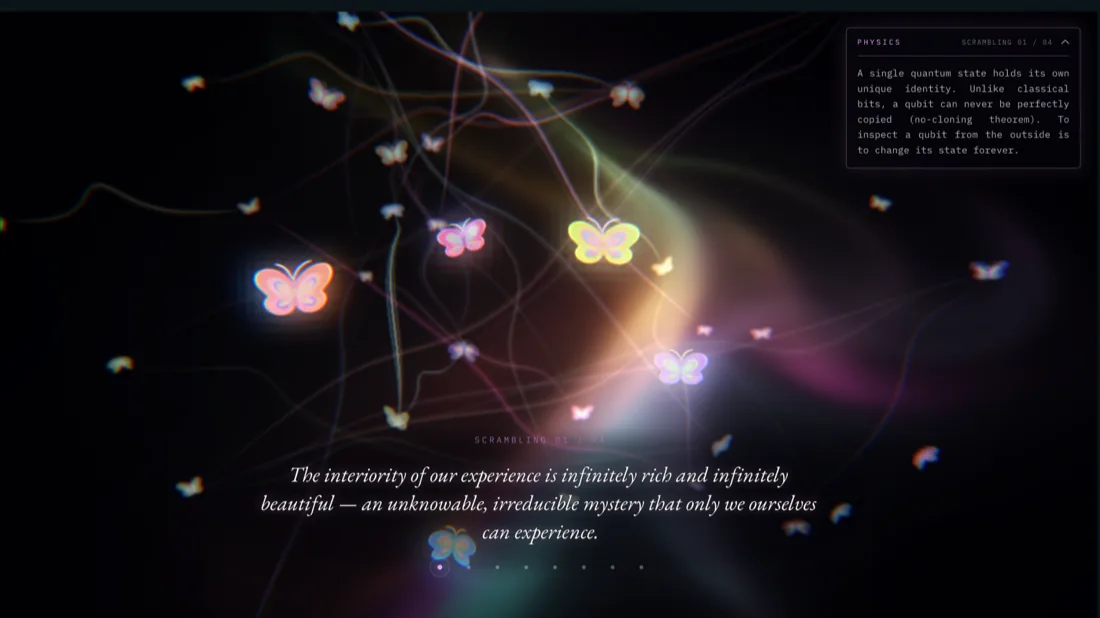 Quantum Butterfly FieldPress Run and the circuit runs all four steps on 6 qubits with 13 CNOTs. Our run on the built-in simulator took about 2 minutes 20 seconds. The project scores the healing by the damaged butterfly's purity, from 0.5 (fully mixed) to 1 (pure). Our run scored 0.78. Change the damaged butterfly or the seed in Run settings to try another field.
Can a quantum computer make art? covers two more: a garden grown from measurements and a body you can touch.
Teaching
Shivani Mayekar has run quantum workshops for more than 250 people, and one problem kept coming back. Newcomers understood the theory but had few ways to experiment with it. Her QuantumCanvas lowers the three walls they hit: the math, noisy hardware, and the syntax of a coding framework.
Instead of code, you drop tiles on a grid and watch the circuit and its state change as you go:
- Shake spreads every possibility equally, which is superposition.
- Mark tags a target with a hidden signal.
- Boost amplifies the marked item, so it becomes the one you are most likely to measure.
- Link entangles two qubits, so they move together.
A Bell state is shake, then link. You can try the live demo in a browser, or read the showcase.
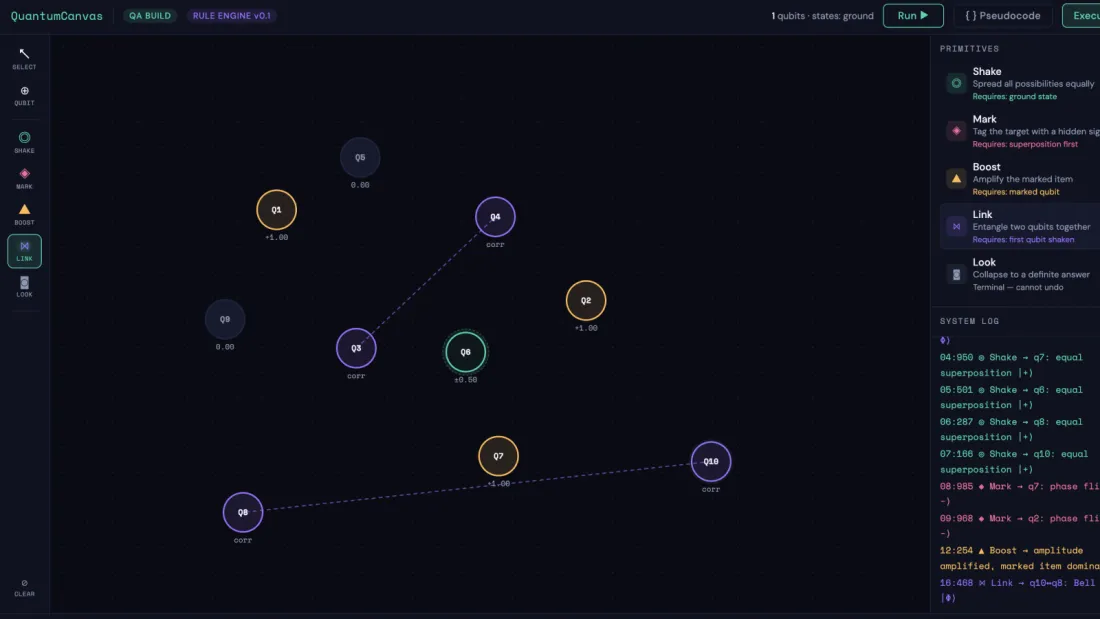 QuantumCanvasIts Qollab project runs the shake-then-link Bell circuit. Pick an IonQ simulator: on the built-in one it stops at an IonQ-only call. Our run on the IonQ Forte 1 noise model took about 3 minutes. Of 100 shots, 48 read 00 and 50 read 11.
See a quantum computer actually work covers five more tools, from an algorithm animator to a routing game.
The next few years
DARPA's Quantum Benchmarking Initiative (QBI) is testing whether any approach can reach "utility-scale operation" by 2033. That means "its computational value exceeds its cost". Its program page rates it "more likely than not" that a company "will be able to create an industrially useful quantum computer by 2033".
Six companies are in its final stage: Atom Computing, Diraq, IBM, IonQ, Microsoft and PsiQuantum. DARPA does not yet know which teams or approaches "will get there", QBI managing director Micah Stoutimore said in an October 2026 release. The US Department of Energy plans to demonstrate fault-tolerant systems in 2028 "with logical qubits numbering in the low hundreds".
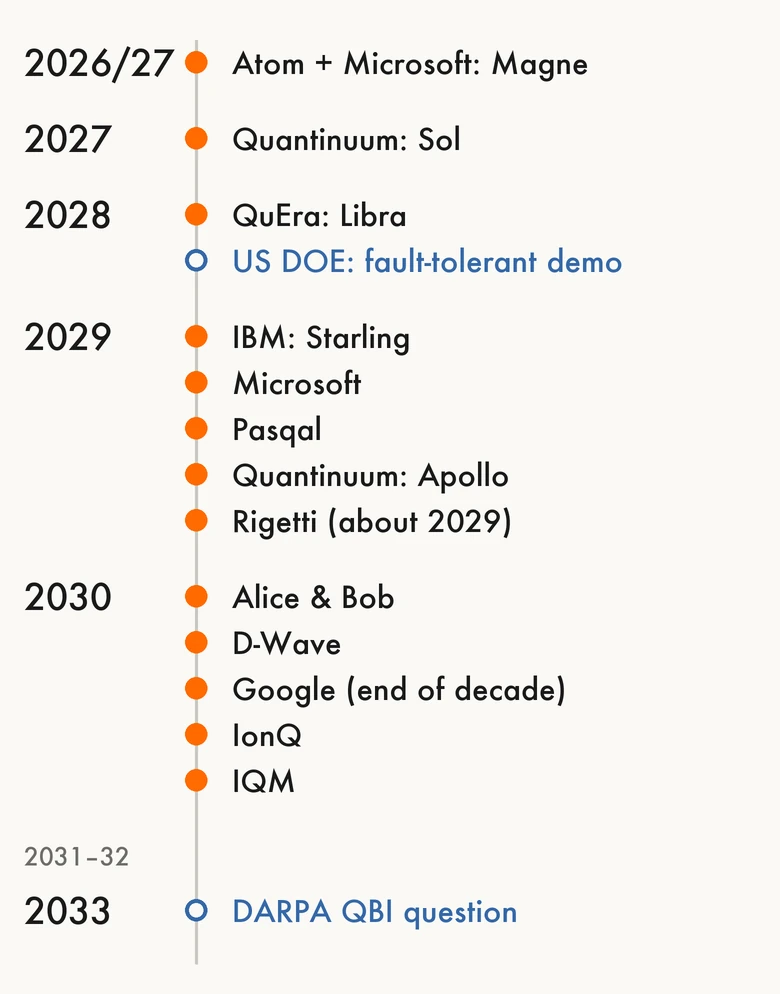
Hardware makers' stated targets, in alphabetical order:
| Company | Target, in its own words | Date |
|---|---|---|
| Alice & Bob | "a universal fault-tolerant quantum computer by 2030" | June 2026 |
| Atom Computing, with Microsoft | Magne, "50 logical qubits and over 1,200 physical qubits", "expected to be ready for its first tasks by the new year 2026/27"; later, "Currently being installed" | July 2025; June 2026 |
| D-Wave | for 2030, "A 1,000 physical qubit dual-rail system with 10 logical qubits" | May 2026 |
| "commercially relevant quantum computers based on superconducting technology" by "the end of this decade" | March 2026 | |
| IBM | Starling, "the first fault-tolerant quantum computer", in 2029, "200 qubits running 100 million gates" | undated page, read October 2026 |
| IonQ | "2 million physical qubits and 80,000 logical qubits by 2030" | undated page, read October 2026 |
| IQM | "a path to achieve fault-tolerant quantum computing by 2030" | November 2025 |
| Microsoft | "a scalable, practical quantum computer" by 2029, "a major milestone on the path to a transformative fault-tolerant quantum computer" | undated page, read October 2026 |
| Pasqal | "200+ logical qubits by 2029" | undated page, read October 2026 |
| Quantinuum | "the launch of Sol in 2027"; "Apollo remains on schedule for 2029" | August 2026 |
| QuEra | Libra, "256 Logical Qubits", "Launching 2028" | undated page, read October 2026 |
| Rigetti | "approximately 1,000 qubits" over "roughly a three-year time horizon" | August 2026 |
Checked against each source on 19 October 2026. Each target is a statement of intent, and several moved in 2026, some later and some earlier. The companies count logical qubits with different codes and error targets, so the numbers do not compare one to one.
Run the projects
Every run described on this page took place on 19 and 20 October 2026, signed out, in a fresh browser each time. We used the built-in simulator unless the text says otherwise. Most runs took 8 to 37 seconds; the longest took about 23 minutes.
Without an account you get one run per browser, on the simulator you pick. Sign in with Google or GitHub to run again. Projects need a browser feature called WebAssembly JSPI, found in a recent Chrome, Edge or Opera, or Firefox 153 or later.
A simulator is ordinary software that calculates what a circuit does, and it takes the same circuits as a quantum computer. A full state-vector simulator runs out of laptop memory at around 30 qubits; a quantum computer is limited by qubit count and errors instead. Free quantum computer simulators explains the kinds.
Signed in, the Run dialog also lists IonQ's Forte quantum computers when IonQ reports them, and they cost credits. A project can run on one only while the machine is online. The project must also send IonQ one circuit, not a list, of 36 qubits or fewer.
Three projects to start with.
Each one finished in under a minute in our runs.
Questions people ask
What is the main use of quantum computing?
Today, quantum computers run small research demonstrations of chemistry, optimization and cryptography methods, and physics experiments. Newcomers also use them through teaching tools. Looking ahead, the researchers cited here rank simulating chemistry and materials first. Their commercial versions need fault-tolerant machines. Optimization and machine learning come third on Aaronson's 2025 list, after breaking today's cryptography.
How far away are we from a useful quantum computer?
DARPA's program page rates it "more likely than not" that a company "will be able to create an industrially useful quantum computer by 2033". The US Department of Energy plans to demonstrate fault-tolerant systems in 2028, with logical qubits "numbering in the low hundreds".
Do quantum computers actually exist yet?
Yes. IBM, IonQ, Quantinuum, Rigetti and others run quantum computers today, and several rent time on them through cloud services. IBM's fleet is built on processors of 100 or more qubits, and IonQ's Forte quantum computers have 36 qubits. Can you buy a quantum computer? compares what that time costs.
Related
More guides
Stay in the loop.
Get the latest tutorials, demos, and project showcases straight to your inbox. No noise, just the good stuff.
Enable JavaScript to sign up.
Qollab updates only. Unsubscribe any time. Privacy Policy.