Free quantum computer simulators you can use today
Run a Bell state free in your browser, then pick a simulator for the job: learning gates, checking a circuit, seeing noise, or going past 30 qubits.

A quantum computer simulator is software that calculates what a quantum circuit does, on an ordinary computer. You can build and test a circuit on one before you use quantum hardware. The free ones run in a browser tab, on your own machine, or on a provider's cloud.
How many qubits a simulator handles depends on its method and on memory. A full simulation of 30 qubits needs 16 GiB in double precision. Stabilizer simulators handle thousands of qubits, for one restricted kind of circuit.
To run one now, open the Bell state example below. Qollab runs it free on any of 14 simulators, from a browser tab.
Run a circuit now
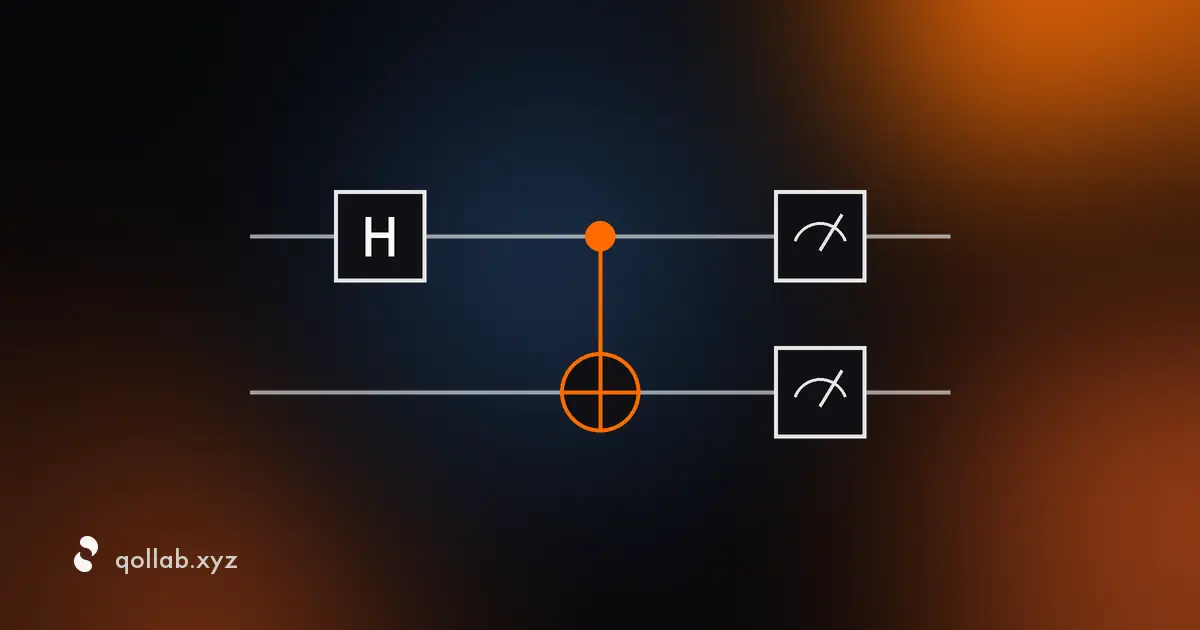
The example below is a Bell state: two qubits prepared in one shared state, then measured 1,000 times. Each repetition is a shot. On an ideal simulator about half the shots read 00 and the rest read 11.
# 'backend' is pre-created for you in the Qollab Playground.
from qiskit import QuantumCircuit

qc = QuantumCircuit(2, 2)       # two qubits, two answer bits
qc.h(0)                         # H gate on qubit 0
qc.cx(0, 1)                     # CNOT: qubit 1 follows qubit 0
qc.measure([0, 1], [0, 1])      # read both qubits into the bits

job = backend.run(qc, shots=1000)
counts = job.result().get_counts()
print(counts)                   # e.g. {'00': 502, '11': 498}
To run it:
- Press Run on Qollab under the code. The project page opens in a new tab.
- Press Run on Qollab on that page. The Run dialog opens, headed Select QPU.
- Pick Built-in simulator and press Run. The counts print in the console.
Without an account you get one run, on one simulator. Sign in with Google or GitHub to run again and to try the other simulators. The playground runs Python through a browser feature called WebAssembly JSPI, found in a recent Chrome, Edge or Opera, or Firefox 153 or later. In other browsers Qollab keeps Run disabled. The first run loads Python and the example's packages, so it takes longer than the runs after it.
The same circuit in JavaScript runs the same way. Its main.js calls the same Qiskit from a JS project.
The simulators in the Run dialog
| Simulator | Kind | Where it runs |
|---|---|---|
Built-in simulator (Qiskit's BasicSimulator), 24 qubits | Ideal | Your browser |
| AWS Braket local simulator, 25 qubits | Ideal | Your browser |
| Eight IBM simulators: Boston, Kingston, Pittsburgh, Fez, Marrakesh and Aachen (156-qubit Heron devices); Miami and Berlin (120-qubit Nighthawk devices) | Noise model | Your browser |
| IonQ Forte 1 and Forte Enterprise 1, 29 qubits | Noise model | IonQ's cloud |
| IonQ Aria 1 and Aria 2, 25 qubits | Noise model | IonQ's cloud |
All 14 are free. Signed out, the dialog marks the IonQ rows Credits apply; the runs still cost nothing. The IBM figures are the sizes of the devices the models copy; how large a circuit your browser can simulate depends on its memory. IonQ has retired the Aria hardware, so the two Aria models copy machines that no longer run. When IonQ reports its machines, the dialog also lists its Forte quantum computers, which cost credits. Compute backends lists every option.
What the counts show
The Bell state above, run on Qollab on 15 October 2026, signed out, 1,000 shots each:
| Simulator | 00 | 01 | 10 | 11 |
|---|---|---|---|---|
| Built-in simulator | 514 | 0 | 0 | 486 |
| AWS Braket local simulator | 497 | 0 | 0 | 503 |
| IBM Boston noise model | 529 | 9 | 8 | 454 |
| IBM Kingston noise model | 351 | 123 | 180 | 346 |
| IBM Pittsburgh noise model | 510 | 10 | 35 | 445 |
| IBM Fez noise model | 497 | 10 | 15 | 478 |
| IBM Marrakesh noise model | 489 | 14 | 2 | 495 |
| IBM Miami noise model | 454 | 20 | 34 | 492 |
| IBM Aachen noise model | 481 | 6 | 6 | 507 |
| IBM Berlin noise model | 476 | 37 | 31 | 456 |
| IonQ Aria 1 noise model | 506 | 3 | 1 | 490 |
| IonQ Aria 2 noise model | 480 | 3 | 6 | 511 |
| IonQ Forte 1 noise model | 479 | 3 | 4 | 514 |
| IonQ Forte Enterprise 1 noise model | 485 | 3 | 4 | 508 |
Every run but one took 5 to 18 seconds from pressing Run to the counts, in a fresh browser. One IonQ cloud run took 133 seconds.
The ideal simulators return only 00 and 11. Their split differs from 500/500 by chance, as any 1,000 samples of a 50/50 outcome do. The noise-model simulators also return 01 and 10, outcomes the ideal circuit never produces. Across the 12 models those two outcomes took between 0.4% and 30.3% of the shots, because each model copies a different device's calibration.
Each noise model adds errors measured on its device. IBM builds its models from calibration snapshots that IBM says were sometimes taken years ago. IonQ calls its models simplified approximations and says hardware results should not be expected to match them quantitatively. One run of one circuit on these models does not rank the devices or their makers. Noise-model runs usually take longer than ideal ones; Ideal vs. noise-model simulators explains when and why.
Which simulator fits which job
- Learning what gates do: a drag-and-drop simulator in the browser, such as Quirk or IBM Quantum Composer, updates the state as you place each gate.
- Checking a circuit's logic: an ideal simulator, such as the built-in one on Qollab, or Qiskit, Cirq or PennyLane on your machine.
- Seeing noise before a hardware run: a noise-model simulator. On Qollab that is any IBM or IonQ model; elsewhere, IBM's fake backends with Qiskit Aer, IonQ's cloud simulator, or the density-matrix simulators in Cirq, PennyLane and Braket.
- Going past 30 qubits: a GPU simulator such as CUDA-Q or PennyLane Lightning, a tensor-network simulator for circuits with limited entanglement, or a cloud service.
- Error-correction research: Stim, which simulates Clifford circuits with thousands of qubits.
Free quantum simulators compared
Each tool below was checked against its maintainer's own pages on 14 October 2026. Free tiers change, so check a tool's pricing page before you plan around it. A hard qubit limit means the tool refuses more; a practical one means memory sets the limit.
In a browser tab
| Tool | Method and noise | Qubits | Free terms |
|---|---|---|---|
| Qollab playground | Ideal and noise-model simulators, run from Python or JavaScript projects | 24 (built-in), 25 (Braket local), 25 or 29 (IonQ models); IBM models: memory | Free; one run without an account, then sign in |
| Quirk | Drag and drop; state vector, no noise | 16, hard | Free, no account |
| Quirk-E | Quirk extended at the University of Jyväskylä; ideal, no noise; exports OpenQASM, Qiskit, Cirq and more | 20, hard | Free to use; its README requires citing Quirk and the Quirk-E paper |
| IBM Quantum Composer | Drag and drop plus an OpenQASM editor; single-shot state vector for its visualizations, no noise | 4 signed out; up to 15 signed in, depending on the view | Free; signing in needs an IBM Cloud account (a 30-day trial, then Pay-as-you-go) |
| THE QUANTUM LÄND circuit simulator | Drag and drop, generates OpenQASM; ideal; runs on the University of Stuttgart's servers | 10 in the designer, hard; 30 through its API with an activated account | Free; without an account, one backend and 1,000 shots per simulation |
On your machine
| Tool | Method and noise | Qubits | Free terms |
|---|---|---|---|
Qiskit Aer and Qiskit's BasicSimulator | Aer: state vector, density matrix, stabilizer, matrix product state and more, with noise models. BasicSimulator: state vector and Clifford, no noise | Aer: memory. BasicSimulator: 24 (state vector), 2,048 (Clifford), hard | Free, open source. Aer has been in reduced maintenance, critical fixes only, since May 2026 |
IBM fake backends in qiskit-ibm-runtime | Noise models from snapshots of IBM devices, run on Aer; without qiskit-aer installed they run without noise | Memory; each model lists its device's qubits | Free, no account |
| Cirq and qsim | Cirq: state vector, density matrix, Clifford, noise models. qsim: a C++ state-vector simulator, noise by trajectories | Cirq: about 20, practical. qsim: fewer than 29 on an 8 GB laptop, Google's guidance | Free, open source |
| PennyLane | default.qubit, default.mixed (noise), default.clifford, default.tensor; Lightning devices in C++ for CPU and GPU | Memory; lightning.qubit is "well-suited for 20+ qubit workflows" | Free, open source |
| Amazon Braket local simulator | State vector; density matrix with noise channels | 25 (state vector), 12 (density matrix), practical | Free in the Braket SDK |
Microsoft QDK, pip install qdk | Sparse simulator (the default); stabilizer simulator with Pauli noise and qubit loss; GPU full-state simulator | GPU full-state: 27. Stabilizer: thousands | Free; no Azure account needed to simulate |
| CUDA-Q | State vector on CPU or GPU, tensor network, matrix product state, density matrix, Stim; GPU targets use NVIDIA cuQuantum | Under 28 on CPU, under 33 on one 64 GB GPU; thousands for some circuits with tensor networks (NVIDIA's guidance) | Free, Apache 2.0; GPU targets need an NVIDIA GPU |
| Quantum Rings SDK | Proprietary CPU and GPU engines | The free key's limit is not published | Free for non-commercial use; needs a licence key and an account |
On a provider's cloud
| Tool | Method and noise | Qubits | Free terms |
|---|---|---|---|
| IonQ cloud simulator | Ideal, plus noise models of IonQ's Forte and Aria systems | 29 (ideal and Forte), 25 (Aria), hard | Free with an IonQ account |
| Azure Quantum | IonQ's simulator and Rigetti's QVM | 29 (IonQ), 30 (Rigetti QVM) | Free of charge; needs an Azure subscription |
| qBraid | Its own state-vector simulator, plus Rigetti's QVM, IonQ's simulator and Quantinuum's H2 checker and emulator | Not published | Free plan: 100 jobs a day per simulator, no credit card |
| BlueQubit | CPU state vector based on qsim, matrix product state, Pauli propagation | 34 (CPU), 96 (matrix product state) | Free plan: CPU state-vector jobs up to 60 minutes, matrix product state and Pauli jobs up to 15; GPU jobs need credits |
Specialist simulators
- Stim simulates Clifford circuits with Pauli noise, at thousands of qubits and millions of operations. Error-correction research uses it.
- QuEST (C and C++) and Qulacs (Python and C++) simulate state vectors and density matrices, with GPU support.
- MQT DDSIM, from the Technical University of Munich, simulates circuits with decision diagrams and plugs into Qiskit.
- QuTiP models open quantum systems; its
qutip-qippackage adds gate circuits and pulse-level noisy devices. - Quantum Inspire 2.0, from QuTech, runs a cloud emulator free up to 26 qubits for non-commercial users, after account approval.
Paid managed simulators
Amazon Braket's managed simulators, SV1 (state vector, up to 34 qubits) and DM1 (density matrix, up to 17), cost $0.075 a minute in US East (N. Virginia). Billing is per millisecond, with a three-second minimum per simulation. AWS changed its Free Tier for new accounts in July 2025, adding sign-up credits, and Braket's pricing page still describes a free simulator hour. Check what your account gets before a long run.
Retired or changed since 2024
- IBM retired its cloud simulators on 15 May 2024. It points users to the fake backends and Qiskit Aer on their own machines.
- Azure Quantum Credits ended on 1 June 2025.
- Xanadu's Quantum Cloud is no longer available; the decommissioning was committed in January 2026, and the Strawberry Fields repository is archived.
- Amazon Braket retired its TN1 tensor-network simulator in June 2026.
- Classiq ended open free access for new users on 9 August 2026; existing users keep access.
- Microsoft removed the Q# katas from its online playground in September 2026. They now run in the QDK extension for VS Code.
How many qubits can a simulator handle?
A state-vector simulator stores 2^n complex numbers for n qubits, at 16 bytes each in double precision. Each added qubit doubles the memory:
| Qubits | State-vector memory |
|---|---|
| 20 | 16 MiB |
| 25 | 512 MiB |
| 30 | 16 GiB |
| 35 | 512 GiB |
| 40 | 16 TiB |
A density matrix, which noise-model simulators can use, holds 4^n numbers: 15 qubits take the same 16 GiB as a 30-qubit state vector. Qollab's built-in simulator stops at 24 qubits, the state-vector limit of Qiskit's BasicSimulator. AWS gives 25 qubits as practical guidance for its local simulator.
Other methods trade generality for size. Stim is a stabilizer simulator: it handles thousands of qubits, but only for Clifford circuits (H, S, CNOT and measurement, with no T gate). The QDK's stabilizer simulator also accepts a small number of non-Clifford operations.
Tensor-network and matrix-product-state simulators reach hundreds or thousands of qubits on circuits whose entanglement stays limited. GPU simulators keep the state vector in GPU memory; NVIDIA's guidance for CUDA-Q is under 33 qubits on one 64 GB GPU. IBM's documentation gives several reasons for retiring its cloud simulators, among them that their usefulness "maxes out at around 50 qubits".
Questions people ask
Does IBM still have a free quantum simulator?
Yes. IBM retired the cloud simulators you sent jobs to on 15 May 2024. For code, it now points to Qiskit Aer and the fake backends in qiskit-ibm-runtime, which copy the noise of IBM devices and run on your own machine. Qollab runs eight of those fake backends in a browser tab, so you can run the Bell state on one. IBM Quantum Composer also shows simulated results in the browser, for up to 4 qubits without signing in.
Is there a way to use a quantum computer for free?
The simulators in the comparison tables above all have a free route. For real hardware, IBM's Open Plan includes up to 10 minutes of runtime a month, and a new Qollab account starts with 100 credits for IonQ hardware. Can you buy a quantum computer? compares the free routes and what paid runs cost.
Is a quantum simulator the same as a quantum circuit simulator?
Not always. In physics, a quantum simulator is a controllable quantum system, such as cold atoms in a lattice, used to imitate another quantum system that is hard to study directly. A quantum circuit simulator is classical software that calculates what a circuit does, and this page covers that kind. QuTiP is classical software for modelling physical quantum systems, and its qutip-qip package adds circuits.
Related
More guides
Stay in the loop.
Get the latest tutorials, demos, and project showcases straight to your inbox. No noise, just the good stuff.
Enable JavaScript to sign up.
Qollab updates only. Unsubscribe any time. Privacy Policy.