Can a Quantum Computer Make Art?
Three teams from Qollab's Creative Challenge answered yes, on real IonQ hardware: a field of butterflies that heal after damage, a garden grown from quantum measurements, and a human body whose parts respond across distance. Here is what quantum art is, in the work of the people making it.

A quantum computer does not draw pictures. Its raw output is a probability distribution, a spread of numbers with no obvious shape. Turning that spread into something you can see and feel is one of the more direct ways to make quantum behavior real to a person, instead of a proof on a page.
This is a story about three artworks that do exactly that. They came out of Qollab's Quantum Creative Challenge, and each one takes the strangest idea in quantum physics, entanglement, and grows it inside something living: a field of butterflies, a garden, and a human body. None of them asks you to know any physics first.
You look at a butterfly and see the color of its wings. In relation to me, a relation is established between you and the butterfly: the butterfly and you are now in an entangled state. Everything in the world does not exist other than in this web of entanglement.
What is quantum art?
Quantum art is art made with a quantum computer. The machine runs a circuit, and what the circuit returns decides what you see. A painting inspired by quantum physics is a different thing, and so is a piece that only uses a quantum chip as a random-number generator.
The field is small, and 2025 gave it a spotlight when the United Nations named it the International Year of Quantum Science and Technology. What Qollab adds is access. Three teams from its Creative Challenge built three artworks you can open in a browser, run on real hardware, and take apart: butterflies that heal after damage, a garden that grows from measurement, and a body whose parts answer each other across distance.
At a glance
Three teams, three living forms, one shared idea: let entanglement happen somewhere you can watch it. Here is who built what.
| Project | The idea | Runs on | What you see | Built by |
|---|---|---|---|---|
| Quantum Butterfly Field | Healing | IonQ Forte hardware | Five qubits scramble into one field; one is damaged, then recovered | Xinyi Zhang |
| Quantum Garden | Growth | IonQ hardware, from a pool of runs | Plants whose form is fixed by real quantum measurements | Amber Wang & Justin Pincar |
| Entangled Body | Connection | IonQ hardware (added later) | A point-cloud body whose parts respond across distance | Chanhyuk Park & Luke Shim |
Why something living?
Entanglement is famously hard to picture. Two particles can share a single state so completely that neither has one of its own, and measuring one tells you about the other, however far apart they sit. Artists have reached for living forms to get that across before. Libby Heaney staged entanglement inside a version of Bosch's Garden of Earthly Delights, and the sculptor Julian Voss-Andreae has been building quantum states into the human figure since his Quantum Man in 2006.
The three works on this page run a circuit underneath the form, and its measurements do the work: a measured purity sets how sharp a butterfly's wings are, a measured outcome fixes what a plant becomes, and a measured correlation decides how strongly two parts of a body respond to each other.
This quantum resilience resonates with the Native Hawaiian concept of lōkahi, unity and wholeness, where individual wellbeing is maintained through the integrity of our relationships within a web of the interconnected whole.
Chanhyuk Park, who built Entangled Body, arrived at the same place from the body's side rather than the physics.
An astronaut cannot exist alone in space; the body depends on the suit, life-support systems, communication signals, and the surrounding environment. Rendered as a point cloud, the astronaut becomes a temporary body made of data and particles, present but constantly dissolving and re-forming.
The opportunity
For most of its history, making art with a quantum computer meant institutional access: a lab, a university, a research partnership. The machines lived behind those doors.
Cloud quantum computers you can reach from a browser tab changed that only recently, and Qollab is a community and coding platform built around that shift: a place to write quantum code and run it on IonQ's trapped-ion hardware, with no lab or affiliation required. In spring 2026, Qollab and IonQ funded a Creative Challenge on top of it, compute credits, cash, and mentorship for open, original projects from anyone with an idea. Quantum Butterfly Field and Entangled Body came out of that round, and Quantum Garden from the one before. All three are open source, and none was built only by physicists.
The wider art world is paying attention too. In 2025, Science Gallery London opened a six-month show called Quantum Untangled, Tokyo's Museum of Contemporary Art exhibited what it billed as the first artwork made with a Japanese quantum computer, and the LAS Art Foundation's Sensing Quantum program won a Grand Prize at the EU's S+T+ARTS Awards. The question under all of it is when a work is really quantum and when the word is decoration. These three answer it by showing their circuits.
You don't need to be a physicist to do something meaningful with quantum; you need a strong concept about time, uncertainty, or connection, and a willingness to collaborate with technical partners. Think of quantum as a new storytelling and interaction medium, not just a buzzword or a black box.
Justin Pincar, who built Quantum Garden with her, spent years thinking quantum was out of reach. What changed his mind was simply being able to reach it.
I realized that through platforms like Qollab and IonQ, you can access real quantum hardware as simply as spinning up any other cloud service. That was the moment it clicked and I realized that it was actually accessible now, not just theoretical.
Where this goes
What exists today is a first pass. Each piece maps one circuit to one experience. The builders are already thinking bigger.
The core idea is treating quantum mechanics as part of the engine itself rather than simply a theme. I'd love to see multi-user entangled bodies that influence each other through shared quantum states, or artwork that continuously responds to live quantum measurements.
For Amber, the direction is to treat the quantum behavior itself as the medium, the way a painter treats paint.
Designing for quantum means treating concepts like superposition, entanglement, and probabilistic measurement as actual creative materials, not just technical details. Instead of thinking, "What output do I want?" you're asking, "What distribution of possible states do I want, and how should people encounter those states over time?"
Quantum Butterfly Field: five qubits, one field
Quantum Butterfly Field is an interactive artwork by Xinyi Zhang, an artist and technologist with computer-science degrees from MIT and the University of British Columbia. Five butterflies are five qubits. As a circuit runs, it scrambles their identities into one entangled field, until no single butterfly holds its own state anymore. Then one is damaged: the circuit entangles it with a throwaway qubit and discards that qubit, cutting the butterfly off from the field.
In a classical chaotic system the damage would spread and the original would be gone for good. Here the circuit runs the scramble backward, and because the butterfly's state was spread across the correlations the other four still hold, it comes back almost completely, with a small residual trace. The physics is a 2020 result by Yan and Sinitsyn known as the anti-butterfly effect, and Zhang stages it as healing. Everything you see is computed from the circuit as it runs: purity sets how sharp a wing is, mutual information draws the threads between butterflies, and the recovered fidelity sets the glow of the healed one. No numbers ever appear on screen.
What does it mean to heal in a quantum world?
Quantum Garden: grown from measurement
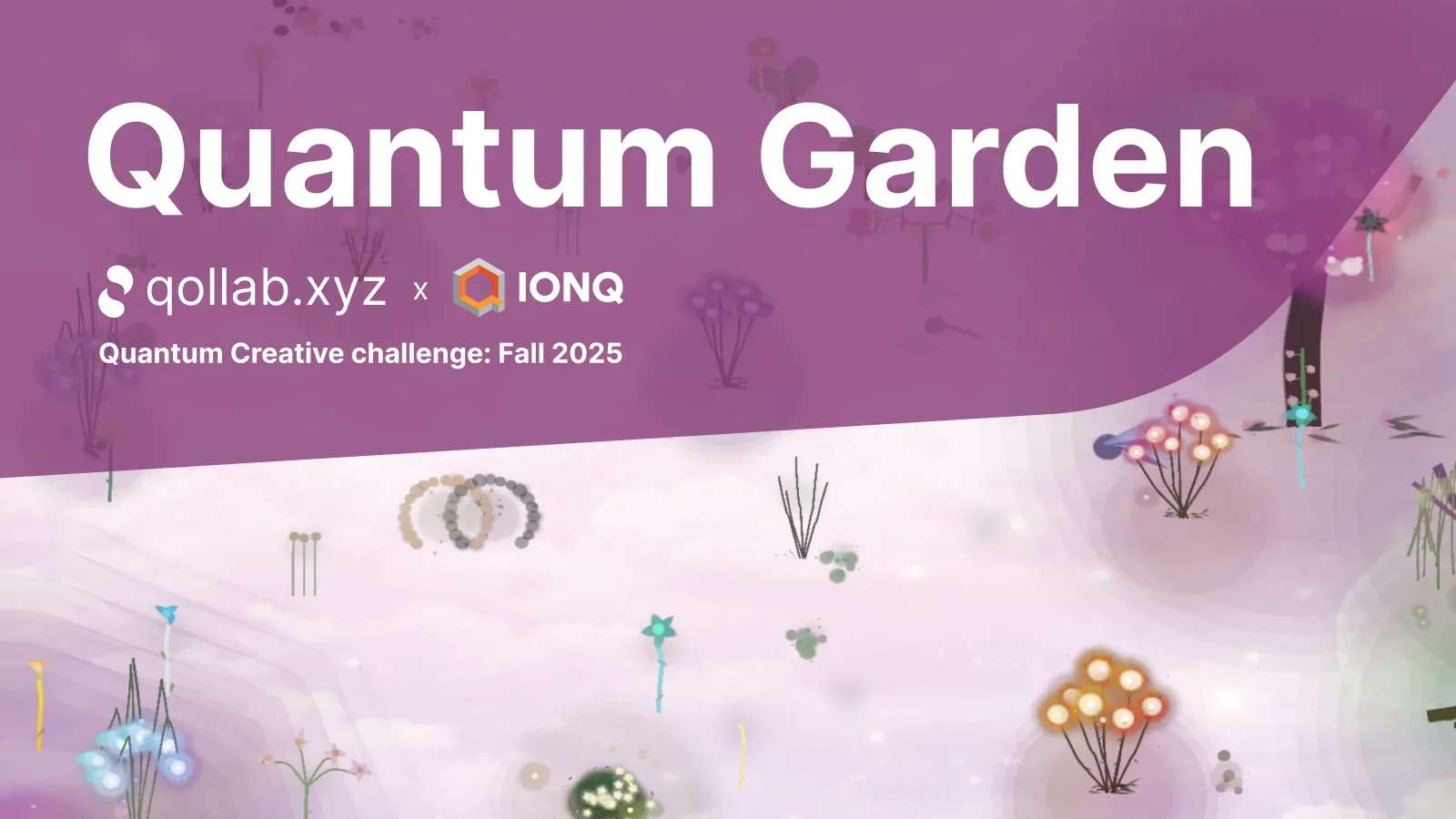
Quantum Garden is a living digital garden by Amber Wang, a data scientist, and Justin Pincar, a software engineer. Every plant gets its form, color, and behavior from a quantum measurement, drawn from a pool of 500 results run on IonQ hardware in advance, and that result is fixed into the plant the first time you look at it.
Some plants are entangled with others across the garden, so observing one tells you something about a plant you have not visited yet. And the garden keeps its own time, germinating and fading whether or not anyone is watching. The hardware's slowness, once a problem, became the reason the garden has seasons.
Working with quantum requires a different way of thinking. Classical programming is deterministic, and you get the output you expect. With quantum, you're dealing with probabilities and superpositions, not exactly random, but similar in practice.
Entangled Body: entanglement you can touch
Entangled Body, by Chanhyuk Park and Luke Shim, is a point-cloud human figure whose parts respond to each other across distance. Touch one region and somewhere else reacts; move your view and the body resolves and dissolves. Fourteen body regions map to fourteen qubits, coupled along a real anatomical graph, so a touch ripples through the figure the way entanglement ripples through a circuit.
A touch sets how strongly each region's qubit turns on, near-certain where you touched and weaker the further a region sits in the graph, and pairs of qubits are coupled with strengths taken from the anatomy: head to chest is a strong link, torso to left foot has no direct edge. The idea came before the circuit, and the measurements come back from IonQ hardware with the noise left in, so the figure never resolves the same way twice.
Entangled Body also explores how observation changes what becomes visible. We did not want it to feel like a science diagram; we wanted it to feel like an artwork first.
Luke Shim, who built the system underneath, treats that uncertainty as the material rather than a flaw.
For Entangled Body, that unpredictability was actually valuable. The project explores the idea that a digital body is constantly becoming rather than remaining fixed. Hardware noise and probabilistic measurement outcomes contributed to that feeling. Instead of treating quantum uncertainty as a problem, we treated it as part of the artistic and interactive experience.
Try one yourself
Every artwork here is open source, and you can run one in your browser right now. Fork the circuit behind it, change the parameters, and see what happens on real hardware. Start with whichever one pulled you in.
Make your own.
Fork any of the three, run its circuit on real IonQ hardware, and make it yours. Everything here is open and yours to build on.
Explore the other categories
Browse all projects
Sound & music
Learning & tools
Markets & finance
Stay in the loop.
Get the latest tutorials, demos, and project showcases straight to your inbox. No noise, just the good stuff.