Project Showcase: Musiq
Tomoya Hatanaka and Emmanuella Adams built a browser studio that turns quantum circuits into sound. Build a circuit, run it on a simulator or real IonQ hardware, and hear its quantum data become music.
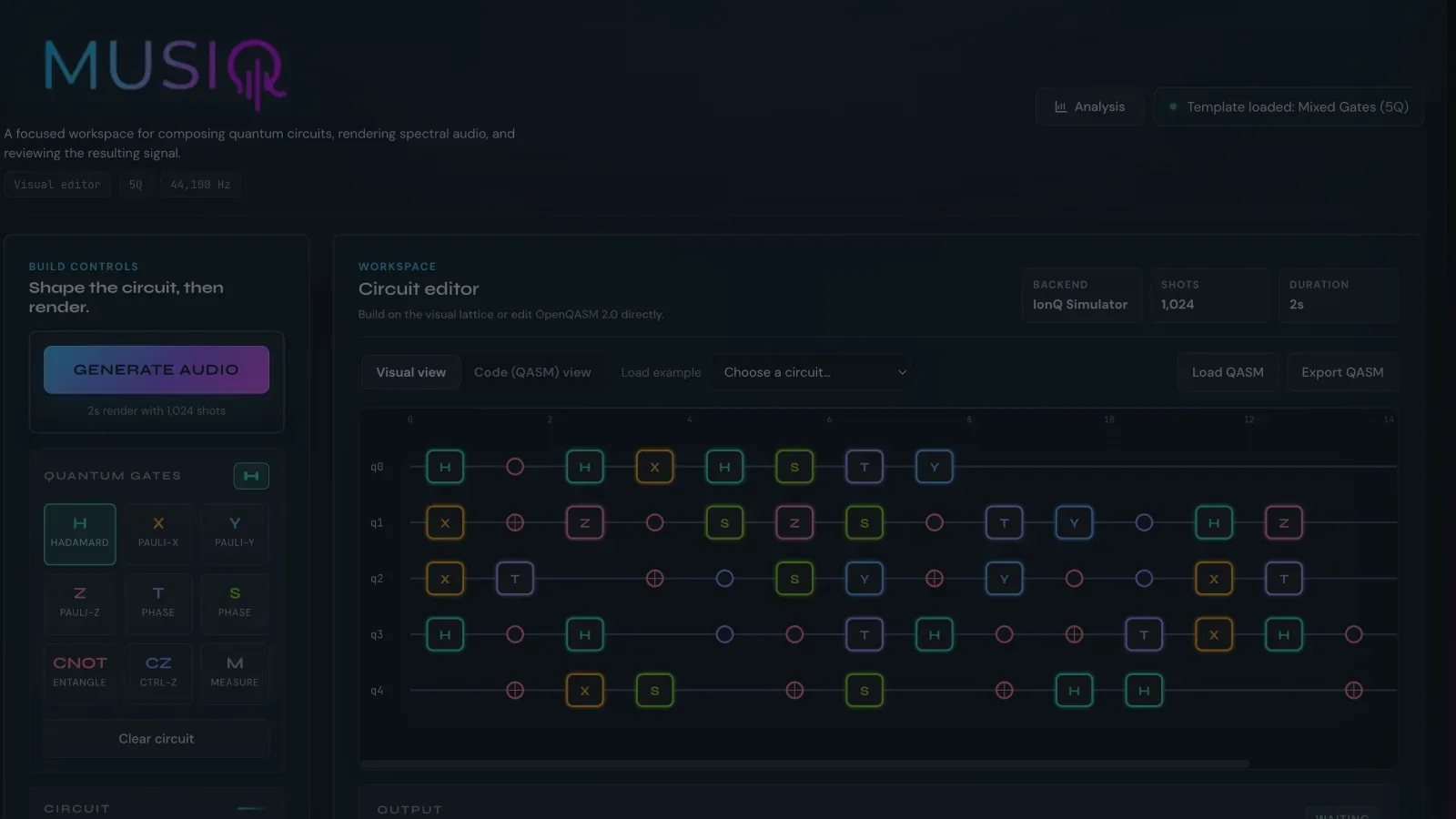
Musiq starts from a simple question: what does a quantum circuit sound like?
The answer is a browser-based quantum sonification studio. You build a circuit out of gates, or import an OpenQASM template, run it on a simulator or real IonQ hardware, and Musiq turns the resulting probabilities, amplitudes, and phases into sound you can play, visualize, and export.
Behind it was a frustration with how generative music usually works.
To overcome the repetitive nature of classical RNG-based music by directly translating the mathematical structures of quantum states into dynamic musical expression.
Built by


What a circuit sounds like
The core of Musiq is a direct mapping from quantum data to audio. After a circuit runs, its outputs are not just plotted; they are turned into the parameters of a sound. Each part of the quantum result drives a part of what you hear:
Quantum data becomes sound through a direct mapping, computed from each run.
| Field | Detail |
|---|---|
| Basis-state index | Musical frequency, which note each outcome plays. |
| Measurement probability | Strength of that frequency component. |
| Statevector amplitude | Loudness contribution. |
| Statevector phase | Oscillator phase and interference. |
| Quantum distribution | Overall spectral and tonal texture. |
Because the whole distribution shapes the waveform, different circuits sound genuinely different. A Bell or GHZ state's correlated outcomes shift the balance of frequencies. Interference-heavy IQP circuits produce dense, irregular textures with sharp peaks and valleys. Quantum-walk templates spread amplitude across many states and drift through evolving, probability-weighted tones.
Hearing a Bell state
The simplest thing you can hear is a Bell state: two qubits put into superposition and entangled, so their measurement outcomes are correlated. On Qollab the circuit runs on a simulator or a real QPU exactly as written, and the counts that come back are what Musiq turns into sound.
# 'backend' is pre-created as a global on Qollab.
from qiskit import QuantumCircuit
# A Bell state: superposition, then entanglement.
circuit = QuantumCircuit(2, 2) # 2 qubits, 2 bits
circuit.h(0)?Superposition. A Hadamard spreads the qubit across 0 and 1. In Musiq, that spread becomes the range of frequencies you hear.
circuit.cx(0, 1)?Entanglement. A CNOT links the two qubits, so their outcomes are correlated. That reshapes the distribution, and so the balance of frequencies in the sound.
circuit.measure([0, 1], [0, 1])
print(circuit)
from qiskit.providers.jobstatus import JobStatus
import time
def main(shots=100, exclude_low_probability=True, low_threshold=0.05):
job = backend.run(circuit, shots=shots)?Submits to a simulator or a real IonQ QPU through Qollab. Audio from a QPU run is derived from measurements on physical hardware.
# Poll until the job finishes
while True:
status = job.status()
print(f"Job status is {status}")
if status is JobStatus.DONE:
break
time.sleep(10)
counts = job.get_counts()?Each basis state's index becomes a musical frequency; how often it appears sets that frequency's strength.
if exclude_low_probability:
threshold = shots * low_threshold
# Filter low-probability noise
counts = {b: c for b, c in counts.items() if c > threshold}?Drops outcomes too rare to be signal, a simple hardware-noise filter, before the counts are mapped to sound.
print(f"Counts for {shots} shots: {counts}")
Musiq is open source, built to be forked and rerun.
| Field | Detail |
|---|---|
| Frontend | Web app, visual circuit editor, players, and spectrum views. |
| Quantum | Qiskit and OpenQASM 2.0, Bell, GHZ, IQP, and quantum-walk templates. |
| Backends | Local ideal simulator, IonQ simulator, or IonQ QPU. |
| Audio | Python with NumPy, SciPy, and SoundFile; WAV output plus spectral analysis. |
| Deployment | Cloud-hosted web app. |
A universal translator
Musiq is built to be a teaching instrument as much as a creative one. By comparing how different circuits sound, a learner can build intuition for how circuit design shapes quantum output, without first having to read the math.
Music serves as a universal translator, allowing users to intuitively "hear" complex quantum concepts like superposition and entanglement without relying on mathematical formulas.
Emmanuella owns the other half of that, how the studio meets someone on their first visit.
I've always lived between two worlds, code and story. So when I first encountered quantum circuits, they felt abstract and unreachable, even as someone in tech. I wanted to make them feel like something you could feel, not just calculate. Helping to design the interface for Musiq seemed like the most human bridge into that strange yet beautiful space.
That work shows up in decisions that are invisible when they go well.
The hardest part was deciding what the user actually needs to see when they first open Musiq. Quantum computing can feel alien, so every button, label, and layout had to bridge the gap between the unfamiliar and the familiar. We had to make it simple enough to feel intuitive, yet deep enough to reward curiosity.
The team is careful about what the tool is and is not. Musiq is a sonification instrument that complements the usual diagrams and equations rather than replacing them, and it is honest about its current scope: it processes a circuit's output as a whole, and does not yet assign individual qubits to separate voices or instruments. What it does do is give superposition, interference, and entanglement a sound, and a spectrum you can inspect afterward.
Where it's headed
Today Musiq generates a single layered waveform from a circuit, with a set of circuit templates and analysis tools to pick apart the result. The ambition Tomoya describes is bigger: to move from sonification toward genuine composition, using the all-to-all connectivity of trapped-ion hardware to give separate musical voices their own entangled structure.
We will scale up to 30-40 qubits on IonQ hardware, expanding from simple sound generation to the automated composition of fully structured music.
The project is also a small argument about what quantum computers are for. Most of the field points its hardware at optimization and simulation; Musiq points it at a speaker.
It proves that quantum computing can expand its use cases beyond pragmatic optimization or calculation tasks, capturing new potential for creative purposes and artistic expression.
For Emmanuella the measure is smaller and more immediate, what happens in the first minute someone spends with it.
Curiosity, not fear. Quantum computing is often presented as this impossible, gatekept thing. I want someone to hear their circuit and think, "Oh, that's mine. I made that." The feeling of creating something you don't fully understand yet. That is where learning starts.
Make it yours
Musiq is open and forkable on Qollab, the full studio is on GitHub, and you can build a circuit and hear it in your browser right now. Start from a Bell or GHZ template, or bring your own OpenQASM, and listen to how the design changes the sound.
Build a circuit. Hear what it does.
Fork Musiq, run a circuit on a simulator or real IonQ hardware, and turn its quantum data into sound. Everything here is open and yours to build on.
More from the Qollab community
Browse all projects
Stay in the loop.
Get the latest tutorials, demos, and project showcases straight to your inbox. No noise, just the good stuff.