Aalto University winners: Qollab x IonQ Hackathon 2026
The winning project from five entered at the Aalto University node.
At the Aalto University node of the Qollab x IonQ Hackathon 2026, 19 teams signed up, most of them solo. More signed up on the professional track than the student track. The online build weekend ran from 7 PM ET on October 9 to 7 PM ET on October 11. In that time, four of the 19 teams entered five projects.
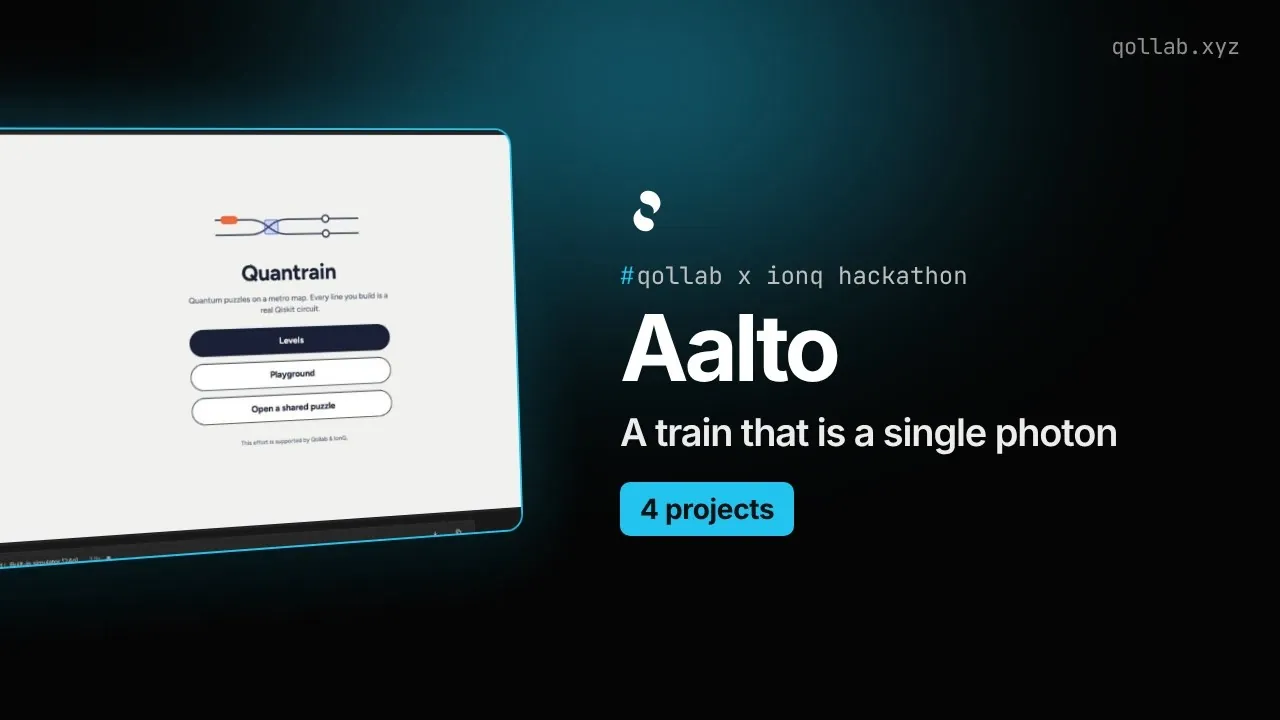
The projects range from a music duet to a check on whether a quantum cloud returns wrong answers. Every one of them is open source on Qollab.
The Aalto University node
Aalto University in Finland signed on in September. Alexandru Paler, an associate professor in Aalto's Department of Computer Science, led the node with Ioana Moflic and Huyen Do. His research covers quantum software for compiling and optimising circuits, quantum error correction and circuit simulation. Ioana is a doctoral researcher in his group, and Huyen works on his project on scalable resource estimates for Shor's algorithm.
Students at Aalto run Aalto Quantum, an association that brings students, researchers and quantum technology companies together. The university offers bachelor's and master's degrees in quantum technology, taught in English.
Three judges from Aalto University scored the projects on novelty, technical execution, impact and documentation. They were Ioana Moflic, Huyen Do and Arshpreet Maan.
Node winner: Quantrain
Quantrain is a puzzle game on a metro map, in the style of Mini Metro. Tomáš Roch, Wiktor Dowgiałło, Stefan Bia and Benjamin Voelkert built it as the team Give me a QIS. In an early brainstorm, they pictured a runner game like Subway Surfers, with the player as a photon. Then came the idea of a quantum metro, and the team built the game around trains.
The train is a single photon, and interference delivers every passenger. Each track is a qubit. A beam splitter mixes two tracks, and a station works as a which-path detector. The train rides a single rail and rotates around it, which makes a qubit's phase something a player can see. Players can also make their own puzzles and share them by link or QR code.
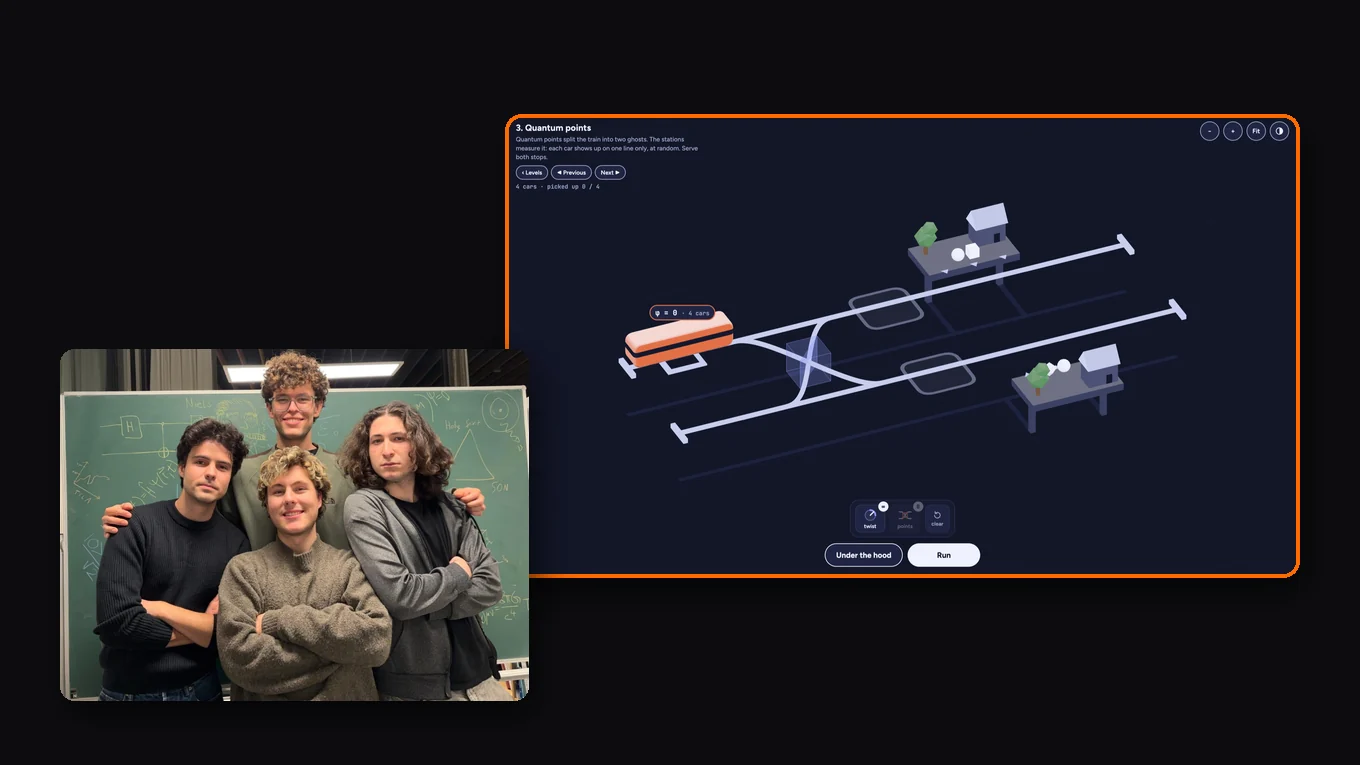
Every map is a Qiskit circuit. A run sends its shots as one job to the backend the player picks in Qollab. The game's Python engine has a JavaScript version for the browser, and the two agree gate for gate on 262 circuits.
All four builders are first-year master's students in quantum information science at the University of Copenhagen, friends since their first days in the programme. Teams picked a node when they signed up or let the Qollab team place them, and Give me a QIS entered on the professional track. Tomáš, the team's full stack developer, spent a year at SAP before moving to Copenhagen. Wiktor is a data scientist, Stefan specialises in quantum error correction and compilation, and Benjamin's background is in physics and photonic quantum computing.
Their most intense moment of the weekend was playing Swords and Sandals, a gladiator fighting game, to clear their heads. Next, they want more levels on harder topics, more languages, and releases on the App Store, Steam and Google Play. The team also entered QCog, a Qiskit library for quantum-probability models of judgement and decision making.
Before this weekend, I thought quantum computing was fun. Now I think it can be even more fun!
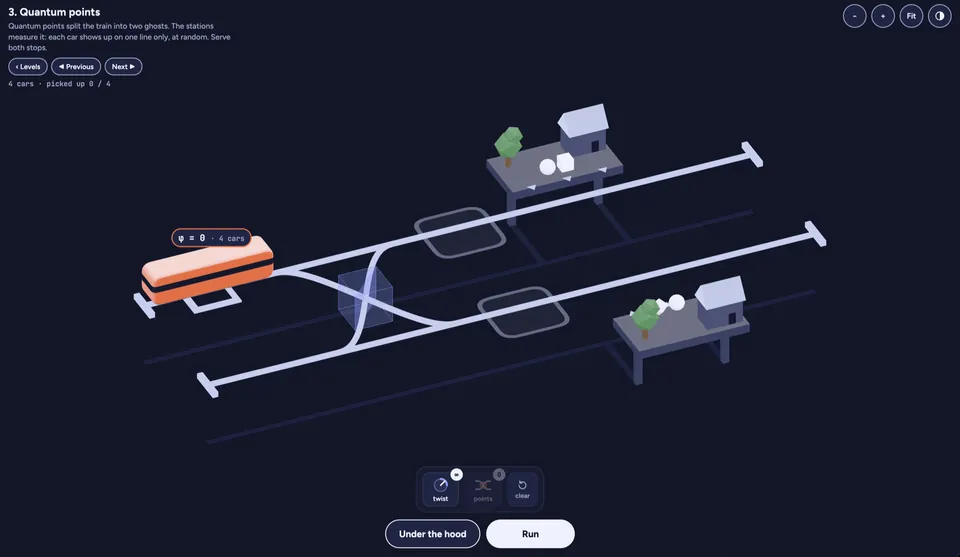 QuantrainA metro puzzle game where the train is a photon and each map is a Qiskit circuit.
Every other project from Aalto University
The other 4 projects entered at the node, A to Z.
- Canary: catch a quantum cloud that cheats: Hides Clifford trap circuits with known answers among your real Qiskit jobs, runs one batch on the backend you pick, and turns dead traps into a 95% bound on wrong answers.
- Heisenberg Chain Explorer: Explore how interacting quantum spins evolve under the 1D Heisenberg Hamiltonian.
- QCog: QCog is a A Qiskit-native library for simulating, explaining and visualising quantum-probability models of cognition, judgement, decision making and collective behaviour.
- Spooky: A daily duet for two, on one device or two.
Aalto University on Qollab
Specialty awards follow on Wed Oct 28 and global winners on Thu Oct 29, and the Hackathon 2026 results page links to every node's post.
Open any project on Aalto University's node page on Qollab to read its code, run it and fork it. You can also follow the node there. The page shows the node's numbers, its members and node team, and its hackathon projects.
 Hackathon 2026
Stay in the loop.
Get the latest tutorials, demos, and project showcases straight to your inbox. No noise, just the good stuff.
Enable JavaScript to sign up.
Qollab updates only. Unsubscribe any time. Privacy Policy.