UNICEN winners: Qollab x IonQ Hackathon 2026
Four winning projects from 19 entered at the UNICEN node.
At the UNICEN node of the Qollab x IonQ Hackathon 2026, 23 teams signed up, five of them solo. Of the 23, 15 were on the student track and 8 on the professional track. The build weekend ran from 7 PM ET on October 9 to 7 PM ET on October 11. In that time, 13 of the 23 teams entered 19 projects.
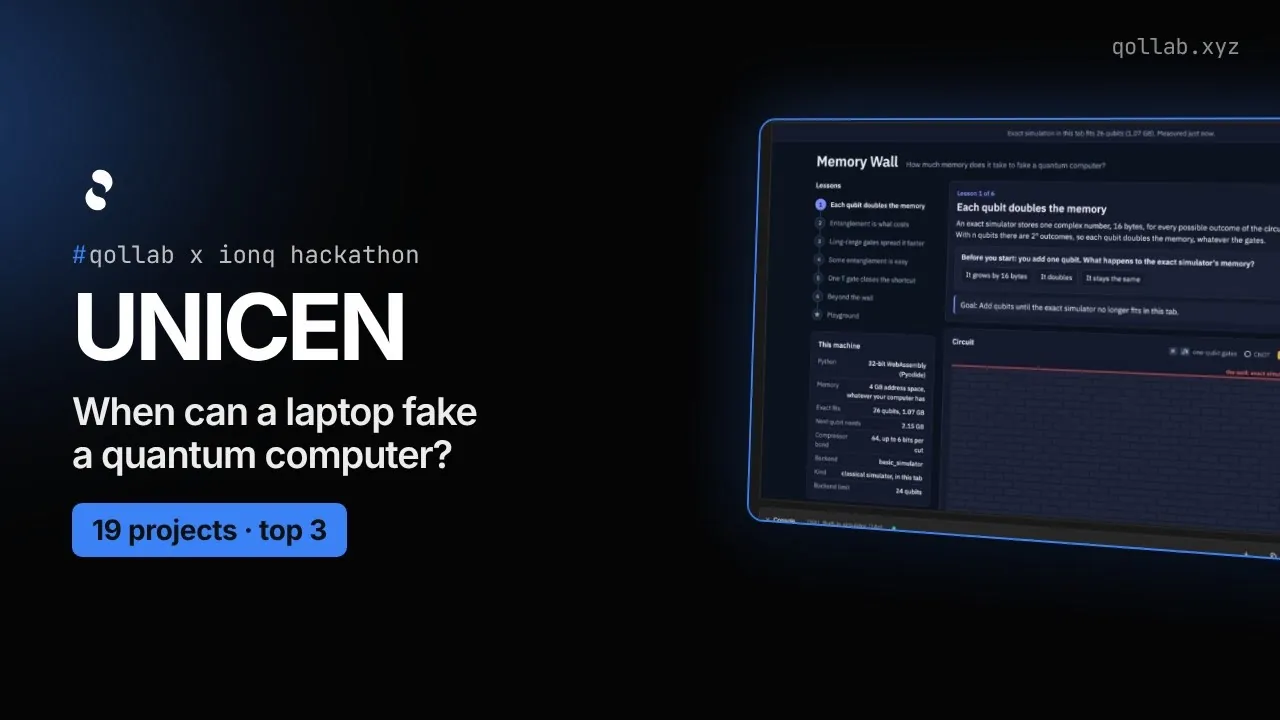
The projects range from wind farms and ambulance placement in Buenos Aires to a hydrogen atom, two card games and ZX-calculus pictures of circuits. Every one of them is open source on Qollab.
The UNICEN node
UNICEN, the Universidad Nacional del Centro de la Provincia de Buenos Aires, hosted the node at its Faculty of Exact Sciences in Tandil. Dr. Martín Vázquez, who directs INTIA, the university's institute for advanced computing research, led it with Lucas Leiva. Both are professors in the Department of Computing and Systems. Teams could build on the Tandil campus or join remotely. The node team kept a Google Meet room open for them through the weekend.
Vázquez and Leiva work in LabSET, the Tandil Embedded Systems Laboratory, which lists quantum computing among its research lines. In 2025 they taught Fundamentos de la Computación Cuántica, an undergraduate elective that also counts as a postgraduate course.
Three judges scored the projects on novelty, technical execution, impact and documentation. They were Dr. Alejandro Fernandez of LIFIA at the Universidad Nacional de La Plata, Franco Raineri of Globant and Lucas Leiva.
1st place: Memory Wall
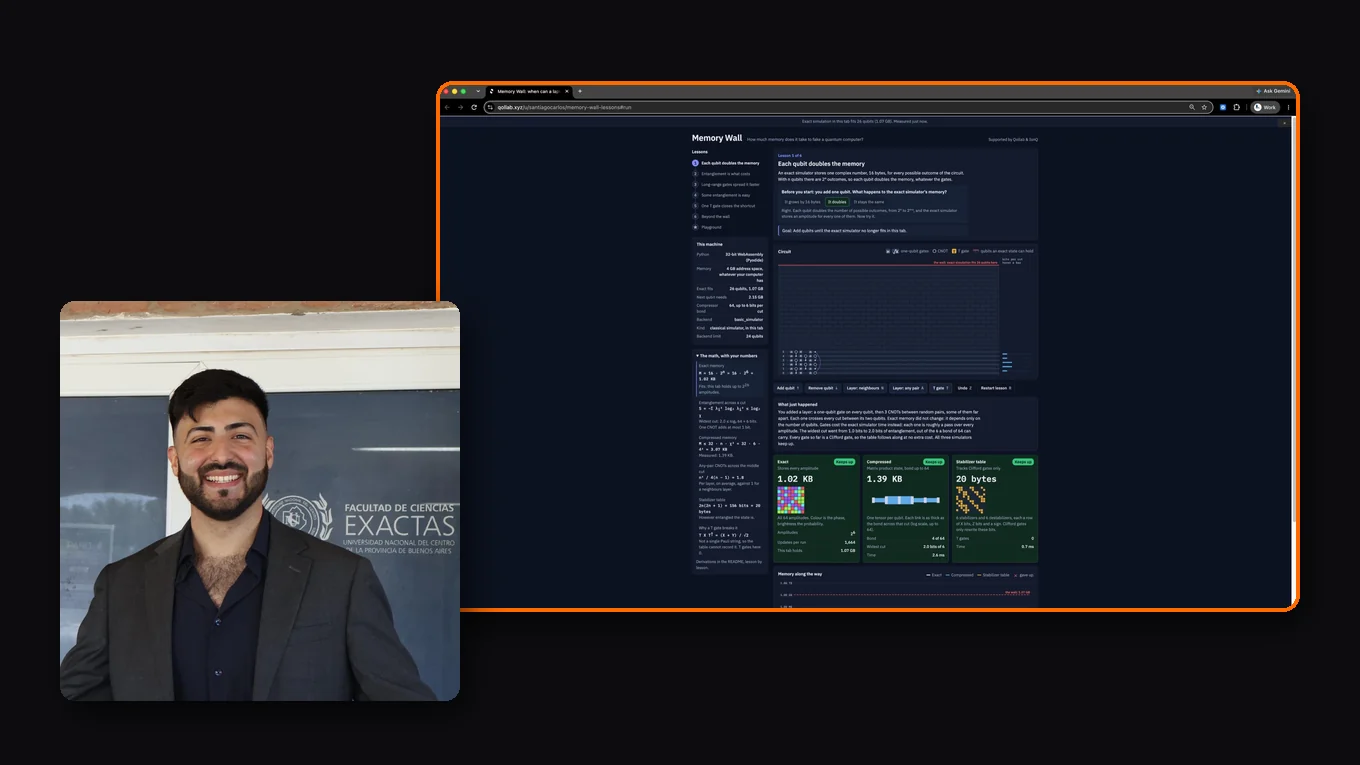
Memory Wall shows the limits a classical computer hits when it simulates a quantum computer. Santiago Carlos built it on his own: he is a UNICEN Systems Engineering graduate who works as an embedded software engineer on avionics software.
He had no quantum computing experience and spent the first hours of the weekend reading Qollab's courses and materials. In an article on superposition he read that each added qubit doubles the memory a full statevector simulation needs. His first test asked for a 27-qubit state, and NumPy said the array was too big, since Python in the browser runs in 32-bit WebAssembly. "That error was the project!"
Memory Wall lets you hit that limit yourself. In lesson 1 the exact simulator turns red at 27 qubits, when the browser tab runs out of memory. In lesson 5 a single T gate adds no entanglement and no memory, yet the stabilizer simulator can no longer simulate the circuit.
Later he sent a lesson 6 circuit, with 27 qubits and one T gate, to a real IonQ Forte. None of the simulators in his browser tab could run it. The Forte never had to store the 2²⁷ numbers they needed: it ran the circuit and returned 100 shots, all of them different bit strings. He clicked submit at 7:59 PM Argentina time, one minute before the deadline, after recording his demo video with the stock macOS apps.
Start from something you already understand. For me that was memory. My first question was how many bytes a qubit costs, and everything else came from there.
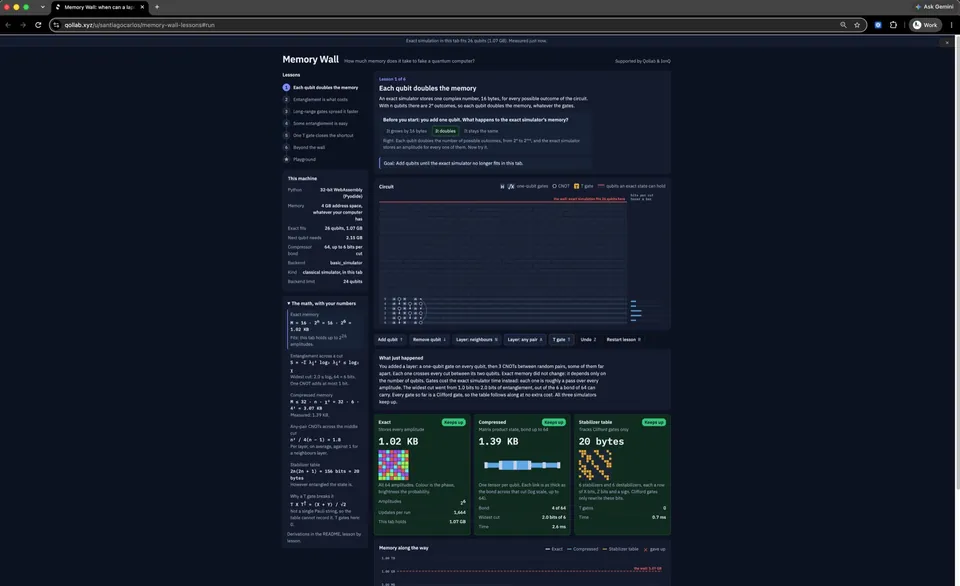 Memory Wall: when can a laptop fake a quantum computer?Browser lessons that show where compression and stabilizer tricks stop working.
2nd place: QViz
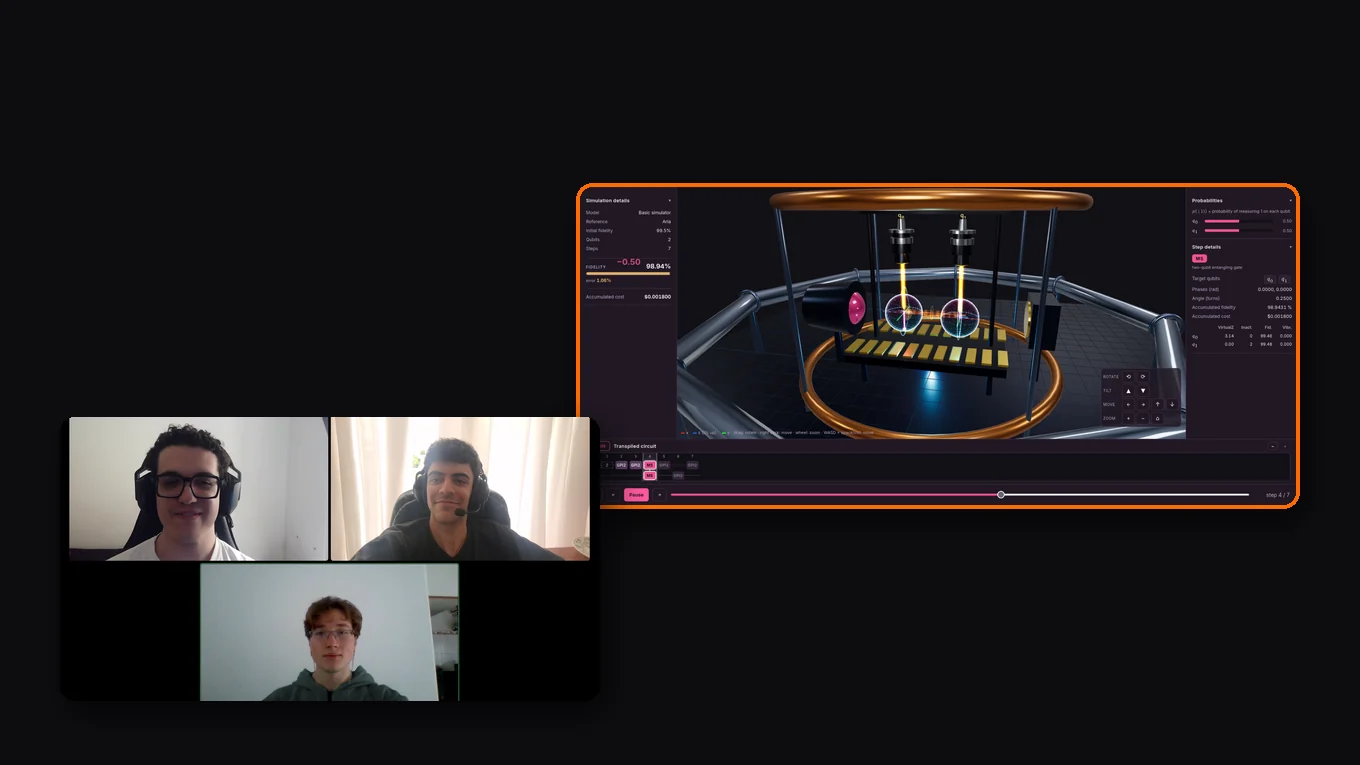
QViz shows how a circuit is transpiled into IonQ's native gates, and how each gate becomes a physical process applied to the ions. Iñaki Roumec, Victoriano Etcheverría and Agustín Buralli, team Qubit Overflow, built it as classmates in their final year of Systems Engineering at UNICEN.
While trying out Qollab they came across IonQ's options, so they read up on IonQ and the architecture of its quantum computers. "It was hard to believe that complex circuits could be transformed into such a small set of basic gates."
With two hours left, key features started throwing errors, and the team had to fix them before the deadline.
QViz is tied to IonQ's trapped-ion architecture for now, so the team suggests a fork start by adding support for other providers.
We visualize entanglement by making entangled ions vibrate in synchrony. The Bloch spheres gradually turn redder as the decoherence error increases.
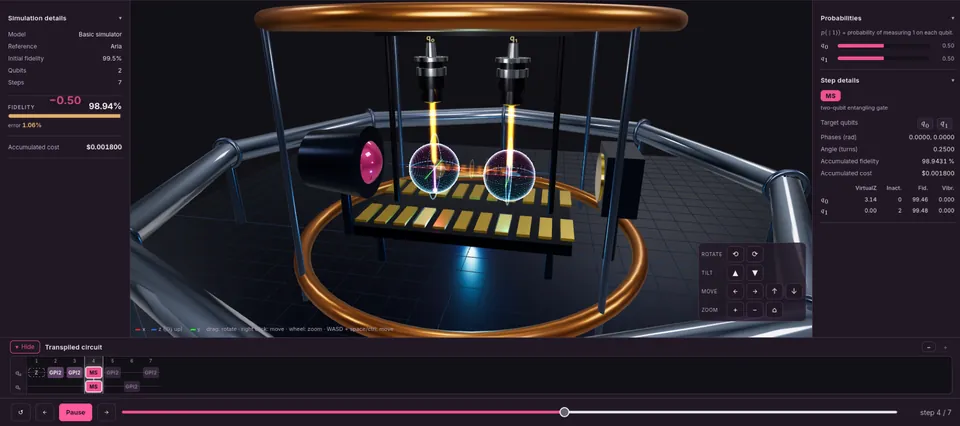 QVizAn educational visualizer for trapped-ion quantum computers, with preloaded circuits to try first.
3rd place (shared): QWind
QWind helps a wind farm that has to switch some turbines off when the power grid is full. Its quantum circuit picks which turbines keep running so they take the least wind from each other. The circuit is wired to keep exactly the number of turbines the farm asks for. The team also tested its wake model with wind patterns from Chubut and Bahía Blanca in Argentina.
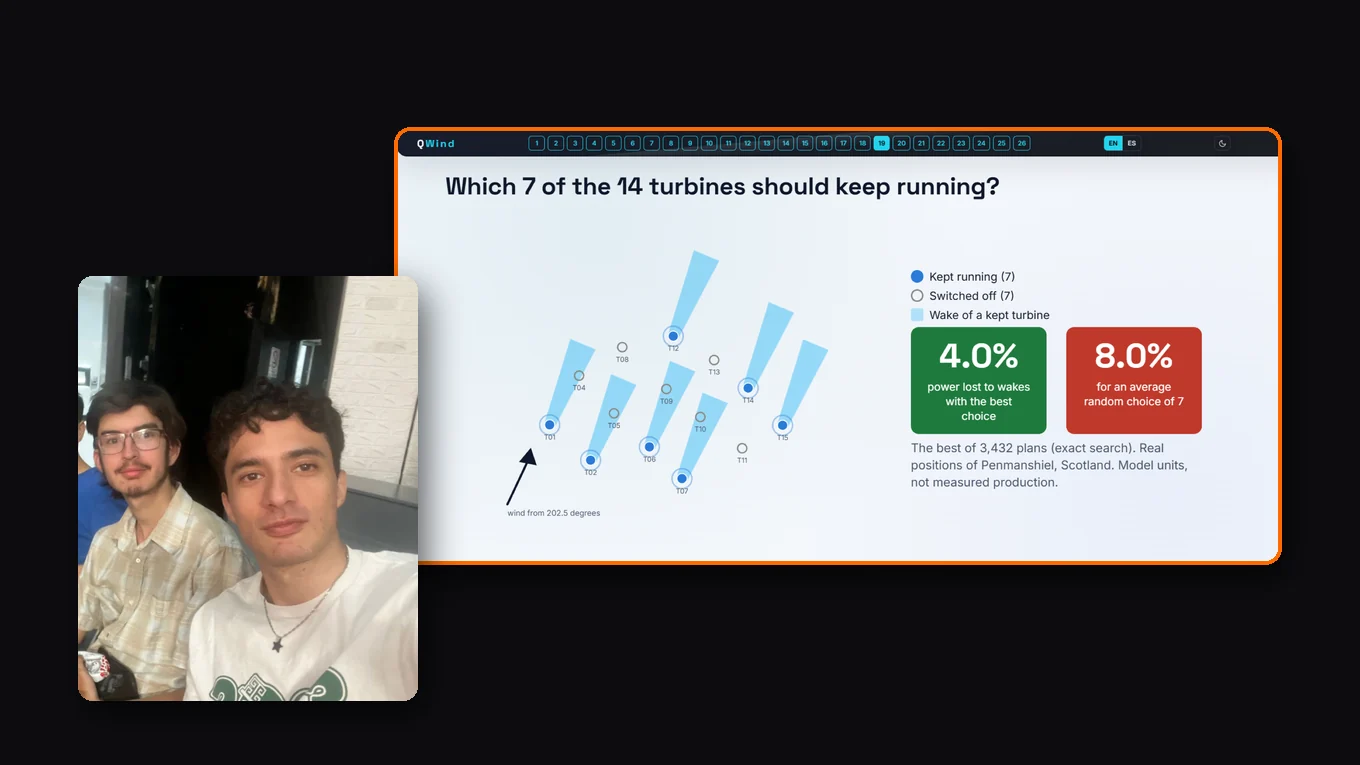
Agustin Diaz-Cano and Baltazar Salerno, the Salta Team, are friends who had worked on small projects together before. Agustin is a master's candidate in Information Systems Engineering at Universidad Tecnológica Nacional and led the quantum and backend work. Baltazar, who starts at the University of Buenos Aires in 2027, built the front end and the presentation. Teams picked a node when they signed up or let the Qollab team place them, and the Salta Team entered on the professional track.
Running code on a real quantum computer had been Agustin's dream since before he learned to program. On IonQ Forte 1 hardware, 78% of the samples kept the right number of turbines, and noise broke the rest. The team filtered those out, and the best remaining sample was the exact optimum.
Next they plan a research paper, with more hardware runs and benchmarks against industry solvers such as Gurobi. The Salta Team also entered Quantum Survivors.
I thought quantum computing was mostly a long-term research topic, something I had only tried for training robotics policies in my thesis. Now I see how symmetry-preserving circuits can model real infrastructure problems, like wind farm curtailment, and run on actual quantum hardware.
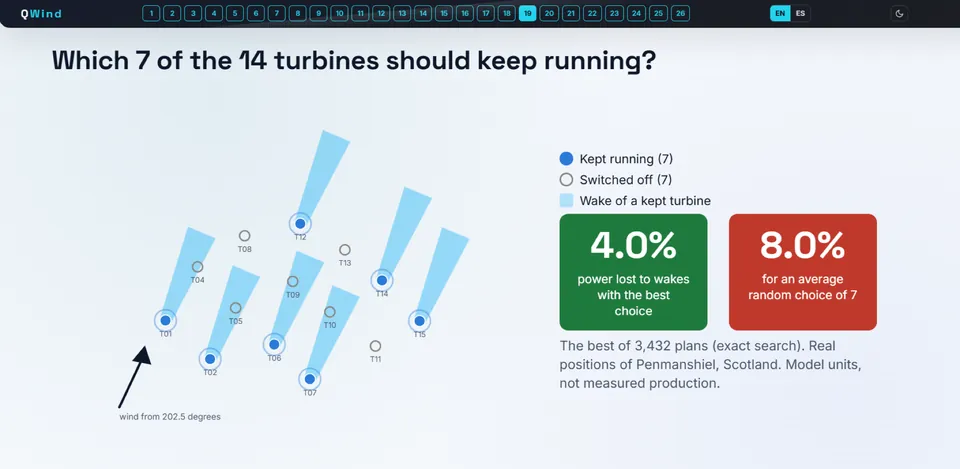 QWindA quantum optimizer for wind farms, with open data from the Kelmarsh and Penmanshiel farms.
3rd place (shared): Qriollo
Qriollo is a version of Truco, an Argentine card game, that teaches the basics of quantum computing as you play. Each player's quantum card is a one-qubit circuit that can be, say, 50% the 7 of cups and 50% the 7 of swords. Players transform the card with gate tiles. Qiskit computes every state, and measuring the card fixes it for the rest of the hand.
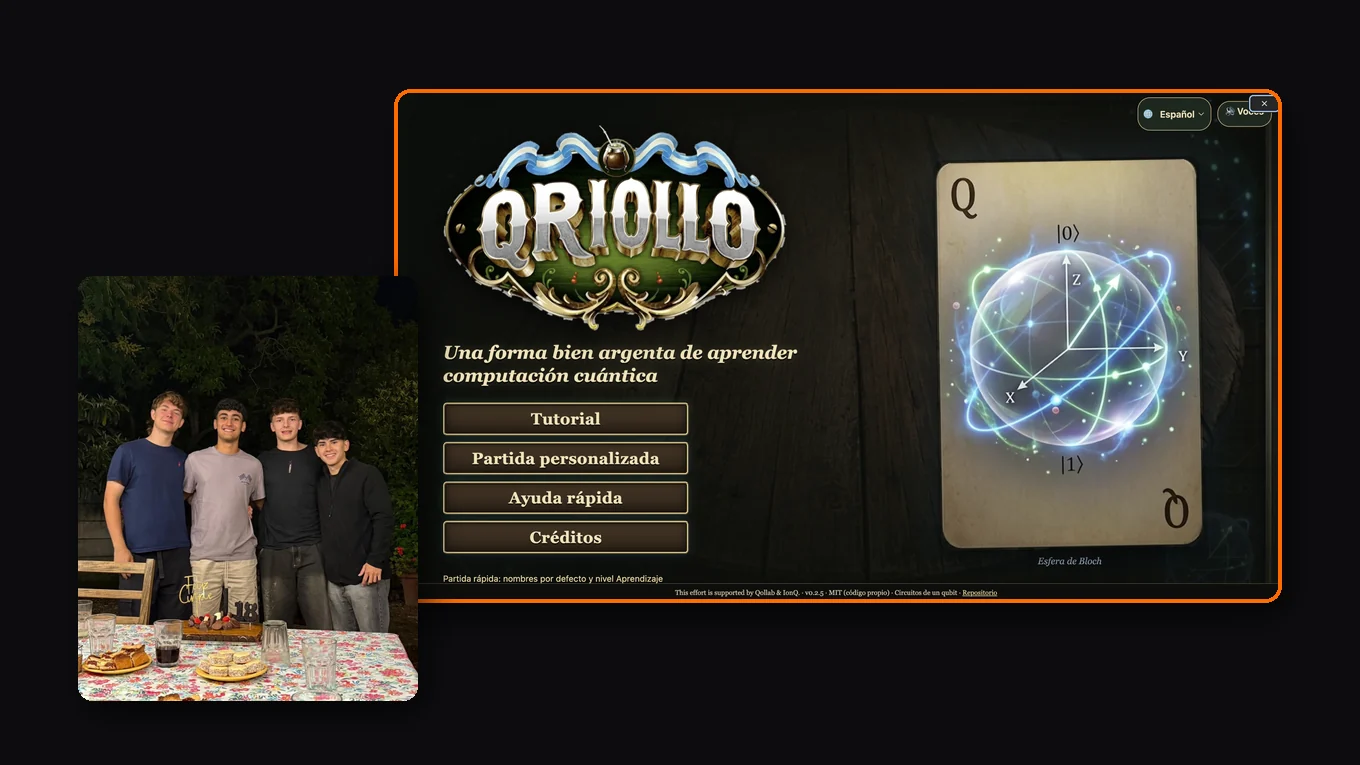
Gaspar Osterrieth, Alejo Dellape and Guido Miniero Cocco of the GIGA Team are friends from secondary school and first-year students at UNICEN. Gaspar and Guido study Computer Engineering, and Alejo studies Medicine. Gaspar saw a post about the hackathon on Instagram a week before registration closed. Qriollo was their first hands-on work with quantum computing.
Nobody on the team could illustrate. They still drew every design by hand, then refined the sketches with OpenAI and Gemini image tools.
Next they want to add entanglement by linking the two players' quantum cards, which are independent qubits today. Later they hope to apply quantum computing to medicine or biology.
Before this weekend, we thought quantum computing was beyond our intellectual reach and our abilities. Now we see it as an open world to explore and keep learning, and as part of the future of technology.
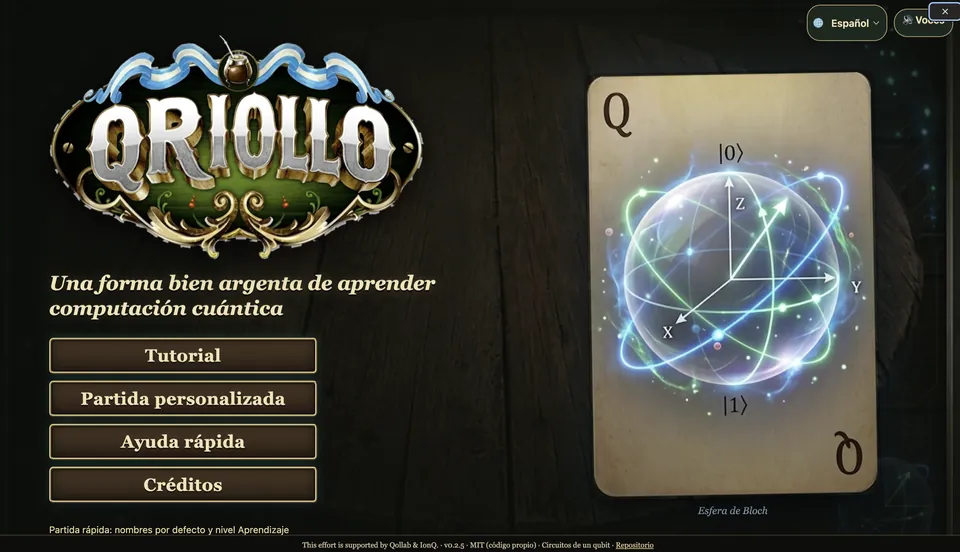 QriolloA Truco tutorial, practice games against Bot Q and two-player matches, in English and Spanish.
Every other project from UNICEN
Health care came up three times: ambulance coverage in Buenos Aires, critical medical shifts and matching branch points across two synthetic angiogram trees. Other teams applied QAOA, VQE or Grover's algorithm to travelling-salesman routes, departure times and Boolean logic. Two projects simulated atoms and molecules, from electron correlation in helium to molecular dissociation with VQE.
The other 15 projects entered at the node, A to Z.
- Ambulance Localizer: A demo of a coverage maximizing algorithm using ambulance location in Buenos Aires as an example.
- Araqnea: Araqnea is an interactive web app translating quantum circuits into Quantum Pictures (ZX-calculus).
- Atomic simulator H & He: A quantum circuit learns the hydrogen atom, and a single extra gate between the two electrons of helium shows that electron correlation is entanglement.
- Continuous parameter initialization in molecular dissociation with VQE: Simulamos la separación de moléculas con algoritmos cuánticos (VQE).
- Entangled Worlds (Mundos Entrelazados): Entangled Worlds (Mundos Entrelazados) is an interactive game where you unlock new worlds as you learn quantum computing.
- Optimización Cuántica de Celdas de Manufactura Flexible: Al aprovechar la conectividad completa (all-to-all) del procesador, el sistema resuelve las dependencias temporales y las restricciones de recursos compartidos de manera directa, minimizando el tiempo total de producción.
- Optimización Dinámica de Microrredes Híbridas y Logística de AGVs (Vehículos de Guía Automática) en: Este escenario se modela matemáticamente como un Problema de Optimización Combinatoria, se transforman las decisiones logísticas (por ejemplo: "¿Debe el robot A tomar la ruta 1 o la ruta 2?") en variables binarias.
- Proyecto: Optimización en la asignación de profesionales a turnos críticos: Optimizamos la asignación de guardias médicas críticas usando QAOA cuántico.
- qards: card game.
- Quantum boolean logic synthesis: Minimizacion de logica booleana mediante una arquitectura hibrida algortimo Quine-McClusley Clasico + formulacion QUBO resuelta con VQE en el simulador IonQ.
- Quantum Cartographer: Quantum Cartographer: map a hidden qubit in a voxel game.
- Quantum Survivors: Survival Game, rogue-like with powers based on quantum physics concepts.
- RutaQ: Constraint-Aware Departure Selection: Public-data departure selection with a reversible Grover constraint oracle.
- TSPLab: Interactive Classical & Quantum TSP Solver: An interactive TSP solver to build weighted graphs, visualize optimal routes, and compare classical optimization with a JavaScript simulation of QAOA.
- Vascular Match Lab: QUBO, QAOA & VQE: An interactive Qiskit lab for matching bifurcations across two synthetic angiogram trees.
UNICEN on Qollab
Specialty awards follow on Wed Oct 28 and global winners on Thu Oct 29, and the Hackathon 2026 results page links to every node's post.
Open any project on UNICEN's node page on Qollab to read its code, run it and fork it. You can also follow the node there. The page shows the node's numbers, its members and node team, and all 19 hackathon projects.

Stay in the loop.
Get the latest tutorials, demos, and project showcases straight to your inbox. No noise, just the good stuff.
Enable JavaScript to sign up.
Qollab updates only. Unsubscribe any time. Privacy Policy.