Project Showcase: Quantum Garden
Amber Wang and Justin Pincar built a living digital garden where every plant gets its form and behavior from circuits run on real quantum hardware.
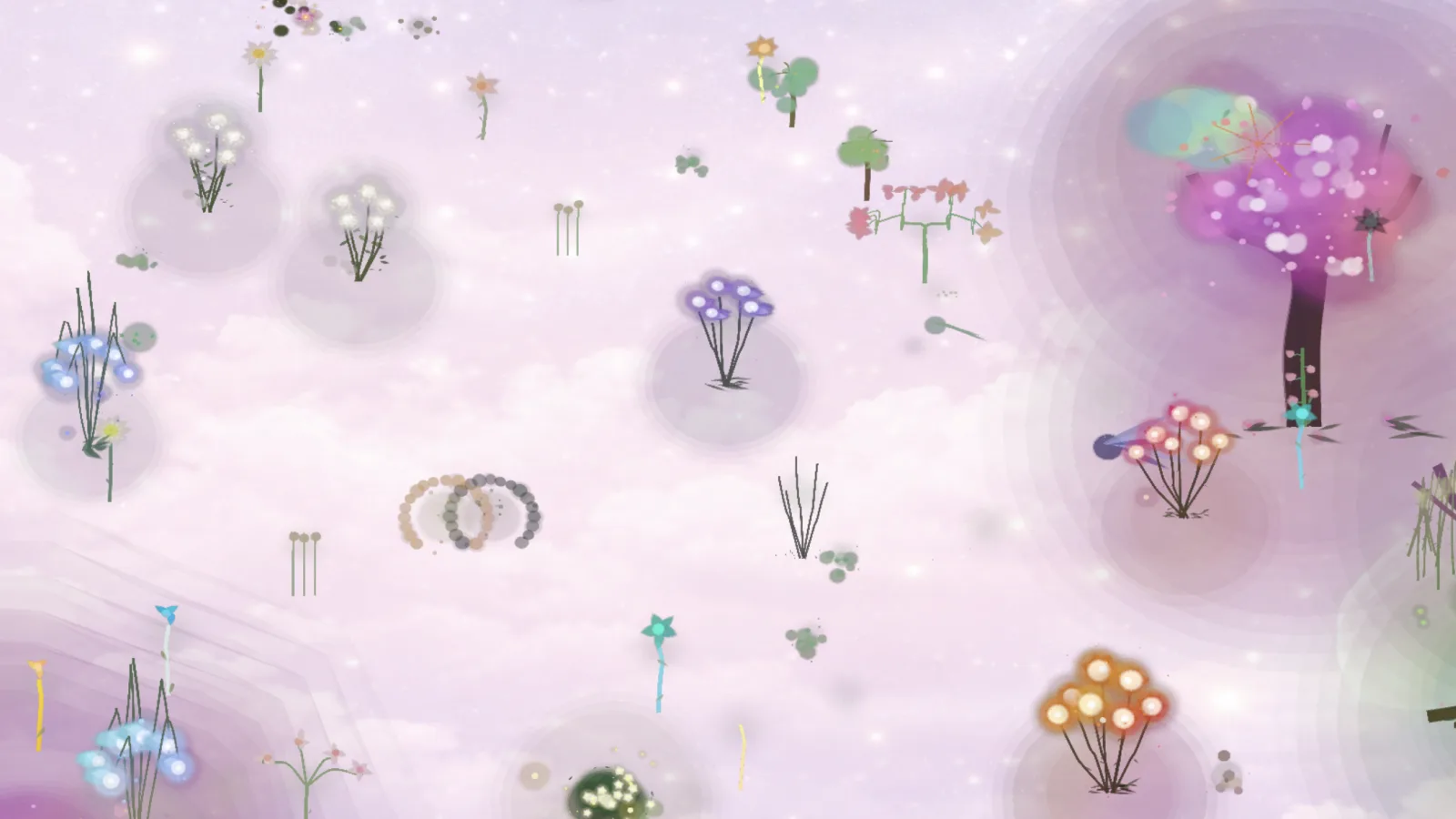
Quantum Garden is a generative art exhibit where digital plants get their form, color, and behavior from circuits run on real IonQ quantum hardware. Not simulated randomness, but actual quantum measurement outcomes baked permanently into each plant. It reframes quantum computing as a creative medium rather than a research tool.
Built by


From "out of reach" to real quantum
Neither Amber Wang nor Justin Pincar are quantum researchers. That's part of what makes this story even more interesting.
Amber is a data scientist, SEO strategist, and co-founder of PressRoom AI. She has been thinking about probability, uncertainty, and complex systems across her work in commercial real-estate analytics and AI. She's also a garden lover, which is where the concept started.
You don't need to be a physicist to do something meaningful with quantum; you need a strong concept about time, uncertainty, or connection, and a willingness to collaborate with technical partners. Think of quantum as a new storytelling and interaction medium, not just a buzzword or a black box.
Justin is a software engineer and CTO of Achievable, with a background that includes open-sourcing AdWhirl at Google and scaling it to over a billion ad impressions per day. He had been tracking quantum from a distance for years. Interested, but treating it as out of reach.
What changed that? Access. Within a few months they were able to build out their quantum art exhibit and present it to the world.
I realized that through platforms like Qollab and IonQ, you can access real quantum hardware as simply as spinning up any other cloud service. That was the moment it clicked and I realized that it was actually accessible now, not just theoretical.
The idea behind Quantum Garden
It started with a feeling. Amber, who co-created the project, has always found deep joy and peace in real gardens; the slow pace of them, the way things grow and fade without asking permission. Justin brought the technical imagination.
Together they asked: what if a garden could be powered by the actual randomness of quantum physics? Not simulated randomness. Real quantum measurement outcomes, run on real hardware, woven permanently into every plant.
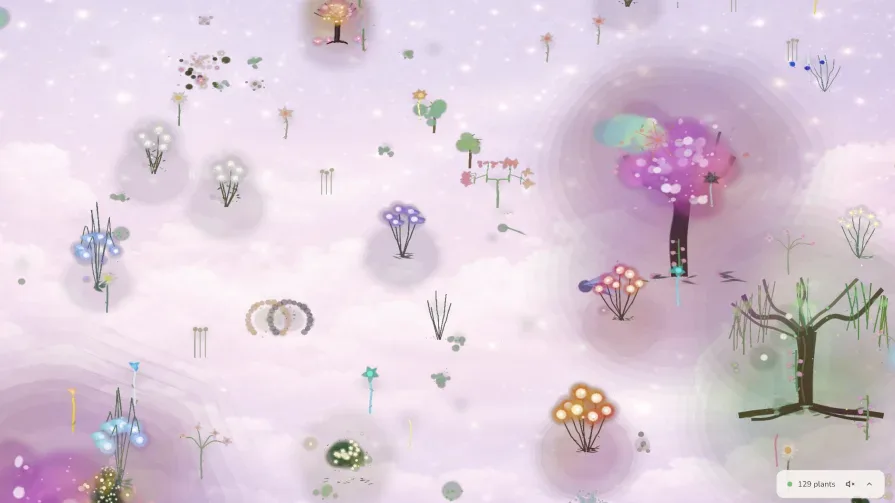
The result is an experience that teaches through presence rather than instruction. You're discovering something that was already true instead of making a choice whenever you hover over a plant.
Some plants are entangled with others across the garden; observing one reveals something about a plant you haven't visited yet. A quiet panel slides in afterward, showing the quantum circuit that shaped what you just saw, never intrusive, always dismissible.
The garden doesn't wait for you. It germinates, blooms, and fades on its own timeline. You can step away for a week and come back to find it has gone through something like a season.
How it works
Quantum Garden is built around a core design decision: instead of running quantum circuits live when a visitor arrives (which would be slow and expensive), the team pre-computes a pool of quantum measurement results in advance. Each plant draws from that pool when it's first observed.
This turned a hardware constraint, quantum circuit execution latency, into a feature. The delay became germination. The asynchronous nature of real quantum runs became the reason the garden has its own sense of time.
from qiskit import QuantumCircuit
import math
# Each plant gets a deterministic seed from its ID hash
seed = 42
qc = QuantumCircuit(5, 5)
# 1 · Full superposition — all 32 outcomes are possible
for i in range(5):
qc.h(i)?Superposition. A Hadamard on every qubit puts all 32 outcomes into play at once.
# 2 · Seed-based Ry rotations — a unique bias per qubit
for i in range(5):
qc.ry((seed * (i + 1) * 0.1) % (2 * math.pi), i)?A seed-based rotation biases each qubit, so every plant is unique but reproducible.
# 3 · Entanglement chain — correlate neighboring qubits
for i in range(4):
qc.cx(i, i + 1)?Entanglement. CNOTs link neighboring qubits, so a plant's traits become correlated.
# 4 · Cross-entanglement — non-local correlations
qc.cx(0, 2); qc.cx(1, 3); qc.cx(2, 4)
# Measure → the plant's permanent quantum fingerprint
qc.measure(range(5), range(5))
counts = backend.run(qc, shots=100).result().get_counts()?Runs on real IonQ hardware through Qollab. backend is provided for you.
Working with quantum requires a different way of thinking. Classical programming is deterministic, and you get the output you expect. With quantum, you're dealing with probabilities and superpositions, not exactly random, but similar in practice.
The rendering system went through similar problem-solving. The team started in PixiJS, hit performance walls, and rebuilt in Three.js and WebGL, with an adaptive rendering layer that progressively scales back effects based on device capability. The result has a cosmic, outer-space quality they didn't plan for but kept.
Designing for quantum means treating concepts like superposition, entanglement, and probabilistic measurement as actual creative materials, not just technical details. Instead of thinking, "What output do I want?" you're asking, "What distribution of possible states do I want, and how should people encounter those states over time?"
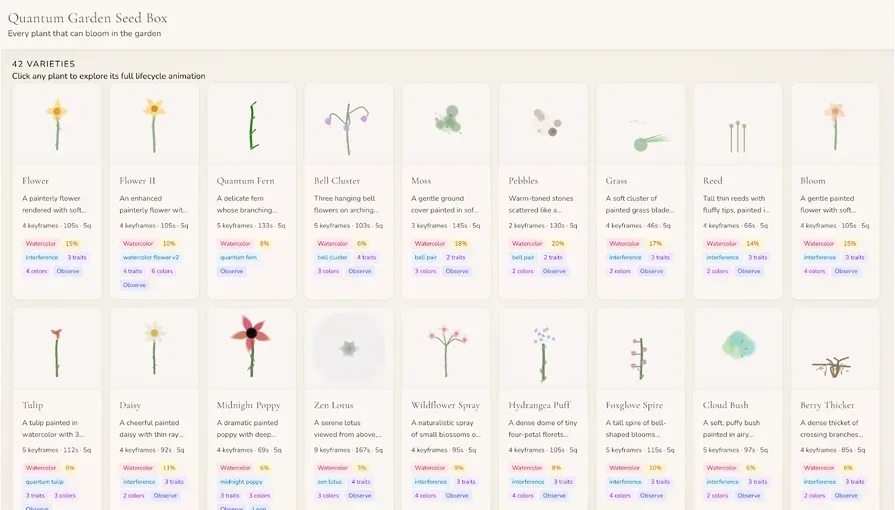
None of this is a black box. Quantum Garden is fully open source, end to end.
| Field | Detail |
|---|---|
| Stack | Next.js 16 · React 19 · Three.js · Qiskit · IonQ · PostgreSQL |
| Quantum pool | 500 authentic results, 100 from each of five circuit types: superposition, Bell pair, GHZ, interference, and the variational circuit above. |
| Observation | Traits reveal in under 50 ms, chosen deterministically from each plant's ID hash. No waiting, and no two gardens alike. |
| Evolution | Runs server-side. The garden germinates, blooms, and fades whether or not anyone is watching. |
What they'd build next
Both builders have clear ideas about where the project could go.
Justin would like to build a generative evolution system: plants combining and merging their quantum circuits to produce offspring, with circuit crossover and mutation as a metaphor for biological genetics. A quantum lineage you could trace from a two-qubit ancestor to increasingly complex descendants.
Amber wants to extend the concept into a full quantum ecosystem: weather, seasons, ambient soundscapes, and visitor traces all driven by quantum outcomes. A living world that responds to the people who return to it over time.
Neither has done it yet. The design space is intentionally left open for others to join, contribute, and add something new.
Make it yours
You don't need a PhD to build with quantum. As Amber and Justin showed, a strong concept plus access to real hardware is enough. The fastest way in is to start from a circuit that already works.
Start from a circuit that already works.
Fork the Quantum Garden templates and framework, and build your own living world on real hardware. Everything here is open and yours to build on.
More from the Qollab community
Browse all projects
Stay in the loop.
Get the latest tutorials, demos, and project showcases straight to your inbox. No noise, just the good stuff.