Project Showcase: Entangled Body
Chanhyuk Park and Luke Shim built a point-cloud body whose parts respond to each other across distance, entanglement you can see.
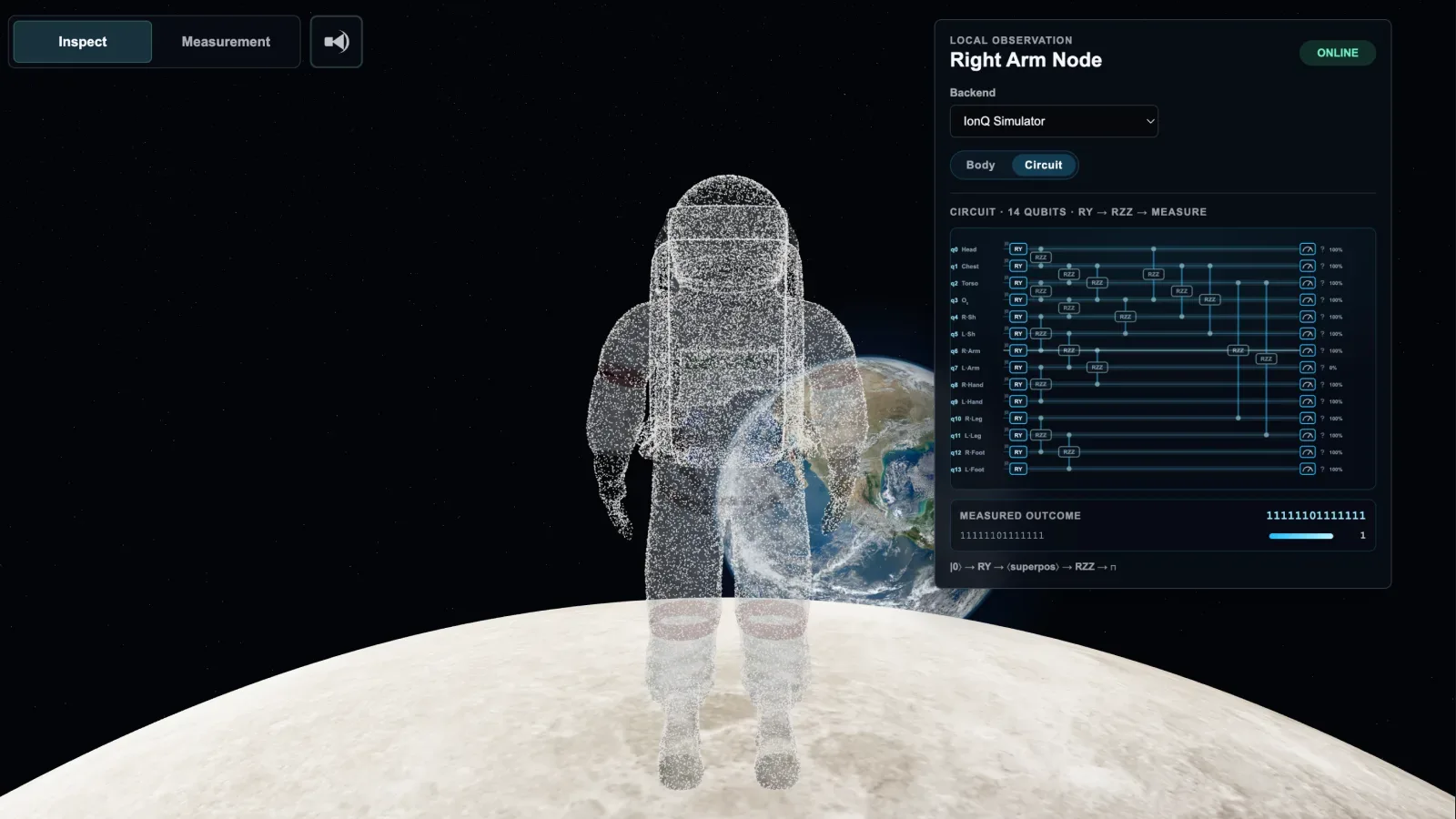
Entangled Body is a point-cloud human figure whose parts respond to each other across distance. Touch one region and somewhere else reacts; move your viewpoint and the body reveals itself differently.
Body regions are mapped to qubits. Measured bits, count distributions and correlations drive how the body activates and how strongly regions connect. They also decide how it resolves from scattered particles into a more stable form.
Once I built my own BB84 simulator and could see how measurement, basis choice, and eavesdropping affected outcomes, quantum mechanics stopped feeling like abstract physics and started feeling like a new computational medium.
Built by

An unseen connection
For Chanhyuk, the way in wasn't an equation. It was a memory of a traditional Chinese medicine clinic, and the strange logic of treating one part of the body by touching another.
I went because my wrist hurt, but the practitioner placed an acupuncture needle around my ankle. I am not making a medical claim from that experience, but it stayed with me as a metaphor for unseen connections inside the body.
Entanglement gave that intuition a name: a way to think about invisible relationships between separate things. The project grew out of that pairing, a felt idea about the body, and a quantum phenomenon that made it concrete.
A body made of relations
The figure they chose is a point-cloud astronaut on the moon, rendered as drifting particles rather than a solid form.
An astronaut cannot exist alone in space; the body depends on the suit, life-support systems, communication signals, and the surrounding environment. Rendered as a point cloud, the astronaut becomes a temporary body made of data and particles, present but constantly dissolving and re-forming.
The visual language borrows from the artist Julian Voss-Andreae, whose sculptures appear or disappear depending on where you stand. That idea, that observation changes what becomes visible, is the heart of the piece.
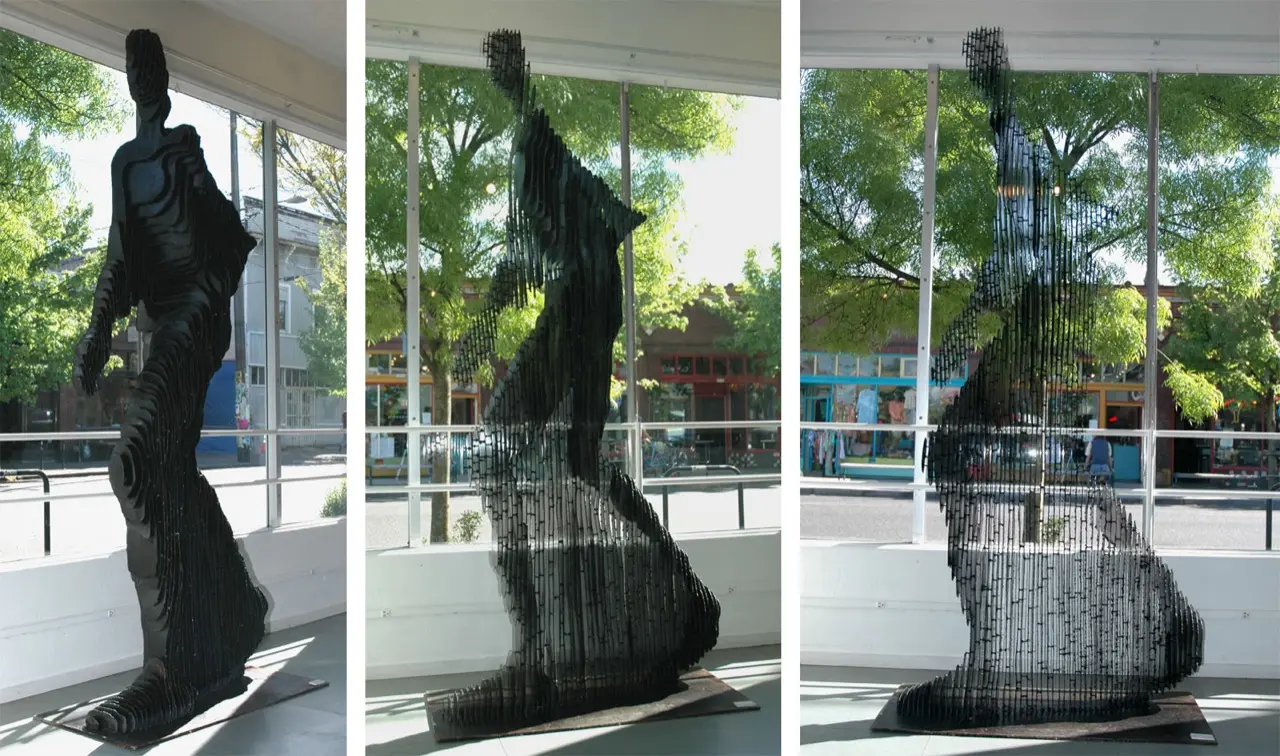
Entangled Body also explores how observation changes what becomes visible. We did not want it to feel like a science diagram; we wanted it to feel like an artwork first.
How the quantum drives the body
The quantum layer isn't only a theme; it shapes what you see. And they ran it on real hardware rather than a clean simulator.
The function that turns a touch into a circuit is compact enough to read in one sitting:
# How a touch becomes a circuit. Excerpt from entangled_body_demo.py.
from qiskit import QuantumCircuit
def build_ops(region, intensity, interaction):
"""Ops for the graph-collapse circuit anchored on the touched region."""
observed = region if region in QUBIT_OF else "torso"
distances = spatial_graph_distances(observed) # Dijkstra through the body graph
max_distance = max(d for d in distances.values() if d != float("inf"))
ops = []
for rid, qubit, _ in REGIONS:
prob = _target_probability(observed, rid, distances[rid], max_distance, intensity, interaction)
ops.append(("ry", qubit, _prob_to_ry(prob)))?One qubit per region. The Ry angle sets how "on" that region should be: near-certain at the touched point, less certain the further it sits in the anatomical graph.
for src, tgt, strength in _ranked_links(distances, interaction):
s = max(0.05, min(1.0, strength))
ops.append(("rzz", QUBIT_OF[src], QUBIT_OF[tgt], _edge_angle(s, interaction)))?Anatomical entanglement. Rzz couples two qubits with a strength taken from the real body graph: head-to-chest is a strong link, torso-to-left-foot has no direct edge at all.
return ops
def build_circuit(ops, measure=True):
qc = QuantumCircuit(QUBIT_COUNT, QUBIT_COUNT)?14 qubits, 14 regions. Head to left foot, every body part the installation tracks lives in one entangled circuit, not 14 separate ones.
for op in ops:
if op[0] == "ry":
qc.ry(op[2], op[1])
elif op[0] == "rzz":
qc.rzz(op[3], op[1], op[2])
if measure:
qc.measure(range(QUBIT_COUNT), range(QUBIT_COUNT))?The noise stays in. Run on real IonQ hardware, this measurement carries genuine hardware noise. Luke and Chanhyuk kept it rather than smoothing it away, since the body is meant to always be becoming, not fixed.
return qc
For Entangled Body, that unpredictability was actually valuable. The project explores the idea that a digital body is constantly becoming rather than remaining fixed. Hardware noise and probabilistic measurement outcomes contributed to that feeling. Instead of treating quantum uncertainty as a problem, we treated it as part of the artistic and interactive experience.
That is the move that gives the piece its texture: the noise isn't hidden or normalized away. The body is always becoming, dissolving and re-forming, precisely because the measurements vary from run to run.
Where it could go
Entangled Body is open for forking, and both builders want to push the connection between quantum behavior and the body further. For Luke, the direction is structural.
The core idea is treating quantum mechanics as part of the engine itself rather than simply a theme. I'd love to see multi-user entangled bodies that influence each other through shared quantum states, or artwork that continuously responds to live quantum measurements.
Chanhyuk wants it to leave the screen entirely: with gesture input, motion tracking, or spatial sound, the audience's own body could begin to affect the point-cloud body and become part of the work, turning it into an interactive installation or performance.
For developers coming from outside quantum, his advice is to start visual and small: tools like Three.js, p5.js, and shaders for intuition about systems and state, paired with IonQ's docs, IBM Quantum Learning, Qiskit, and PennyLane, and to pick one idea, like measurement or entanglement, and build a small visual experiment around it.
You do not always have to enter a field through its most technical door. Quantum became less intimidating when I stopped thinking of it only as equations and started seeing it as a way to think about invisible relationships, how separate parts of a body, or even separate people, can still affect one another.
Make it yours
If you want to see entanglement as something a body does rather than something an equation describes, Entangled Body is a good place to start. It is open for forking on Qollab and GitHub, with a live experience you can move through right now.
See the body that only exists in relation.
Fork Entangled Body, map your own regions to qubits, and let real measurements shape the figure. Everything here is open and yours to build on.
More from the Qollab community
Browse all projects
Stay in the loop.
Get the latest tutorials, demos, and project showcases straight to your inbox. No noise, just the good stuff.