University of Toronto winners: Qollab x IonQ Hackathon 2026
Three winning projects from 17 entered at the University of Toronto node.
At the University of Toronto node of the Qollab x IonQ Hackathon 2026, 24 teams signed up, 17 of them solo. Of the 24, 20 were on the student track and 4 on the professional track. The online build weekend ran from 7 PM ET on October 9 to 7 PM ET on October 11. In that time, 8 of the 24 teams entered 17 projects.
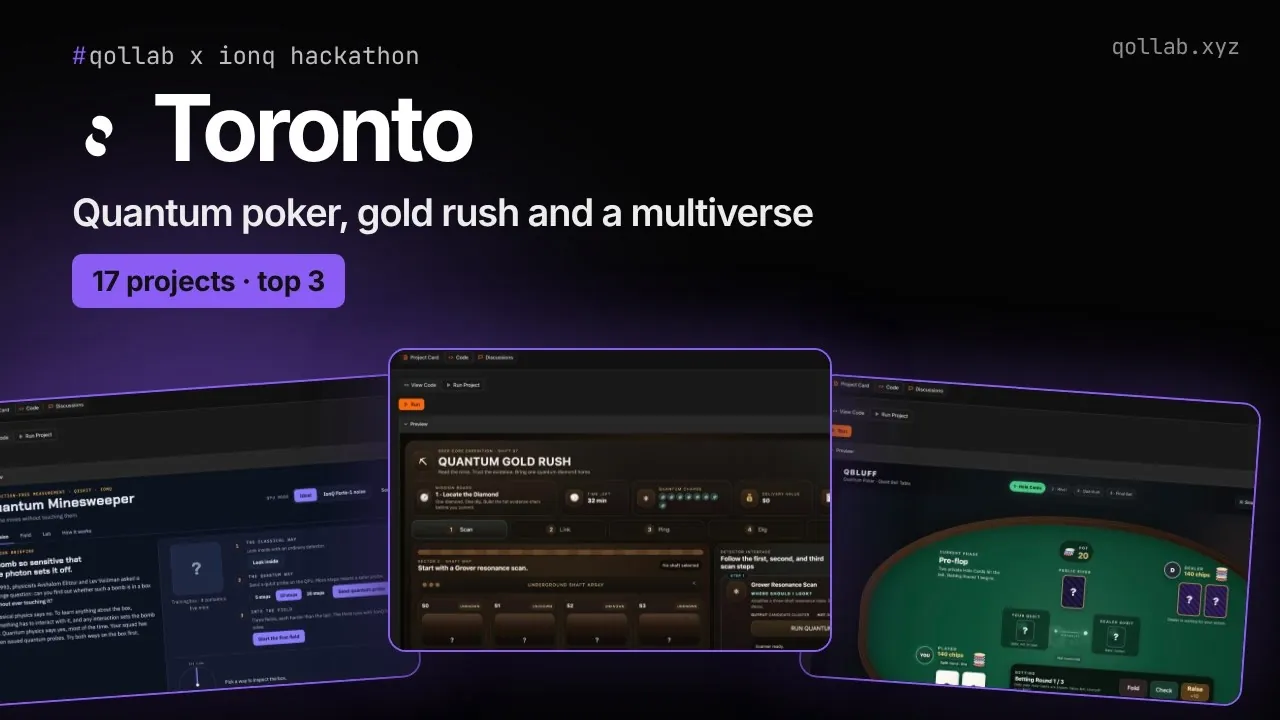
The projects range from entangled poker and a gold rush to a CubeSat shock simulation and a circuit lab you can hear. Every one of them is open source on Qollab.
The University of Toronto node
Michael Silver, president of the University of Toronto Quantum Computing Club, led the node with Kathleen Wu, who is on the club's communications team.
The club's weekly qLearn lectures teach quantum computing from the basics, with no prerequisites. The club also hosts IBM Qiskit Fall Fest, a beginner-friendly hackathon, and the annual Toronto Q-SITE Conference for undergraduate and early-graduate students.
At the university, the Centre for Quantum Information and Quantum Control runs a seminar series and coordinates graduate courses in quantum science. U of T's Master of Science in Applied Computing also has a quantum computing concentration.
The projects were scored on novelty, technical execution, impact and documentation. The node's judging panel was Michael Silver, Youssef Rachad and Maforikan Amoussou.
1st place: Band Gap Lab
Band Gap Lab predicts how much energy a molecule needs to absorb light. Whether a material works in a solar panel or an LED depends on that number. Mohamed Mahrous built it on his own. He is a third-year PhD candidate in Electrical and Computer Engineering at U of T, where he studies energy storage with atomistic modelling.
Quick, cheap methods get this wrong: they show the energy gap disappearing when a bond stretches, though in reality it stays open. Band Gap Lab computes the gap with a quantum algorithm for a few molecule shapes and predicts the rest with machine learning.
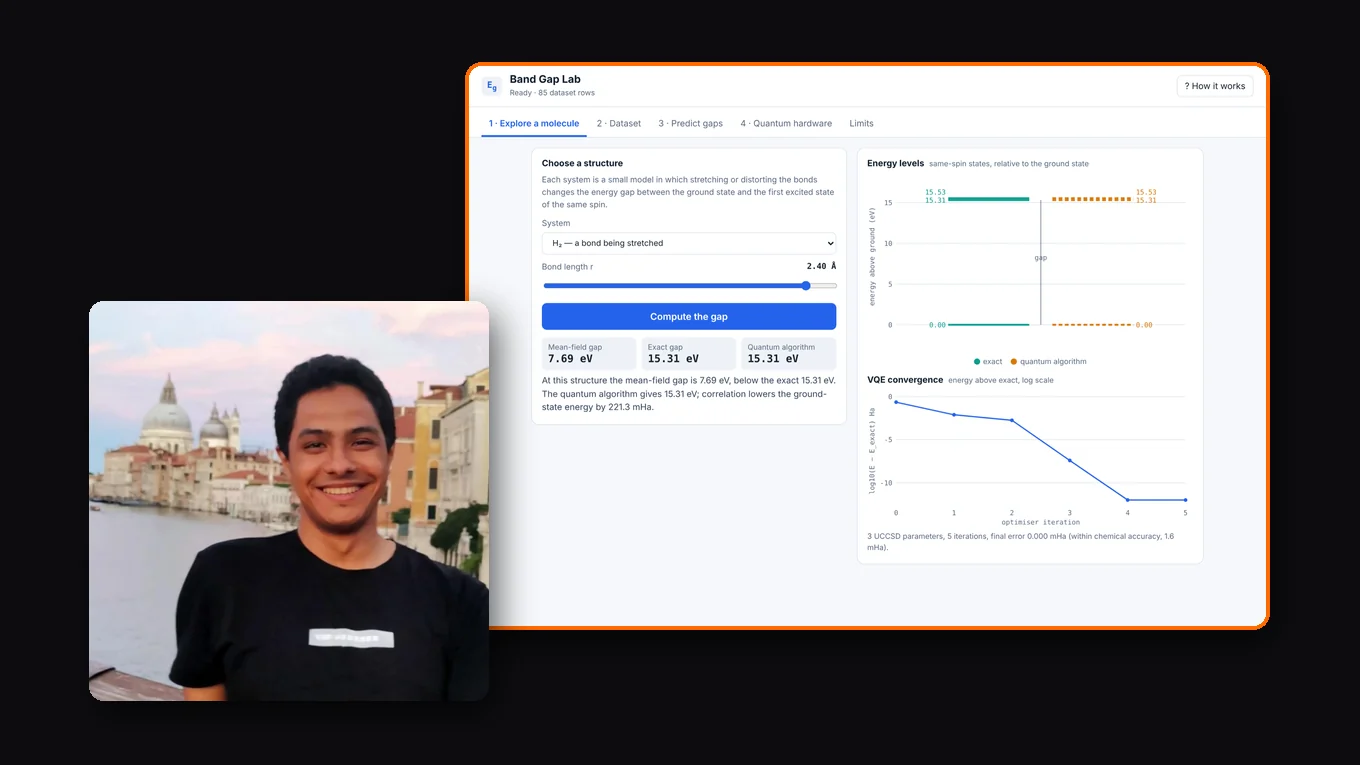
Measuring the energy of H₂ normally takes five separate jobs, and an IonQ backend on Qollab accepts one per run. So Mohamed placed five copies of the state side by side in one 24-qubit circuit, each measured in its own way. The last four qubits check the readout, with two left at zero and two flipped to one. What comes back shows how often the device misreads a bit, and Mohamed corrects the result for it.
On Saturday night, Mohamed saw that his plan was too ambitious. He dropped the extra dashboard features and spent the remaining time on the core quantum and machine learning engine. Next he wants to go from three molecules to dozens, since the model fails on molecules it has not seen. More examples would show whether that is a real limit. He also entered Learn the Qubit.
I worked alone, so the complement came from my own mix of backgrounds. My PhD is in molecular simulation, which gave me the chemistry and the instinct to distrust a cheap method that looks right.
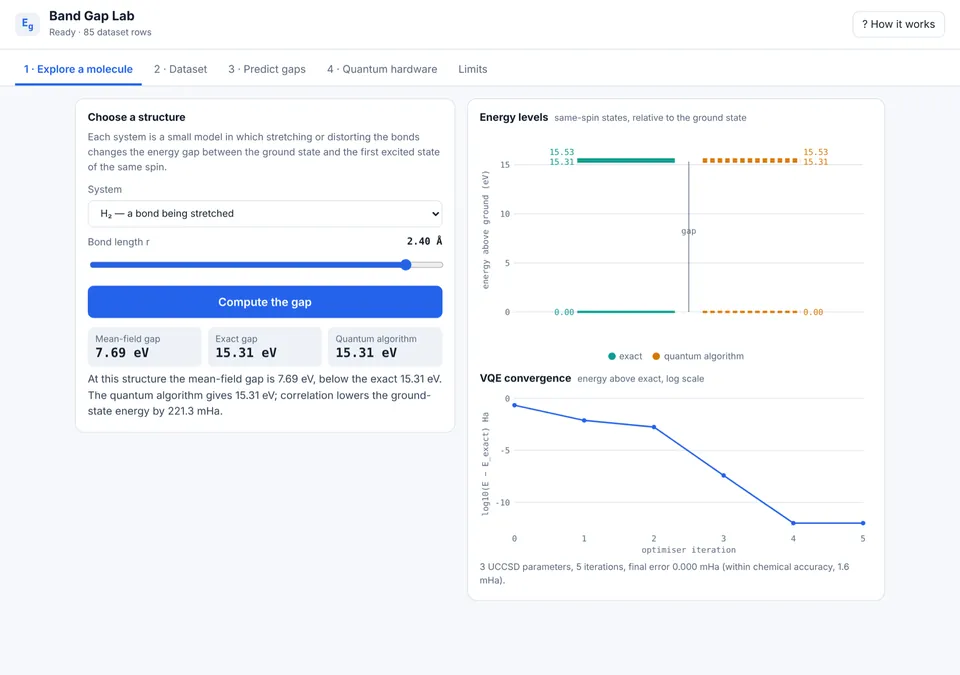 Band Gap LabA browser lab that tracks the band gaps of H₂, HeH⁺ and H₄ as their bonds stretch.
2nd place: Grid-Security-Quantum
Grid-Security-Quantum is a pipeline that detects attacks on the communication layer of a smart grid, entered by team Q-One (jumaana on Qollab). A quantum kernel SVM sorts flows from the CIC-IDS2017 network traffic dataset into benign traffic and eight types of attack. The kernel's quantum part, a ZZ feature map, runs on a simulator. The team's question is whether the quantum model, which makes different mistakes from the classical baseline, holds up better under noise.
When the detector raises an alert, an agent looks up related vulnerability records (CVEs) and checks them against CISA's Known Exploited Vulnerabilities catalog. It maps the attack to a MITRE ATT&CK technique and writes a short explanation an analyst can act on.
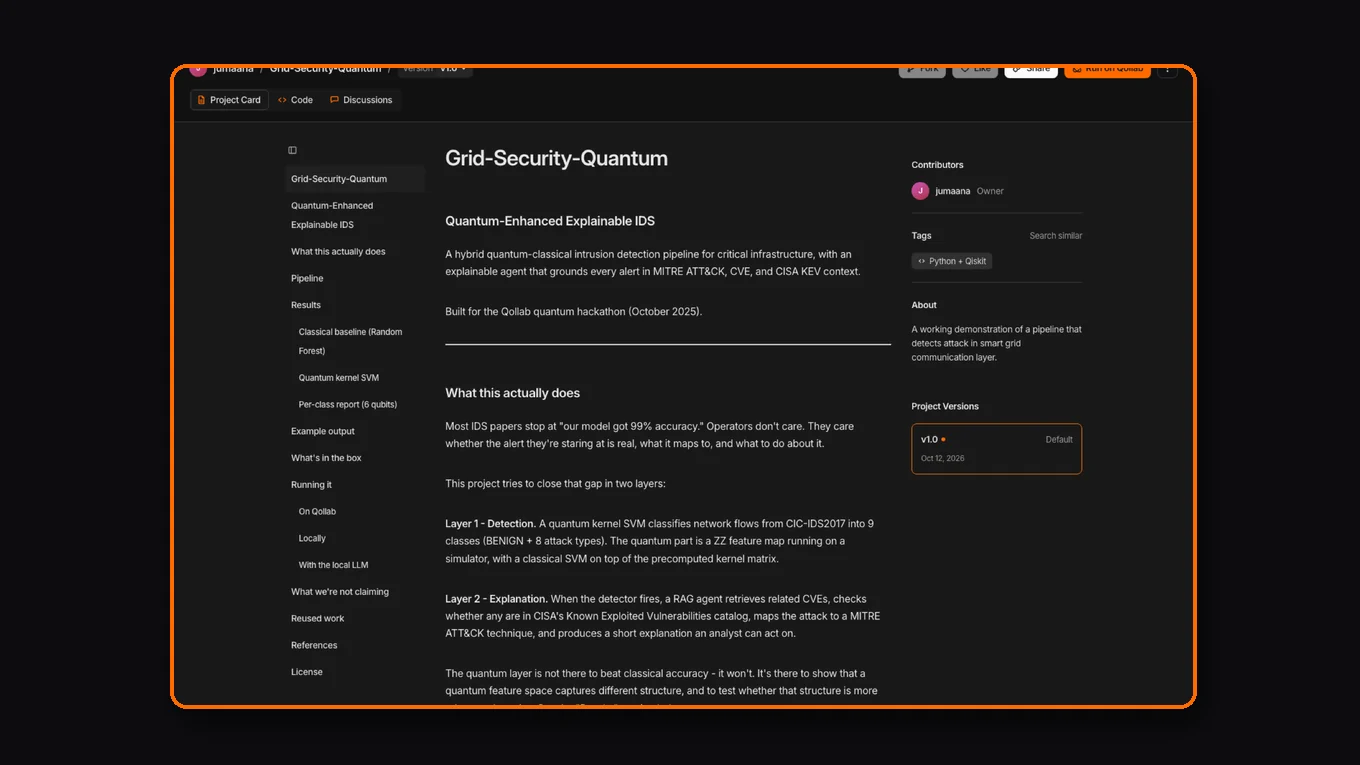
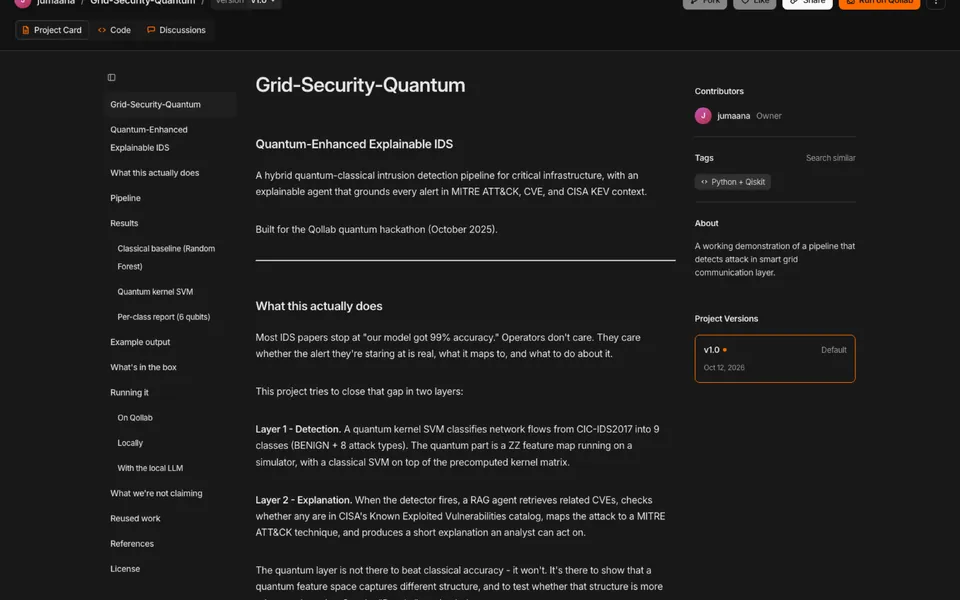 Grid-Security-QuantumDetects DoS, brute-force and port-scan attacks in network traffic, with a threat-intelligence note on every alert.
3rd place: Is it quantum?
In Is it quantum?, two machines say they ran the same five-qubit circuit, and you pick the real one. Dhiraj Kavuri built it on his own. He is an indie founder and product builder at Simon Fraser University, making iOS apps, SaaS products and AI tools. Teams picked a node when they signed up or let the Qollab team place them, and he entered on the professional track.
Dhiraj's idea started with quantum supremacy claims. "Every few years a lab announces that its quantum computer did something no supercomputer could, and the proof rests on one number. I wanted to know what that number measures, and whether a machine that never ran the circuit could fake it."
The game then scores the two machines with linear cross-entropy benchmarking, the test behind those claims. The peeker, one of three fakers that try to beat the test, works out the answer in advance and scores higher than the real machine.
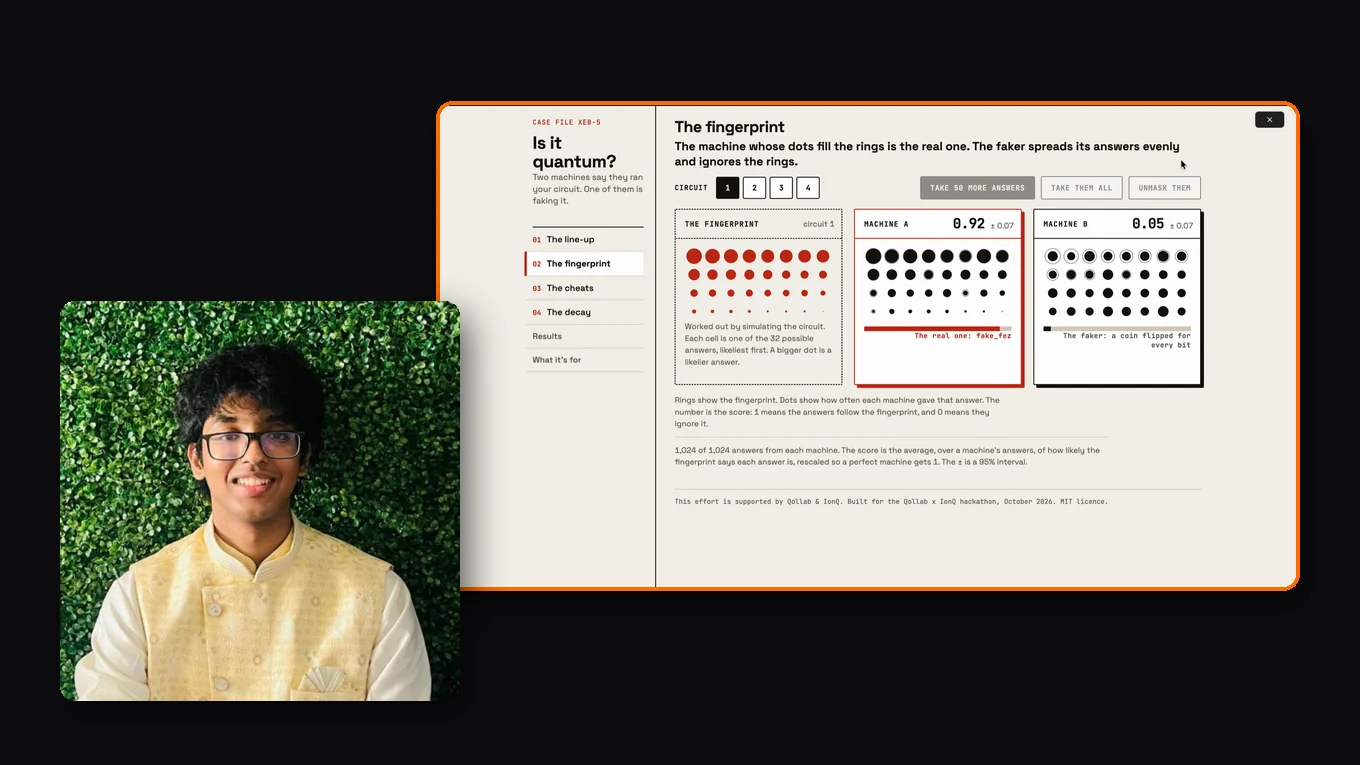
Dhiraj's first version was wrong about its own premise. At five qubits you can tell the machines apart by eye, because the real one repeats answers about twice as often as a coin. The page now counts repeats after every guess and explains why the trick stops working at 53 qubits. Next he plans a second test to catch the cheater the score misses, and a box for scoring results from your own quantum job. He also entered Legal Tender.
Before this weekend, I thought quantum computing was proven by running something impossibly hard. Now I know a lot of the work goes into proving the machine ran it at all.
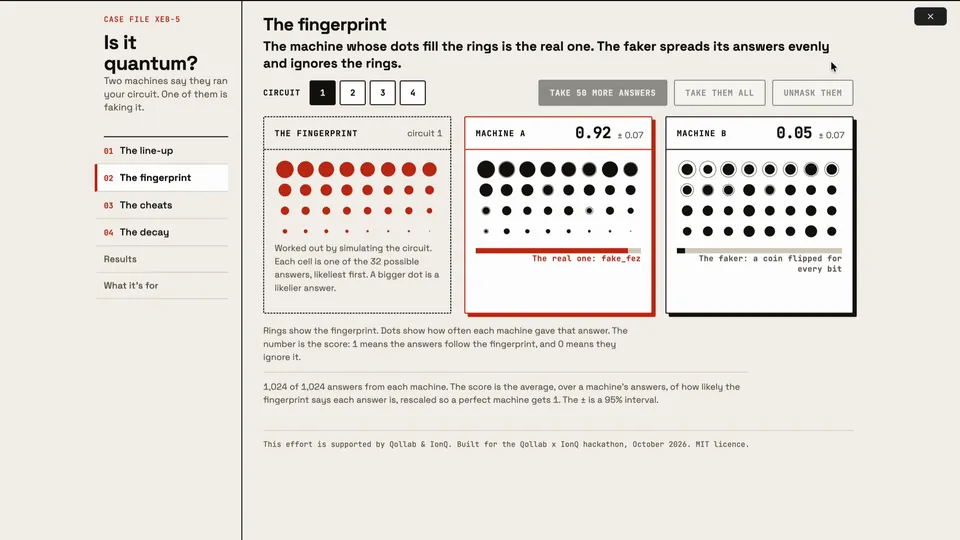 Is it quantum?A browser game about how you catch a faked quantum result.
Every other project from the University of Toronto
Many of the node's other projects are games: players sweep for mines with a quantum probe or team up to escape a vault.
The other 14 projects entered at the node, A to Z.
- Bell's Bluff : Poker, but the Cards Are Entangled: A playable quantum poker game where entanglement, hidden gates, measurement basis, and collapse become betting mechanics.
- Learn the Qubit: An interactive game: a qubit is hidden on the Bloch sphere.
- Legal Tender: A forgery game with a proof inside.
- Quantum by Ear: A quantum circuit lab you can use without seeing it.
- Quantum Gold Rush: Quantum Gold Rush is a quantum prospecting game built with Qiskit where Grover search narrows the mine, entanglement links the clues, and measurement forces you to choose between information and preserving a valuable quantum state.
- Quantum Minesweeper: Minesweeper with a quantum probe that finds mines without touching them.
- Quantum Simulation of Pyroshock: Will a CubeSat's battery and instrument survive the separation shock?
- Quantum supersampling of supermassive black holes: Watch a black hole render itself twice: classical Monte Carlo on one side, quantum amplitude estimation on the other.
- Repeater Run: entanglement from Toronto to Montreal: A puzzle game that teaches quantum repeaters: swap and purify entangled pairs over a 540 km fibre route and beat the repeaterless bound.
- Split Vaule: Escape with Quantum: Split Vault turns entanglement, teleportation, and quantum interference into a cooperative puzzle adventure.
- The Multiverse Foundry: An interactive 8-qubit quantum world where 256 complete realities coexist.
- Traffic Quantum Optimization (QAOA & QUBO): A small-scale Toronto-style traffic signal scheduling demo using QUBO and constrained QAOA.
- VQA Playground: VQA Playground is an interactive Variational Quantum Algorithm dashboard that visualizes circuit runs and lets users configure settings.
- Why More Shots Stop Helping: a C-F Quantum Chemistry Audit: Separates circuit error from measurement error along a C-F bond stretch in CH3F.
University of Toronto on Qollab
Specialty awards follow on Wed Oct 28 and global winners on Thu Oct 29, and the Hackathon 2026 results page links to every node's post.
Open any project on University of Toronto's node page on Qollab to read its code, run it and fork it. You can also follow the node there. The page shows the node's numbers, its members and node team, and all 17 hackathon projects.

Stay in the loop.
Get the latest tutorials, demos, and project showcases straight to your inbox. No noise, just the good stuff.
Enable JavaScript to sign up.
Qollab updates only. Unsubscribe any time. Privacy Policy.