University of Barcelona winners: Qollab x IonQ Hackathon 2026
Three winning projects from 11 entered at the University of Barcelona node.
At the University of Barcelona node of the Qollab x IonQ Hackathon 2026, 26 teams signed up, 20 of them solo. Of the 26, 13 were on the student track and 13 on the professional track. The online build weekend ran from 7 PM ET on October 9 to 7 PM ET on October 11. In that time, six of the 26 teams entered 11 projects.
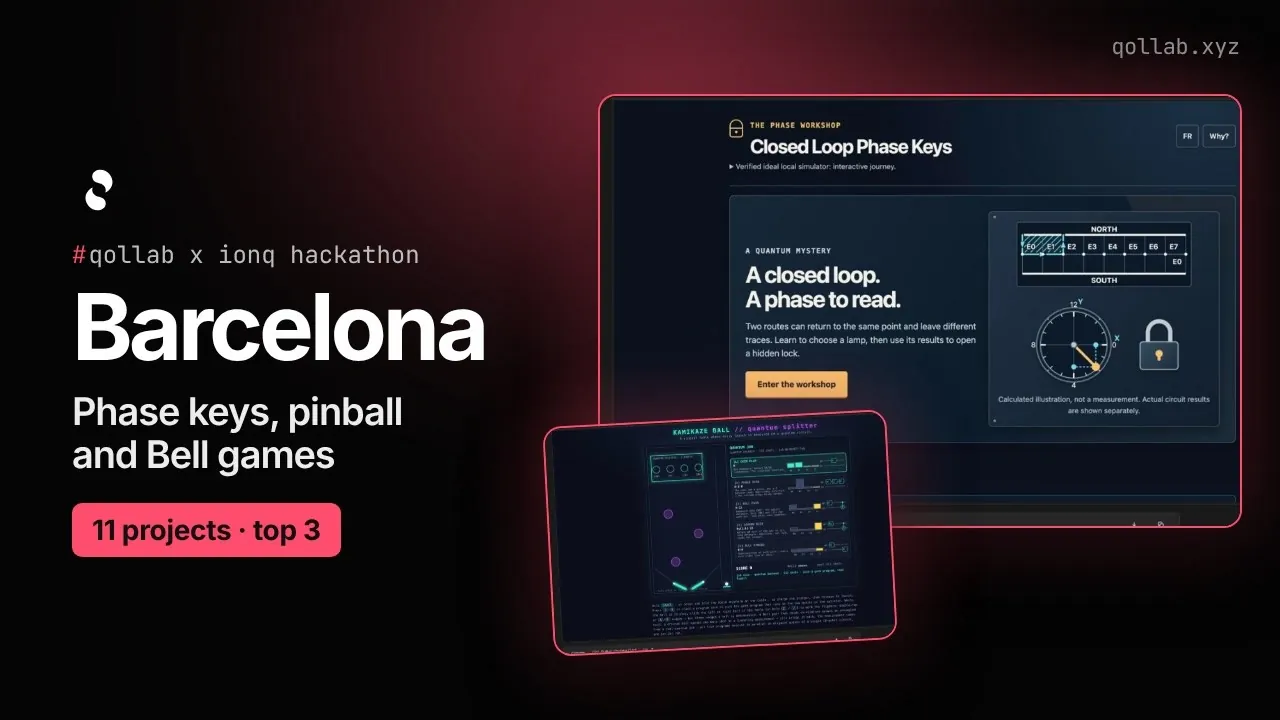
The projects range from a pinball table and a detective game to quantum neural networks and overnight charging for electric buses. Every one of them is open source on Qollab.
The University of Barcelona node
Bruno Juliá Díaz led the node with Jhonathan Souza. Bruno is a professor in the Department of Quantum Physics and Astrophysics and principal researcher of the university's quantum communications research group. He also coordinates the Master in Quantum Science and Technology. Jhonathan is a quantum computing researcher at the Institute of Theoretical and Computational Chemistry (IQTCUB).
The university runs the master's programme with the Autonomous University of Barcelona, the Technical University of Catalonia and four research centres. In the Advanced Quantum Laboratory at the Faculty of Physics, students measure Bell inequalities with entangled photons on a setup Bruno helped design. Two physics students also built Quantum Tycoon, a free game about running a quantum computer company, which Bruno co-supervised.
Six judges from the University of Barcelona scored the projects on novelty, technical execution, impact and documentation. They were Alejandro Jaramillo, Arnau Moron, Emanuele Costa, Kerman Gallego, Jhonathan Souza and Bruno Juliá Díaz.
1st place: Closed Loop Phase Keys
Closed Loop Phase Keys is a puzzle game where each lock hides which of two routes was used, and the right measurement tells them apart. Athmane Mekhalfia, an independent builder from Lyon, France, on a gap year, built it on his own. Teams picked a node when they signed up or let the Qollab team place them, and Athmane entered on the professional track.
Athmane's starting question was whether two routes can return to the same point and still leave a difference that a quantum measurement reveals. Players choose an X or Y measurement, predict what each route will show, then read the simulator's counts to name the hidden route. In the circuit, controlled rotations give each route a geometric phase, and phase kickback transfers it to a witness qubit.
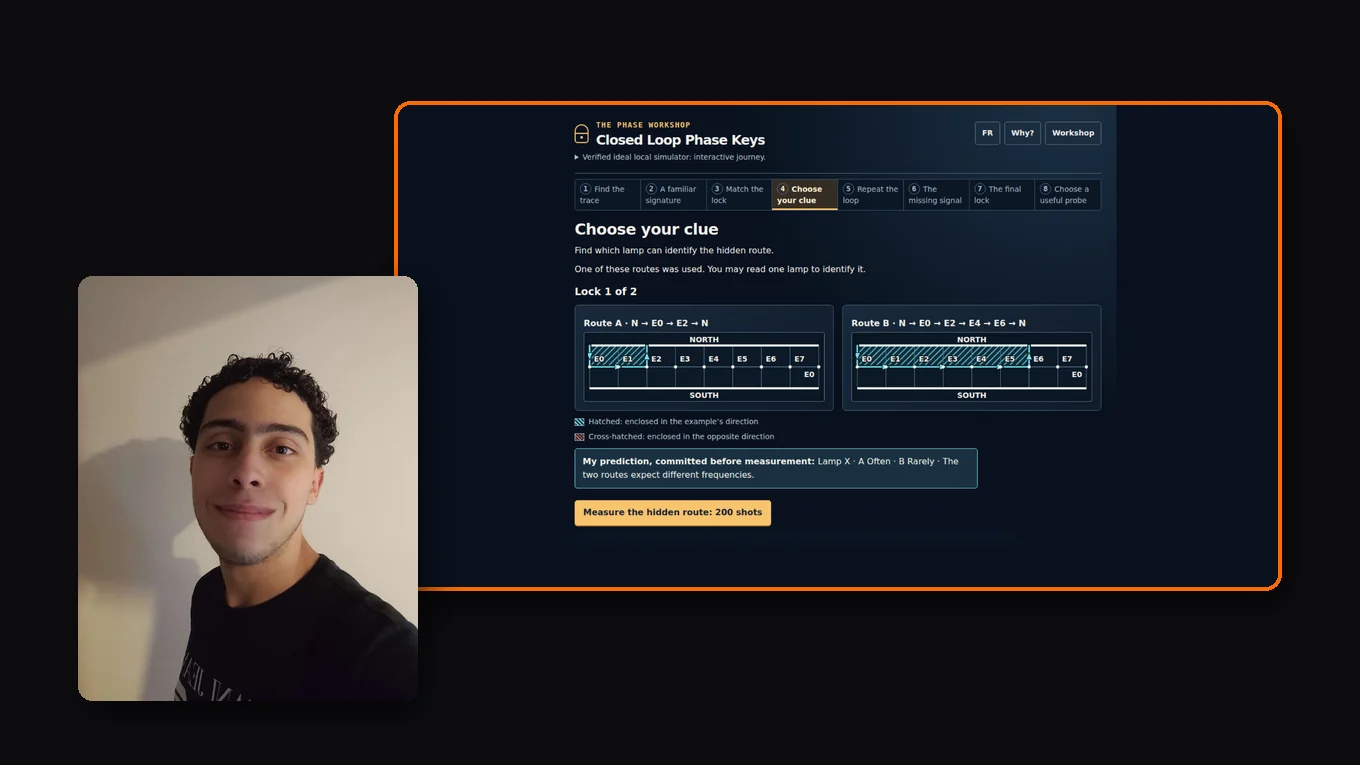
Athmane is proudest that a wrong measurement can leave the lock closed and show the player why the choice mattered. The game also shows when repeating the loop helps and when it erases the clue.
The hardest part was making the circuit, the game and the explanations agree. Next, Athmane wants to test the game with beginners and improve the parts where they get stuck. He also plans more route pairs, and challenges that players can create and share.
Before this weekend, I thought quantum computing was mostly about difficult equations and circuits. Now I see how an experiment can turn an abstract idea into a choice you can make, test and learn from.
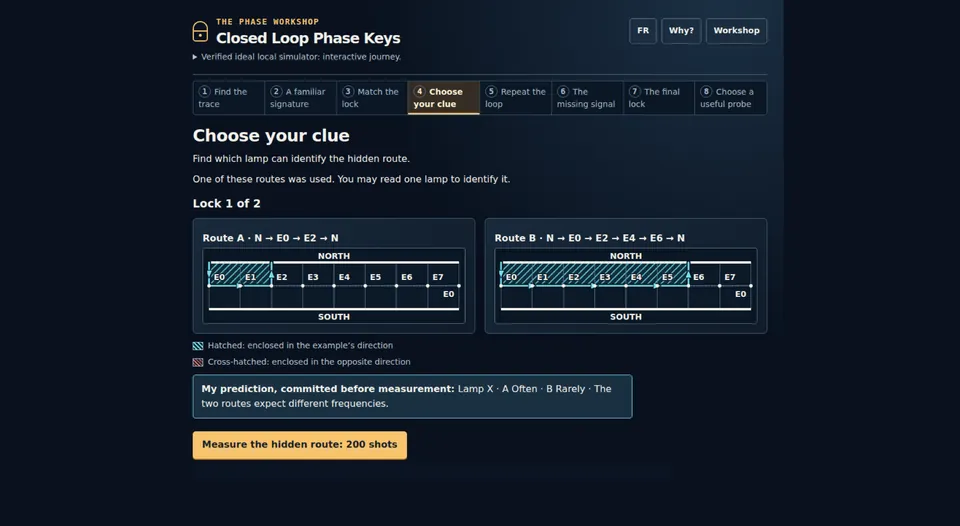 Closed Loop Phase KeysA puzzle game in English and French, with a reusable teaching kit.
2nd place: Carbon-Aware Charging for an Electric Bus Depot with QAOA
Carbon-Aware Charging plans which bus charges in which hour overnight, so an electric bus depot runs on cleaner, cheaper electricity. Kerem Yurtseven entered it as Bountum, a team of one. Asked how the team formed, he wrote: "I know my teammate for more than 20 years, it is just myself." He is a first-year master's student in electrical engineering at TU Delft, and Bountum also signed up on the professional track.
Kerem compares the problem to feeding a colony of stray cats with a few bowls and one bag of food. Every cat has to be fed by morning, and no bowl can overflow.
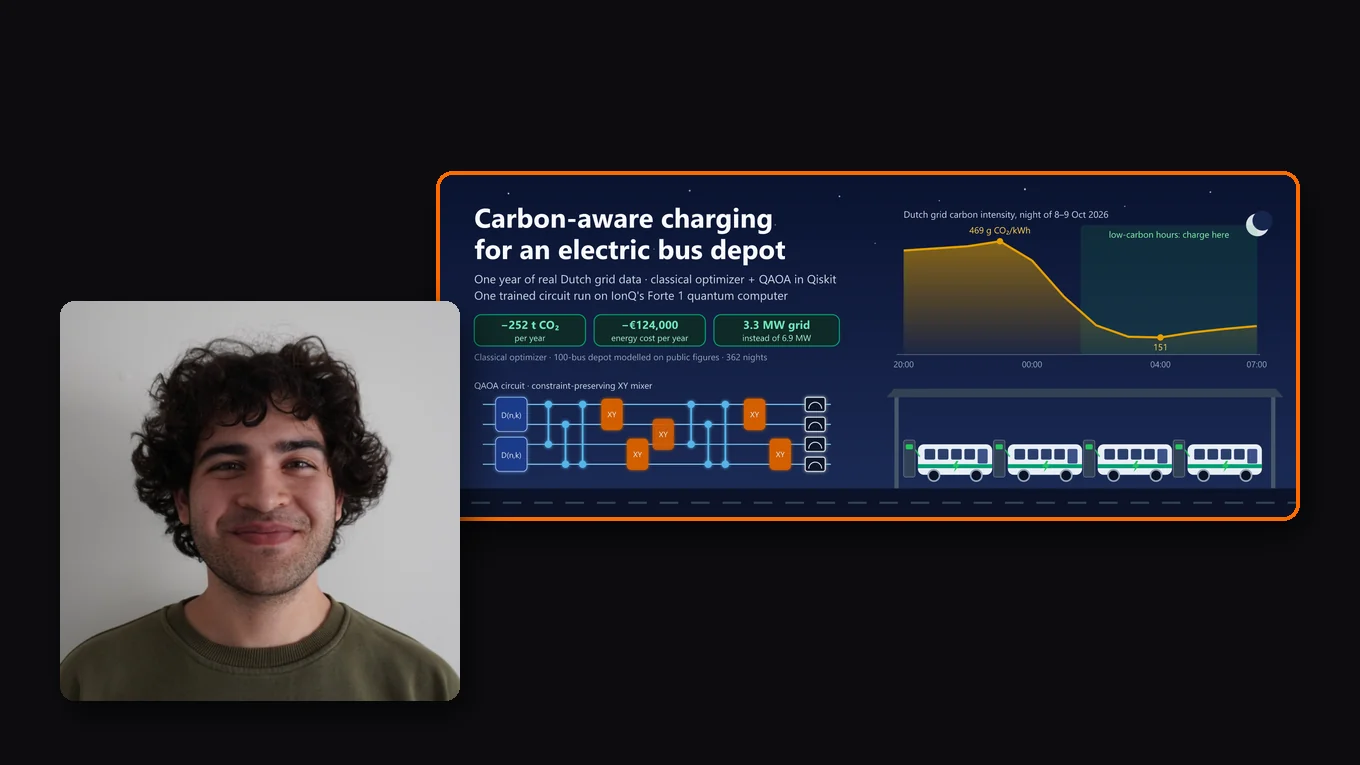
Every schedule the QAOA circuit samples charges each bus for exactly the hours it needs. That comes from the XY mixer, the part Kerem is proudest of. Each bus's qubits start in a Dicke state, and the mixer only moves charging hours between slots. On real grid data, this encoding samples near-optimal schedules 39 times more often than its starting state.
Next, Kerem wants to give QAOA three or more buses at a time and see how the approach behaves as qubit counts rise.
Saturday evening, about 20 hours in. Everything worked, but the result was three cars saving a few euros a night: correct, and forgettable. I then extended the impact side around a 100-bus Dutch depot and a full year of grid data, which meant fetching eleven more months of data and handling daylight-saving changes. I kept QAOA where today's qubits fit: 16-qubit pieces of the depot plan, plugged into the classical optimizer.
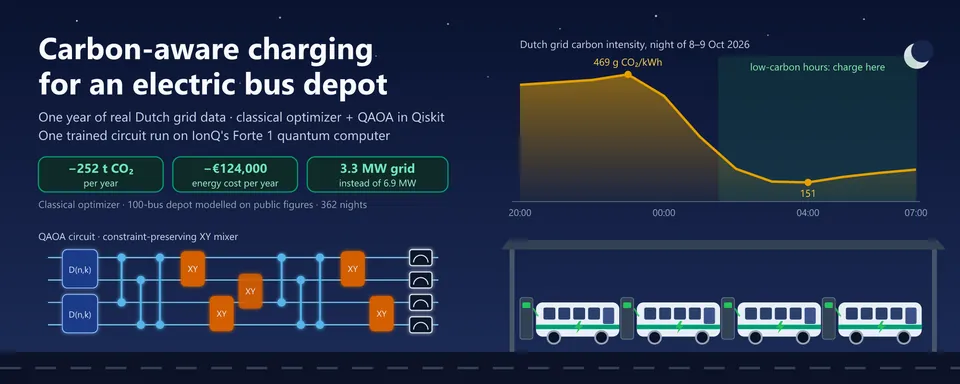 Carbon-Aware Charging for an Electric Bus Depot with QAOAA Dutch depot's overnight charging schedule, with QAOA in Qiskit as a subroutine.
3rd place: Beat the Bell
Beat the Bell is a version of the CHSH game, a test of Bell's theorem. Álvaro Cuñado Moya de la Torre, another professional-track entrant, built it on his own as his first quantum computing project. He studies cybersecurity at Universidad Francisco de Vitoria in Madrid and co-founded the startup Naxogon.
Players first try classical plans, and the best of all 16 wins 75% of rounds. Then four angle sliders set an entangled strategy, which can reach about 85%. He made the referee quantum too: two Hadamard qubits pick the questions, and controlled-RY gates turn each player's polarizer. In cybersecurity, Álvaro's field, the same game is the basis of device-independent quantum cryptography.
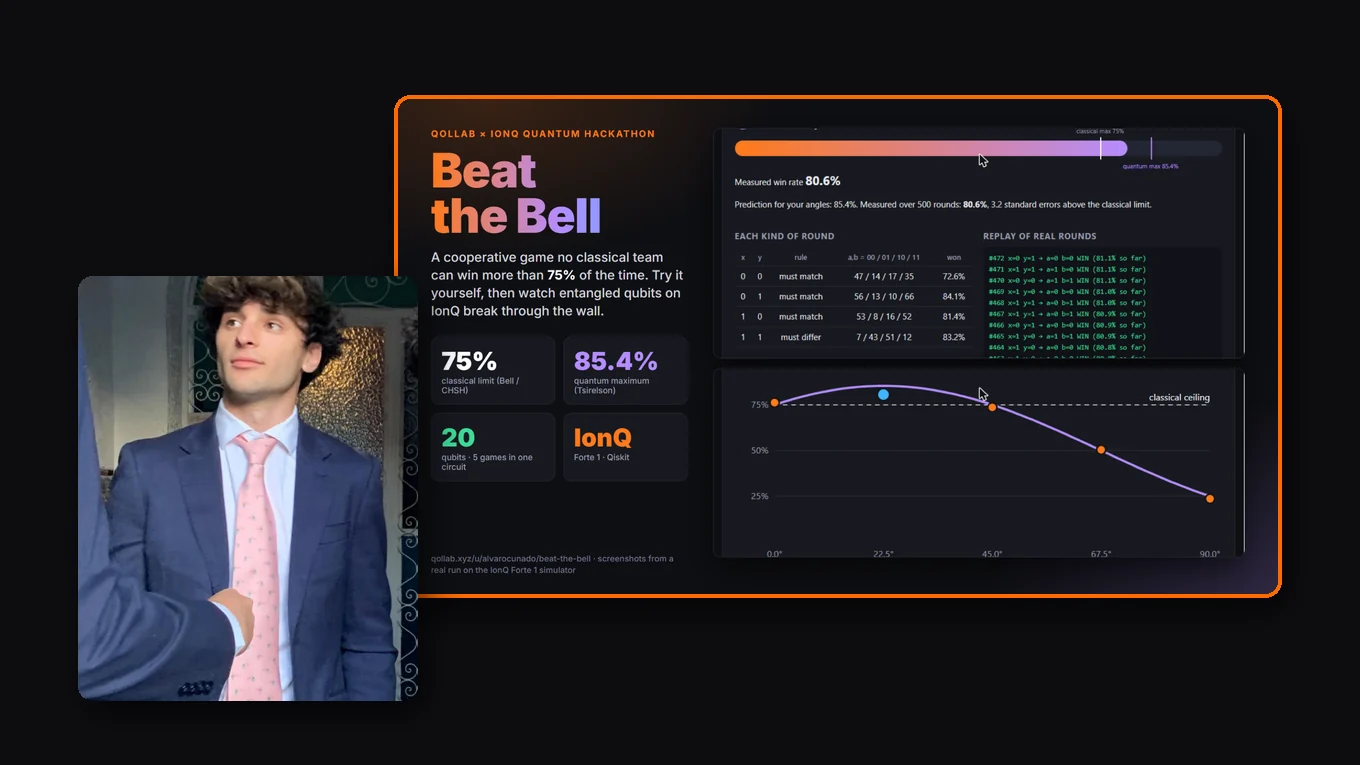
IonQ rejected Álvaro's first version, which sent 40 separate circuits in one job, because only single-circuit jobs are accepted. Hours before the deadline, he rebuilt it as one 20-qubit circuit that runs five games side by side. On IonQ's Forte 1 noise-model simulator, his first run came back at 83.6%, more than five standard errors above the classical 75%. He ran it again to make sure it was not luck. In another run, the entangled strategy won 80.6% of 500 rounds, 3.2 standard errors above the classical limit.
Next on his list are a two-phone mode where two people play Alice and Bob, and a run on IonQ Forte hardware.
Seeing Bob’s answers come back at almost exactly 50/50 whatever Alice was asked. The correlation was there, but there was no message. That’s when “no faster-than-light signalling” finally clicked for me.
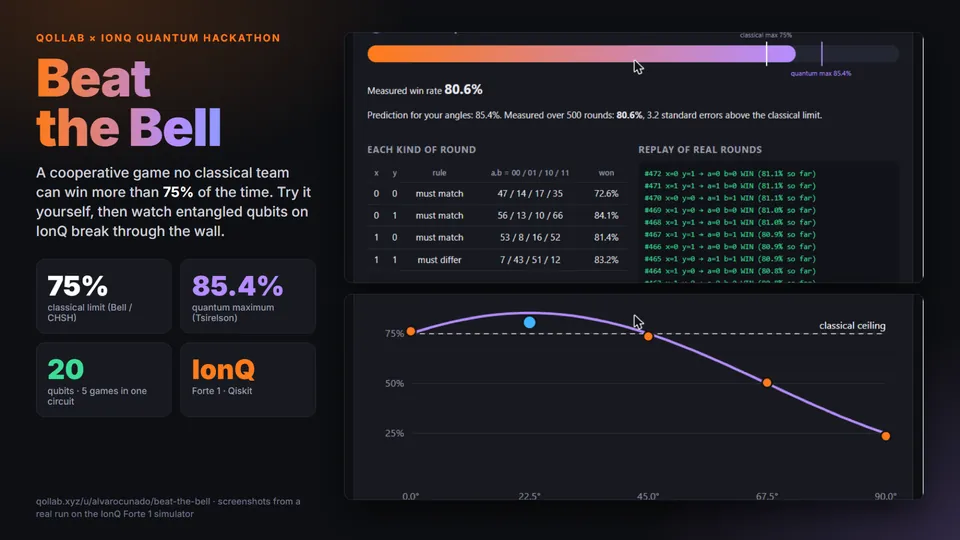 Beat the BellA browser game that shows its circuit, the measured counts and a no-signalling check.
Every other project from the University of Barcelona
Two of the node's other projects are games, Quantum detective and Kamikaze Ball, and two use quantum walks, GlyphGenesis and kytos. Three others take on practical problems, among them Tieout, which matches open items to bank statement lines as a subset-sum problem.
The other 8 projects entered at the node, A to Z.
- GlyphGenesis: Generative Art from Quantum Walk Measurements: A generative-art instrument: discrete-time quantum walks and Bell-entangled walker pairs are measured on Qiskit/IonQ backends; their probability and phase distributions render as evolving ASCII specimens minted on-chain.
- Hackathon - QNN & Lie Algebras Symmetry: Project for the Hackathon of October 2026.
- Kamikaze Ball: Quantum Splitter: A pinball table where every launch is resolved by a real quantum measurement, pick a 2-qubit gate program and the collapse picks your exit.
- kytos: A runnable Qiskit quantum walk on a four-node slice of a KRAS contact graph.
- Quantum city: Quantum city: This program models a cityi as a graph, where the nodes are zones or ambulances and the arestes represent conflicts or direct connections of the route.
- Quantum detective: This program simulates an interactive game in which you are a detective trying to find the coordenates of your qubit.
- Quantum Matchmaker: Quantum Matchmaker uses quantum computing to create compatible teams by maximizing the relationships between team members.
- Tieout: Quantum settlement matching for the financial close: Which open items settle each bank statement line?
University of Barcelona on Qollab
Specialty awards follow on Wed Oct 28 and global winners on Thu Oct 29, and the Hackathon 2026 results page links to every node's post.
Open any project on University of Barcelona's node page on Qollab to read its code, run it and fork it. You can also follow the node there. The page shows the node's numbers, its members and node team, and all 11 hackathon projects.

Stay in the loop.
Get the latest tutorials, demos, and project showcases straight to your inbox. No noise, just the good stuff.
Enable JavaScript to sign up.
Qollab updates only. Unsubscribe any time. Privacy Policy.