SJSU Society of Quantum Engineers winners: Qollab x IonQ Hackathon 2026
The winning project from seven entered at the SJSU Society of Quantum Engineers node.
At the SJSU Society of Quantum Engineers node of the Qollab x IonQ Hackathon 2026, 19 teams signed up, 15 of them solo. Of the 19, 14 were on the student track and five on the professional track. The online build weekend ran from 7 PM ET on October 9 to 7 PM ET on October 11. In that time, five of the 19 teams entered seven projects.
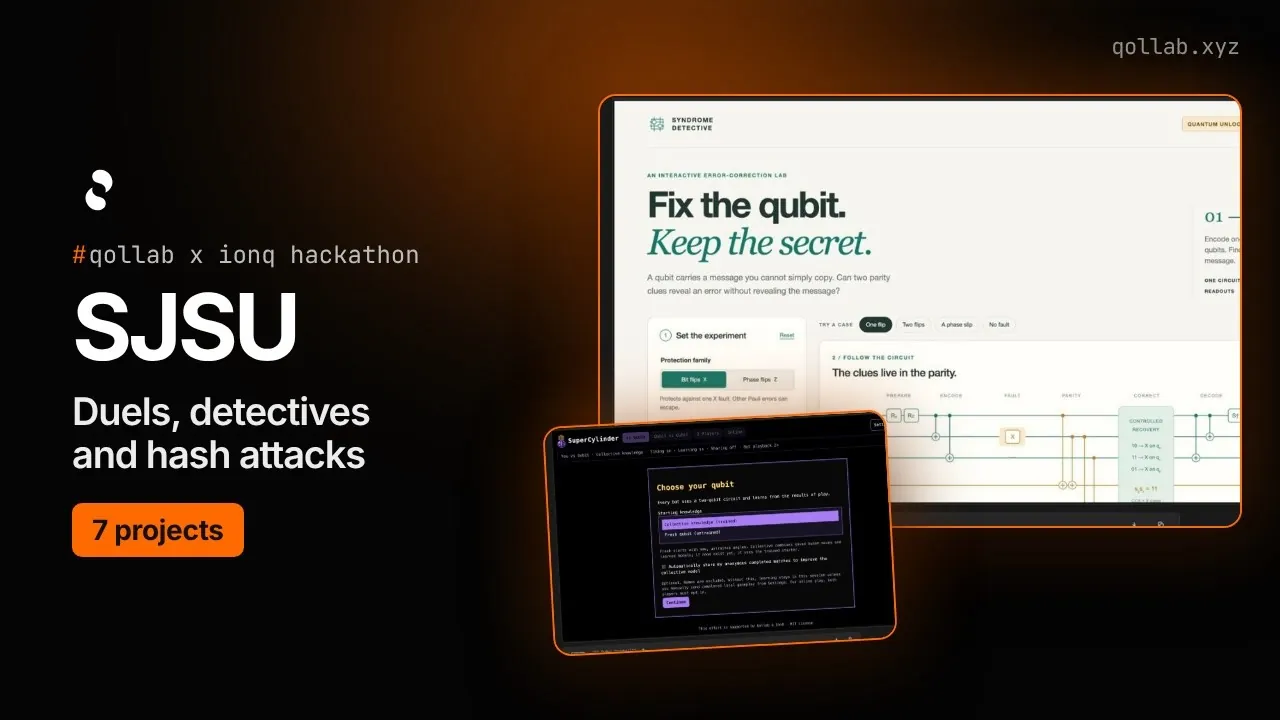
The projects range from a quantum error correction lab and a Bay Area network navigator to the black hole information paradox. Every one of them is open source on Qollab.
The SJSU Society of Quantum Engineers node
The Society of Quantum Engineers (SQE) is a student-led club at San José State University. Its president, Justin Oliver, led the node with vice president Daman Singh. Nobel laureate John Martinis joined a special SQE meeting in April. In a campus lab, members run a Thorlabs kit that demonstrates BB84 quantum key distribution. Justin and two other members also competed in person at iQuHACK 2026, MIT's quantum hackathon.
SJSU also offers a Master of Science in Quantum Technology, run by its Department of Physics and Astronomy and Department of Electrical Engineering.
Three judges from IonQ and San José State University scored the projects on novelty, technical execution, impact and documentation. They were Samuel Petruescu, Gabriele Nicula and a guest from IonQ.
Node winner: Introduction to Quantum Hash Collision
Introduction to Quantum Hash Collision lets you assemble your own hash function in a Scratch-style editor and see how Grover's algorithm attacks it. The project also estimates what the attack would cost. Yutaka Shibata built it on his own. A King's College London student on a study exchange at the University of Hong Kong, he was previously tech lead of the KCL Blockchain Society.
In the middle of the night, Yutaka wanted homemade hash browns and wondered why no tool let you build a homemade hash function. That led him to build the editor, so that his 85-year-old grandmother could make both at the same time.
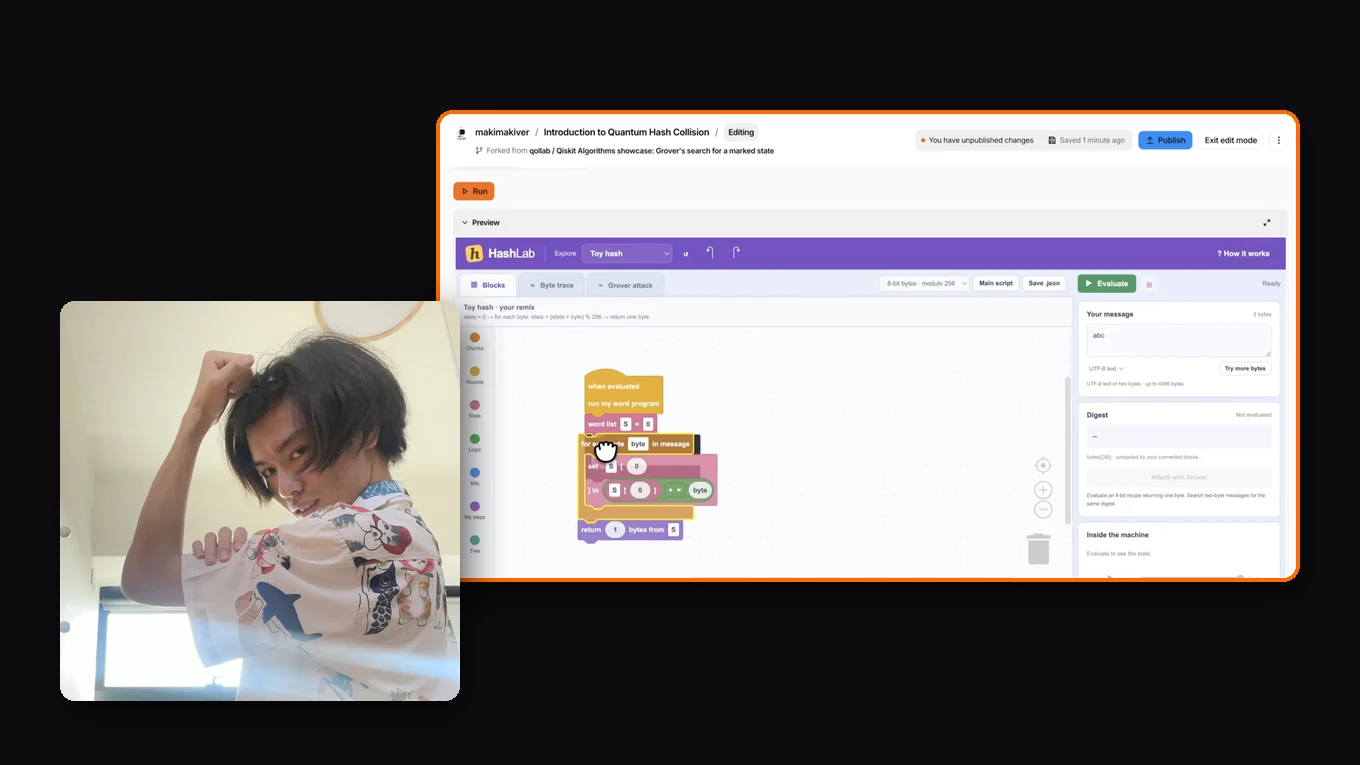
The project started with warnings about attacks on the elliptic-curve cryptography behind crypto wallets, and with advice to keep assets behind a hash instead. Grover's algorithm can attack hash functions too.
At every step, the project shows the signed amplitudes next to the measurement probabilities, which makes Grover's mechanism visible. The oracle flips the sign of each matching state without changing its probability. The diffusion step then uses those sign differences to raise the chance of measuring an input with the target hash. Yutaka is proud of that design choice.
Next, Yutaka wants to create visual lessons on position-based cryptography with quantum teleportation, and to look more closely at how attacks on SHA-256 have improved.
Before this weekend, I thought quantum computing was some kind of magic that just made things faster. Now, I understand more of the logic behind it and why it offers an advantage for certain problems.
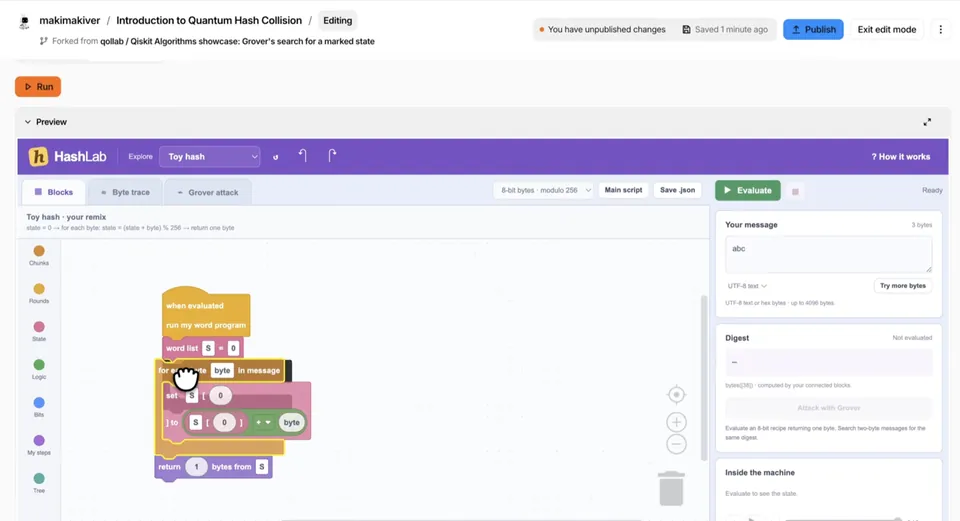 Introduction to Quantum Hash CollisionDesign your own hash function and follow Grover's algorithm as it searches for a match.
Every other project from SJSU Society of Quantum Engineers
Two of the node's other projects are games, Entangled Vaults and SuperCylinder.
The other 6 projects entered at the node, A to Z.
- Bay Area Quantum Navigator - Test Version: Incorporating Quantum Efficiency Algorithms into a Network.
- Entangled Vaults: Entangled Vaults is a Fireboy-and-Watergirl–style co-op game where the puzzles are real quantum experiments meant to be a fun way to educate people about quantum computing concepts.
- Paradoxical Punctures: Many of the popular aspects of the Black Hole Information Paradox: an empirical derivation of the famous Page curve, the recently popular SYK black holes, scrambling efficiency and black holes, and wormholes.
- QSentry: Train and evaluate a 4-qubit quantum autoencoder and classical intrusion detectors live on UNSW-NB15.
- SuperCylinder: A fast Outlaw-vs-Arcanist duel powered by a trained 32-angle, two-qubit circuit.
- Syndrome Detective: An interactive Qiskit lab exploring quantum error correction.
SJSU Society of Quantum Engineers on Qollab
Specialty awards follow on Wed Oct 28 and global winners on Thu Oct 29, and the Hackathon 2026 results page links to every node's post.
Open any project on SJSU Society of Quantum Engineers' node page on Qollab to read its code, run it and fork it. You can also follow the node there. The page shows the node's numbers, its members and node team, and all 7 hackathon projects.

Stay in the loop.
Get the latest tutorials, demos, and project showcases straight to your inbox. No noise, just the good stuff.
Enable JavaScript to sign up.
Qollab updates only. Unsubscribe any time. Privacy Policy.