QUTE.sk winners: Qollab x IonQ Hackathon 2026
Three winning projects from 13 entered at the QUTE.sk node.
At the QUTE.sk node of the Qollab x IonQ Hackathon 2026, 21 teams signed up, 11 of them solo. Of the 21, 13 were on the student track and 8 on the professional track. The online build weekend ran from 7 PM ET on October 9 to 7 PM ET on October 11. In that time, 9 of the 21 teams entered 13 projects.
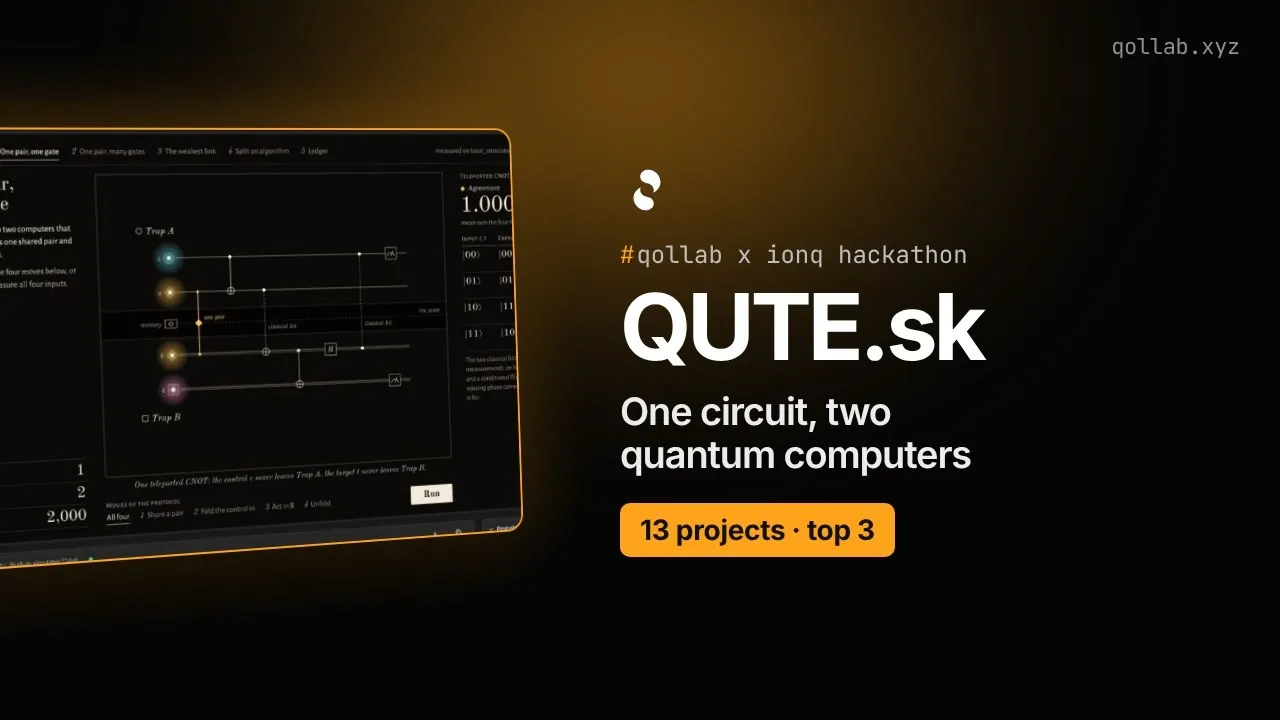
The projects take on tokamak plasma control, mid-circuit measurement and quantum linear-system algorithms, and one turns molecular calculations into sound. Every one of them is open source on Qollab.
The QUTE.sk node
QUTE.sk, the Slovak National Center for Quantum Technologies, signed on in September to coordinate one node for all of Slovakia. Its partners include institutes of the Slovak Academy of Sciences, six university faculties and two companies. Diana Cencer Garafová, who writes QUTE.sk's news and is its media contact, led the node. On Saturday, October 10, QUTE.sk offered its pavilion in Bratislava, from 1 PM to 8 PM CEST, to teams who wanted to meet in person.
Three judges scored the projects on novelty, technical execution, impact and documentation. They were Prof. Gabriel Semanišin of Pavol Jozef Šafárik University in Košice, Michal Mrena of the University of Žilina and Daniel Reitzner of CyberSecurityHubCZ.
1st place: Seam
Seam is a step-by-step lab for splitting one quantum circuit between two simulated trapped-ion computers. On October 9, the hackathon's first day, IonQ announced a photonic link that entangles a trapped ion with a quantum memory. Seam asks what a link like that can compute, and at what cost. Kateryna, who builds smart contracts, AI agents and voice apps at hackathons, entered Seam solo. Teams picked a node when they signed up or let the Qollab team place them, and Kateryna entered on the professional track.
Each remote gate uses one entangled pair, and gates that share a control can share a pair. In phase estimation on four ions, eight gates cross the cut, but two shared pairs are enough. IonQ's simulators on Qollab take one job per run and have no mid-circuit measurement, so every experiment had to become a single circuit.
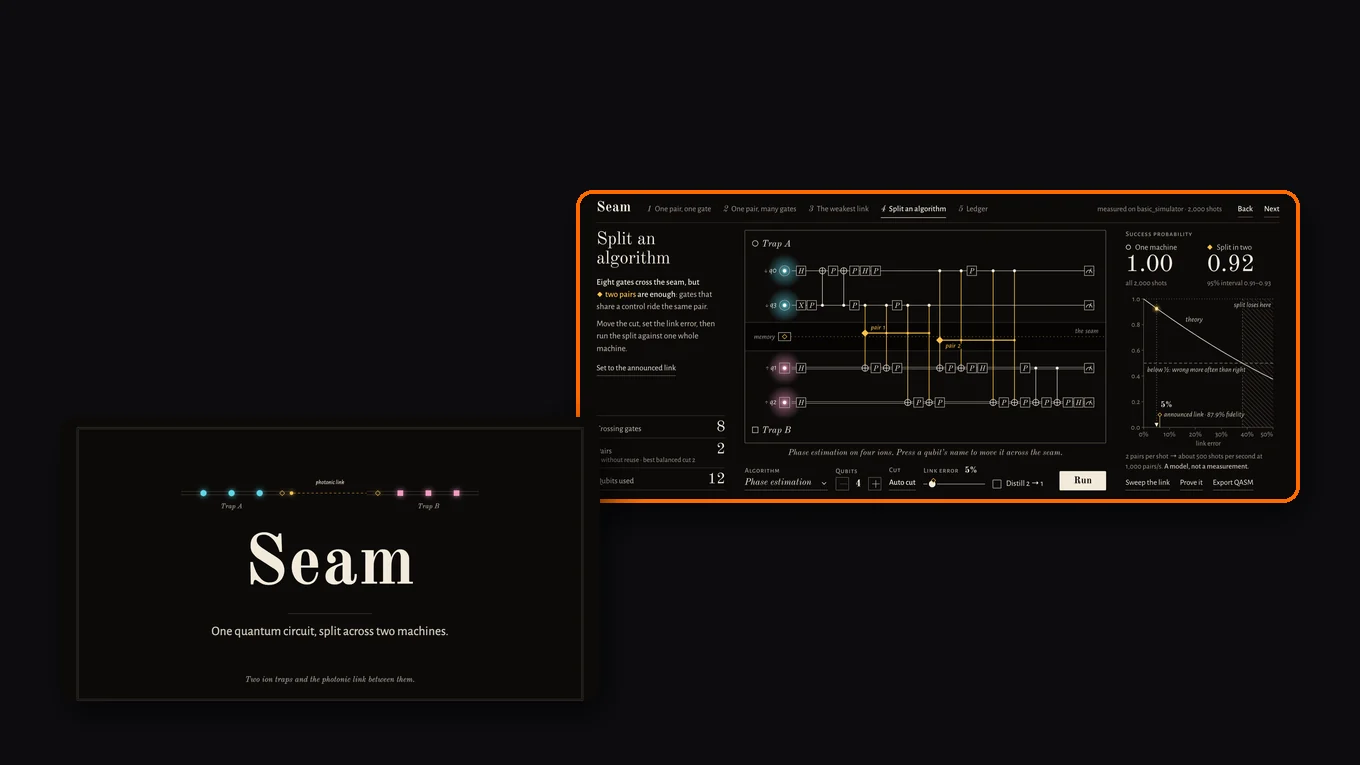
Seam's page tags each number as measured, proven by a statevector check, modelled or not claimed. On Sunday evening, Kateryna caught the page claiming a "best cut" when the search only covered balanced cuts. "We fixed the label, re-recorded that line of the video, and added the mistake to the project's claims ledger."
Next, Kateryna wants to run the opening experiment on IonQ Forte hardware, with real mid-circuit measurement and feed-forward.
Before this weekend, I thought quantum computing would scale by building one ever-bigger machine. Now I see it growing the way data centres did, by linking smaller machines, and every link has a price you can count in entangled pairs.
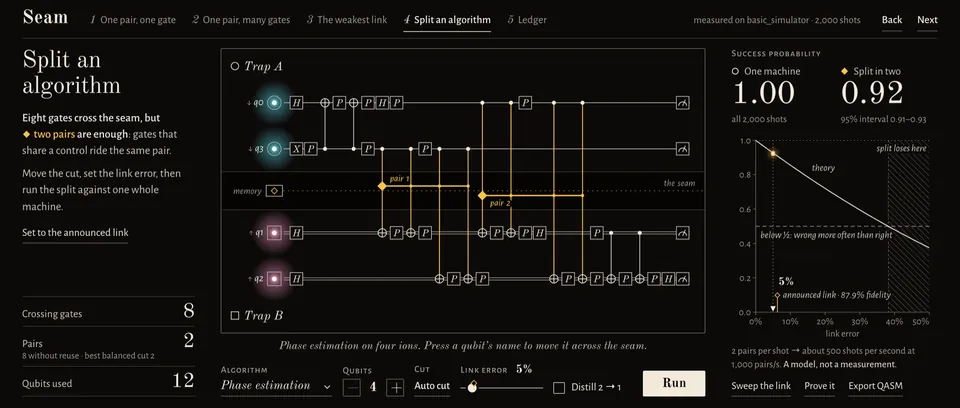 SeamA lab that counts the entangled pairs each way of splitting a circuit needs.
2nd place: Quantum Alliance
Quantum Alliance is a game for four AI agents who cannot communicate. A buyer gives Aria, Bram, Cleo and Dax one secret task bit each, and their four answer bits must satisfy a public Boolean contract. Murat Keskin, a self-taught developer in Germany who founded AgentNOMOS, built it on his own. Like Kateryna, he entered on the professional track.
The idea came from a question Murat has been exploring: how independent AI agents can coordinate their decisions when communication is restricted. The best of all 256 classical plans meets the contract on 10 of the 16 task patterns, or 62.5%. A shared GHZ strategy, simulated on eight qubits, reaches an ideal 85.4% on every input.
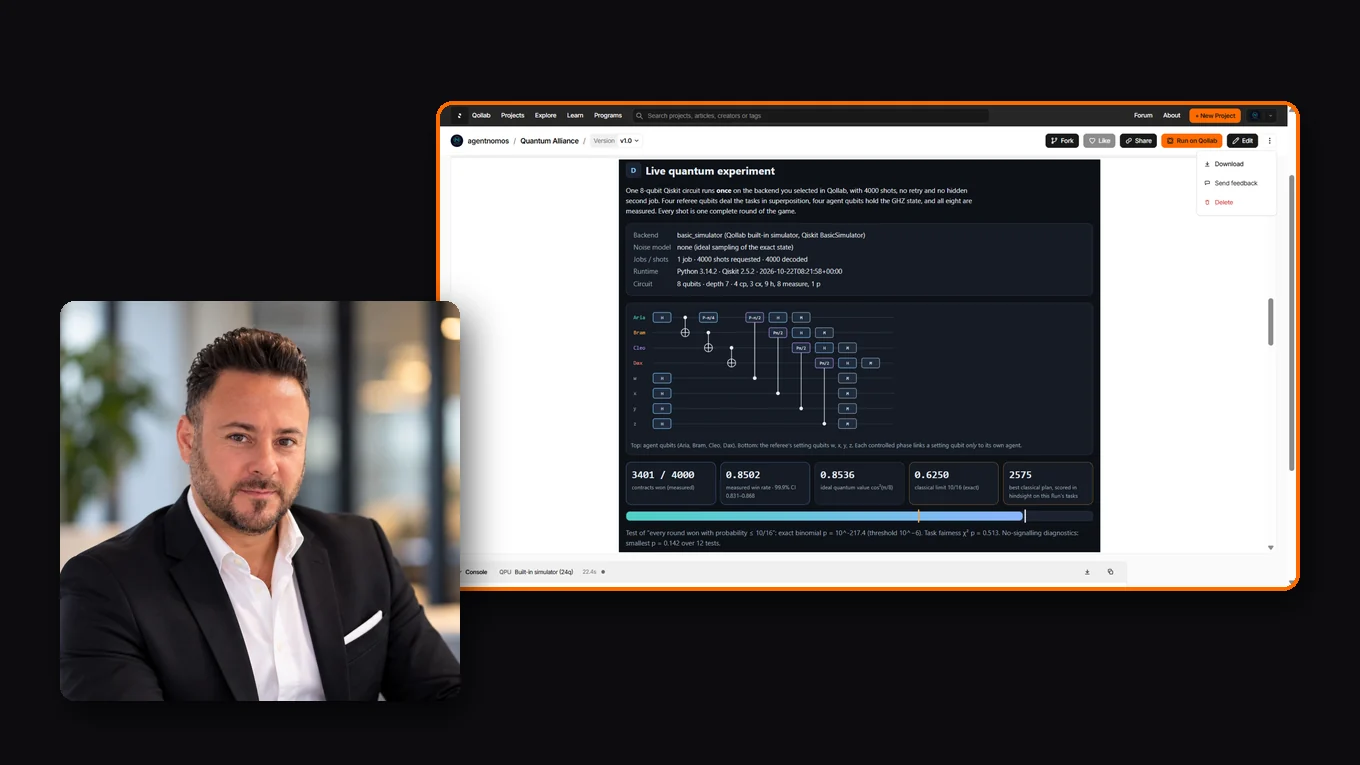
The game builds on a published four-qubit CHSH game. Getting its maths right was one of the hardest parts. "The reference paper contained an inconsistency in the classical benchmark and notation that could easily lead to implementing the wrong game." The project ships a separate Python verifier and a tamper lab in the browser that shows how manipulated evidence is detected.
Next, Murat wants to grow Quantum Alliance into a platform for quantum-assisted multi-agent coordination. The platform would test whether quantum correlations give a measurable advantage in coordination problems, and whether it survives noise and real hardware limits.
Murat also entered Quantum Allocation Lab, Quantum Claim Court, Quantum Research Governor and Quantum Impossible: The 9/9 Challenge.
I'm particularly proud of the independent verification system.
I didn't want visitors to simply trust a displayed quantum result. I wanted them to understand where the numbers came from, inspect the evidence, and verify the experiment independently.
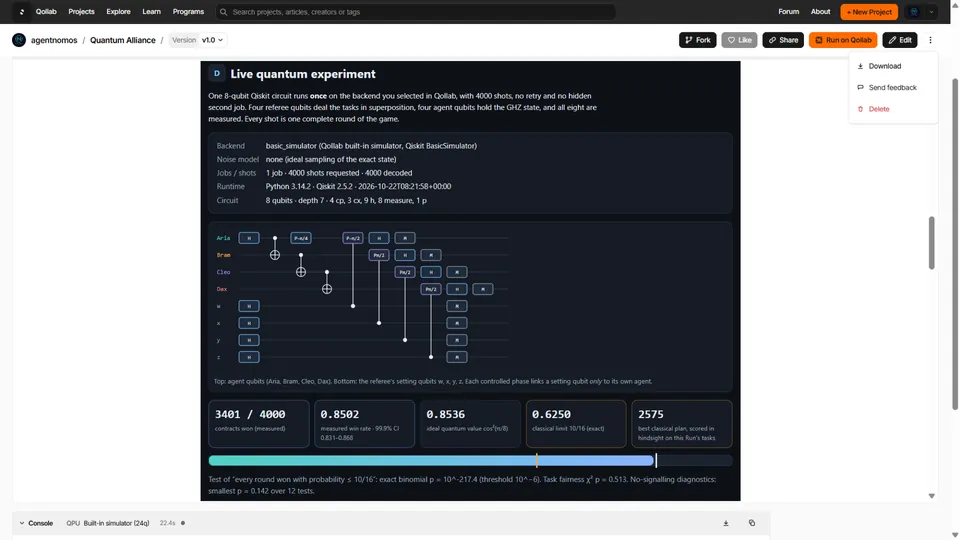 Quantum AllianceA game where four agents coordinate without talking, with evidence you can check yourself.
3rd place: Single-Depot Vehicle Scheduling Problem (VSP) for Electric Buses
The FRIQs scheduler plans electric buses that run from a single depot and need charging. The team is four students at the University of Žilina's Faculty of Management Science and Informatics, and three of them are called Juraj. Juraj Kultán captained the team and presented the project, and PhD student Tomáš Sobek handled the quantum design. Juraj Beňo and Juraj Gacho covered algorithm research, filming, operations and version control.
Transport network optimisation is heavily researched at the faculty, which is why the team picked the problem. The quantum side runs QAOA, with an XY mixer on a QUBO formulation, on Qiskit Aer's simulator. The classical side uses mixed-integer programming, simulated annealing and tabu search, and the timetables come from King County Metro.
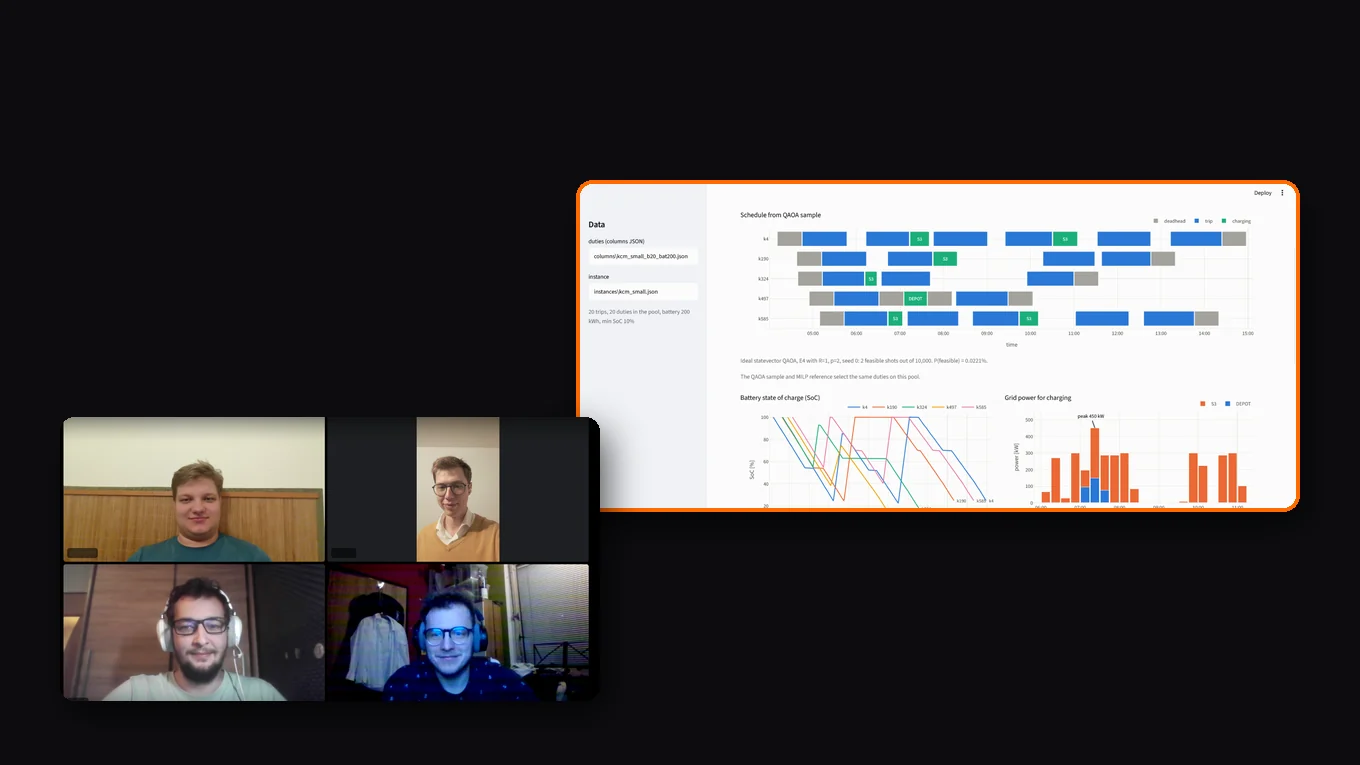
In the team's demo, you can set up a disruption at any moment. The scheduler reorganises the routes when a bus or a charging station fails.
Next, the team wants to apply QAOA to the multi-depot version of the problem for electric buses.
Touch some quantum, get your hands dirty and create something cool.
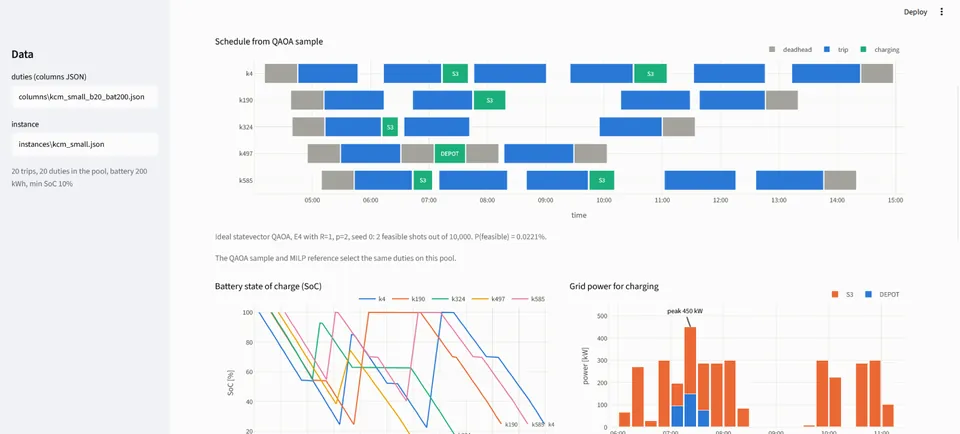 Single-Depot Vehicle Scheduling Problem (VSP) for Electric BusesElectric-bus scheduling with QAOA, checked against three classical solvers.
Every other project from QUTE.sk
Three projects at the node use QAOA: the electric-bus scheduler, Quantum Allocation Lab, which assigns four tasks to two agents, and QuantumFusion. Games came up as well, with tic-tac-toe in qic-qac-qoe and a playable two-deck quantum poker in Quantum Hold’em.
The other 10 projects entered at the node, A to Z.
- Adaptive implementation of quantum instruments
- EigenWall: EigenWall is an experimental investigation into whether quantum linear-system algorithms (HHL-style procedures) can reproduce the inverse-covariance operation central to adaptive antenna beamforming.
- qic-qac-qoe: Tic-Tac-Toe with quantum mechanics.
- Quantum Allocation Lab: Governed Quantum Task Allocation: Quantum Allocation Lab explores task assignment using QAOA: 4 tasks, 2 agents and 8 qubits.
- Quantum Claim Court: Quantum Claim Court tests scientific claims about optimal approximate quantum cloning.
- Quantum Hold’em: Playable two-deck quantum poker with visible state changes, guided challenges and a Qiskit verifier for interference, phase, measurement and entanglement.
- Quantum Impossible: The 9/9 Challenge: Can quantum mechanics win a game that classical strategies cannot win perfectly?
- Quantum Research Governor: Quantum Research Governor demonstrates syndrome-based error detection using a [[4,2,2]] code in a 7-qubit circuit.
- QuantumFusion: Trapped-Ion Tokamak Plasma Stabilizer: Real-time tokamak plasma stabilization via IonQ all-to-all QAOA.
- Sound Of Molecules: Sound of Molecules is an interactive web app bridging quantum molecular calculations (QPE) with audio synthesis.
QUTE.sk on Qollab
Specialty awards follow on Wed Oct 28 and global winners on Thu Oct 29, and the Hackathon 2026 results page links to every node's post.
Open any project on QUTE.sk's node page on Qollab to read its code, run it and fork it. You can also follow the node there. The page shows the node's numbers, its members, and all 13 hackathon projects.

Stay in the loop.
Get the latest tutorials, demos, and project showcases straight to your inbox. No noise, just the good stuff.
Enable JavaScript to sign up.
Qollab updates only. Unsubscribe any time. Privacy Policy.