MPC (Minho, Porto, Coimbra) winners: Qollab x IonQ Hackathon 2026
The winning project from nine entered at the MPC (Minho, Porto, Coimbra) node.
At the MPC node of the Qollab x IonQ Hackathon 2026, 21 teams signed up, 15 of them solo. Of the 21, 12 were on the student track and 9 on the professional track. The online build weekend ran from 7 PM ET on October 9 to 7 PM ET on October 11. In that time, four of the 21 teams entered nine projects.
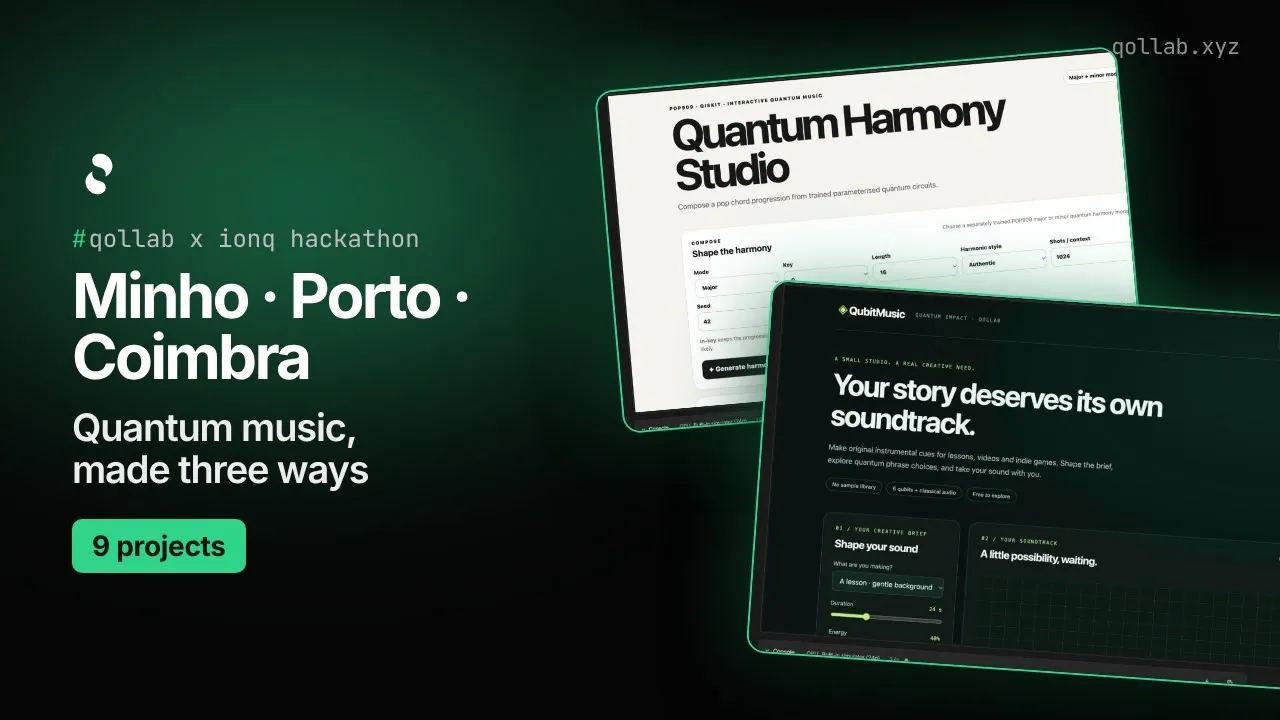
The projects range from a noir detective game and a farm game built on QAOA to quantum duets and adaptive soundtracks. Every one of them is open source on Qollab.
The MPC node
MPC signed on in September, named for the universities of Minho, Porto and Coimbra. André Sequeira of INESC TEC led the node with two professors from Minho's Department of Informatics, Luís Soares Barbosa and Luís Paulo Santos.
Luís Paulo Santos teaches quantum data science at Minho. At the University of Coimbra, Jorge Lobo is a founding member of the Quantum@UC interest group. He started an optional course on quantum computing for electrical and computer engineering students and helped create a specialisation course in quantum computing and technologies.
Three judges scored the projects on novelty, technical execution, impact and documentation. They were André Sequeira of INESC TEC, Sagar Pratapsi of the University of Porto and Jorge Lobo of the University of Coimbra.
Node winner: Ghost Route: Quantum Rescue Game
Ghost Route is a game in which a boat named SPOOFED sails to rescue astronauts stranded at sea, and its GPS can be spoofed. Beatriz Karoline Cordeiro da Silva, Daiane Fonseca and Sonia Janara Silva Barros built it as team QuantGirls. The three are from Brazil and met at earlier hackathons, but they had never built with quantum computing together before.
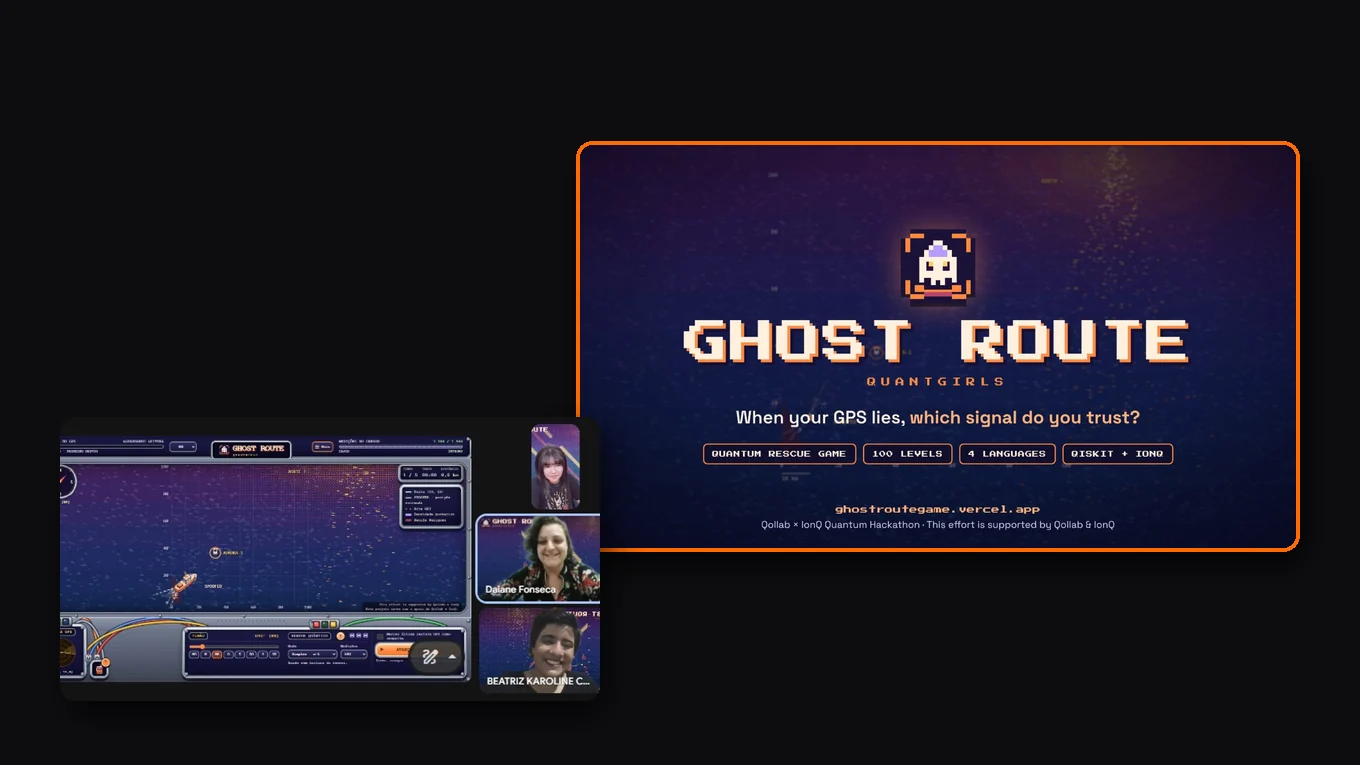
The idea came from a brainstorm about quantum sensors that could help aircraft and submarines navigate when GPS is unreliable. Players check the GPS against readings from two simulated quantum sensors: a one-qubit Simple sensor and a three-qubit GHZ sensor. The GHZ sensor is sharper, but three positions fit its data equally well, so players use movement and earlier readings to pick the right one. In one mechanic, the Ghost Aurora, two capsules look identical, and only the quantum estimate can tell which one is real.
Beatriz studies cartographic and surveying engineering at the Federal University of Pernambuco (UFPE) and was the team's product and player experience lead. Daiane, a financial management graduate and data analytics student, led game design and data analytics. Sonia, from the computer science programme at Anhembi Morumbi University, led quantum research and scientific documentation. The maritime setting was partly inspired by Beatriz's involvement in Navícula Boat Design, a UFPE extension project on small and radio-controlled vessels.
The game is free to play in any browser, in English, Brazilian Portuguese, European Portuguese and Spanish. On Qollab, a Qiskit version combines both sensors into one eight-qubit circuit, which the team verified on IonQ's Aria 1 noise-model simulator.
Near the end of the weekend, one teammate was still making the game's 100 levels harder, so the team reworked the difficulty curve again. Another teammate said, "I CAN’T LOOK AT ANOTHER BOAT!"
Next, the team wants to test whether Ghost Route helps people understand quantum sensing, starting with a classroom pilot for Brazilian students. QuantGirls also entered QubitMusic and Qubit Stories.
You don't need to understand quantum to start exploring it. You just need a question you're curious enough to follow.
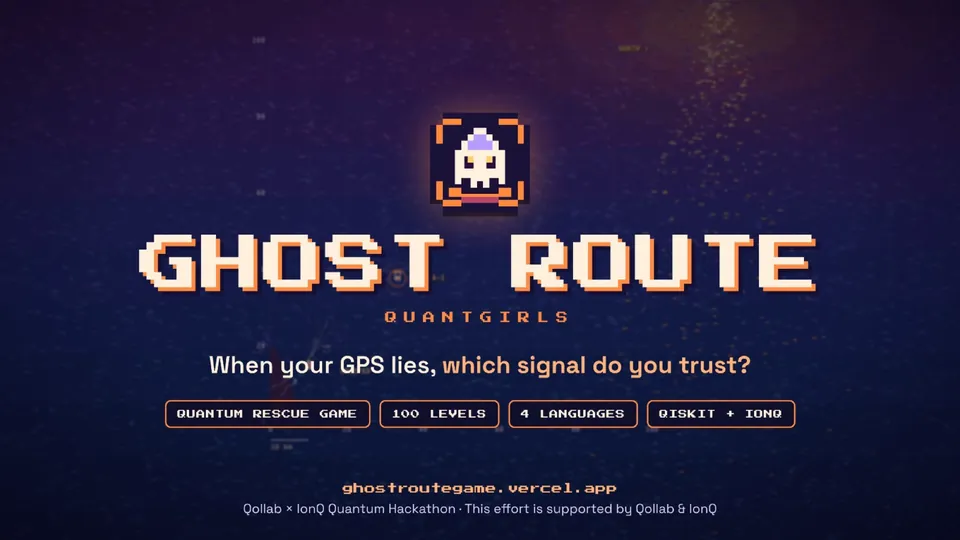 Ghost Route: Quantum Rescue GameA pixel-art rescue game about navigating by quantum sensor when the GPS is wrong.
Every other project from MPC
Most of the node's other projects make music. Team OxfordQ entered four of them: two duets built on CHSH coordination, Quantum Graph Composer and Quantum Harmony Studio.
The other 8 projects entered at the node, A to Z.
- Collapse: A noir detective game where clues are quantum states.
- OxfordQ Composition Verification: OxfordQ turns quantum/classical CHSH coordination into a duet, with a separate frozen PRE-GENERATED 16-bar composition.
- OxfordQ IonQ Joint-Cue Verification: OxfordQ: verified FREE IonQ Aria 1 simulator duet with RECORDED melody and frozen PRE-GENERATED Composition.
- Quantum Farm
- Quantum Graph Composer: A quantum walk and persistent ideal quantum dynamics jointly compose melody, rhythm and harmony.
- Quantum harmony studio: Quantum Harmony Studio uses separately trained 3q/4q PQCs on POP909 to generate major/minor chord progressions.
- Qubit Stories: Multilingual Quantum Learning Lab: Four illustrated videos and 16 chapters in English, Spanish, Brazilian Portuguese and European Portuguese, linked to eight Qiskit experiments.
- QubitMusic: Adaptive Soundtracks with Quantum: Create adaptive instrumental soundtracks for lessons, videos and indie games.
MPC on Qollab
Specialty awards follow on Wed Oct 28 and global winners on Thu Oct 29, and the Hackathon 2026 results page links to every node's post.
Open any project on MPC's node page on Qollab to read its code, run it and fork it. You can also follow the node there. The page shows the node's numbers, its members and node team, and all 9 hackathon projects.

Stay in the loop.
Get the latest tutorials, demos, and project showcases straight to your inbox. No noise, just the good stuff.
Enable JavaScript to sign up.
Qollab updates only. Unsubscribe any time. Privacy Policy.