IIIT Dharwad winners: Qollab x IonQ Hackathon 2026
Three winning projects from 23 entered at the IIIT Dharwad node.
At the IIIT Dharwad node of the Qollab x IonQ Hackathon 2026, 37 teams signed up. More of them came from the professional track (20) than as students (17). Most signed up solo: 27 of the 37. The online build weekend ran from 7 PM ET on October 9 to 7 PM ET on October 11. In that time, 17 of the 37 teams entered 23 projects.
The projects range from fraud triage and option pricing to a music duet, a detective game and a security scanner for quantum circuits. Every one of them is open source on Qollab.
The IIIT Dharwad node
IIIT Dharwad signed on in September, the only university in India to host a node. Dr. Aswath Babu, who heads the Department of Arts, Science and Design, led it with Dr. Rajesh Kumar, head of Electronics and Communication Engineering. Aswath Babu researches quantum optics and quantum information theory.
Students on campus already run the Quantum Computing Club, and both of the node's student winners are taking a minor in quantum information science. The institute also offers an online M.Tech in Quantum AI and Computing, with a batch starting in November.
Four judges scored the projects on novelty, technical execution, impact and documentation. They were Dr. Jayakumar V, Rishi Koushik Reddy and Dr. Aswath Babu of IIIT Dharwad, and Anandaraman of NISER Bhubaneswar.
1st place: Q11 Emergency
Tomoya Hatanaka built Q11 Emergency on his own. He is a freelance quantum computing researcher with a master's in applied physics from the University of Tokyo.
The game turns a small city into a quantum error-correcting code. Houses are qubits, red and blue fires are X and Z errors, and alarm stations are the stabilizer checks. In later missions the fires are hidden, so players read the alarms to decide where to send the fire crews. A quantum computer's decoder does the same job: it infers the most likely error from the syndrome.
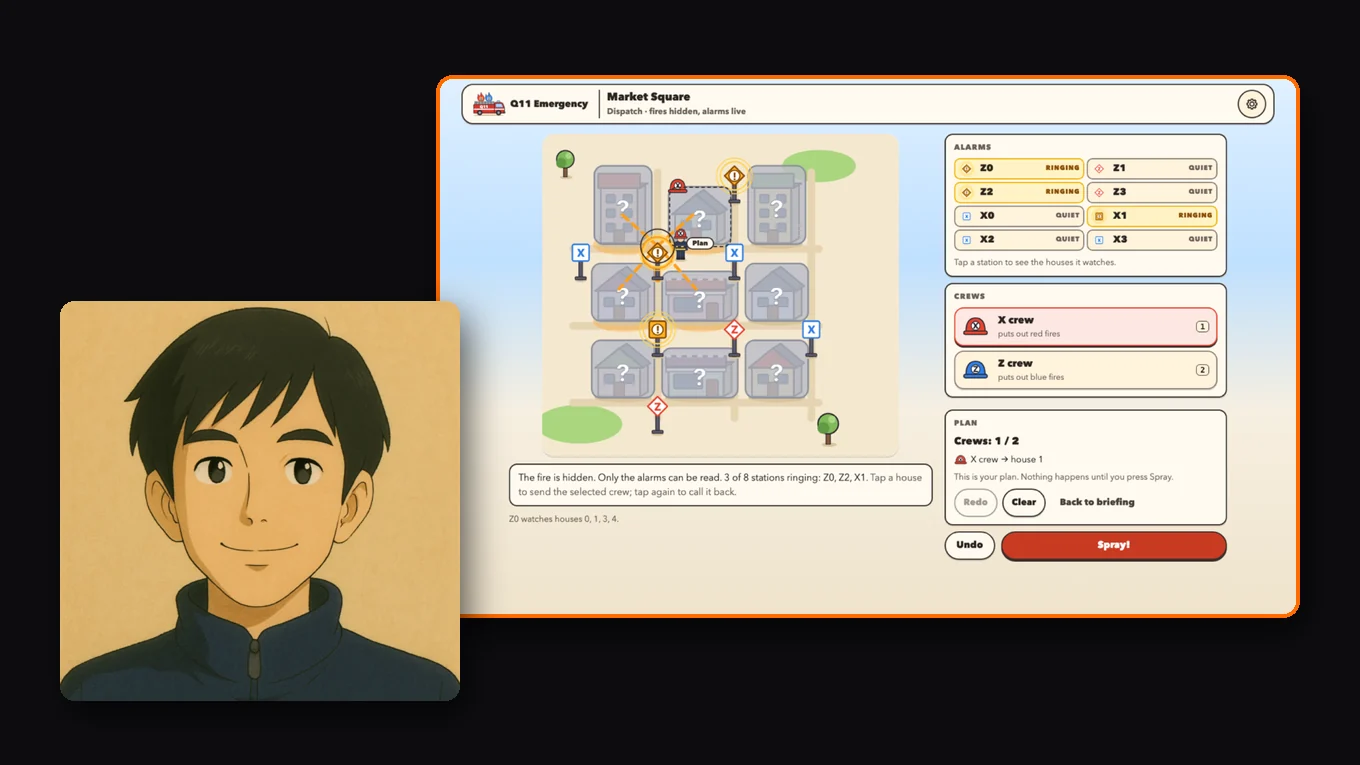
His favourite detail is the moment after you place the detectors, when a fire truck pulls up and the crews head out. The game's calculations are checked independently with Qiskit.
Tomoya built the game with an AI coding assistant. The first working version was simple, and making it fun to play took many more rounds of refinement. His advice to beginners quotes Christopher Nolan's Tenet: "Don't try to understand it. Feel it."
I see quantum computing as a technology that could drive the next major scientific and technological revolution after AI. Through Q11 Emergency, I wanted to make some of its underlying ideas accessible through an experience that people could enjoy and explore.
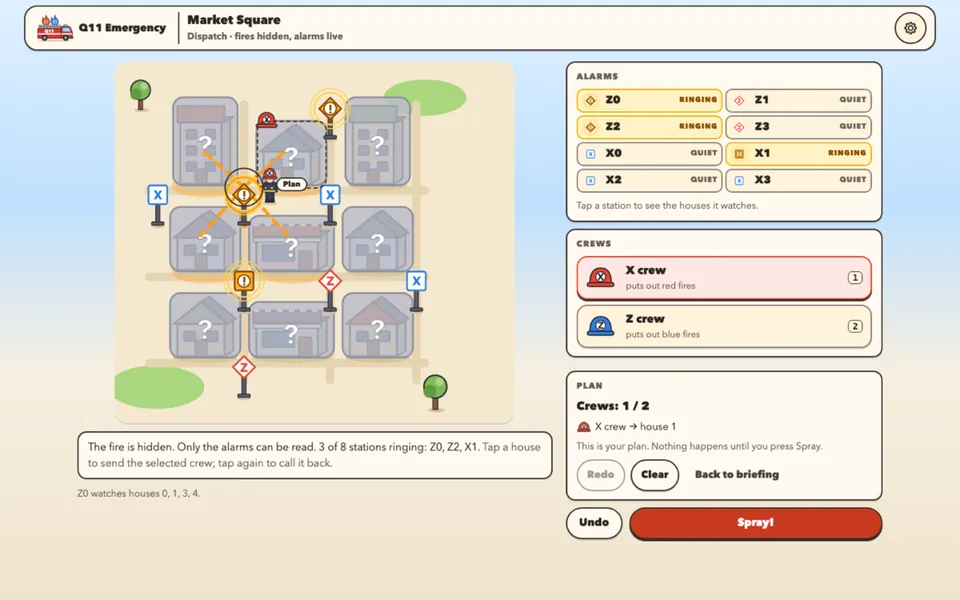 Q11 EmergencyA puzzle game where players fix hidden errors using only the alarm signals.
2nd place: Syndrome: You Are the Decoder
Kanhaiya Mehta built Syndrome: You Are the Decoder on his own. He is a third-year computer science student at IIIT Dharwad with a minor in quantum information science. Kanhaiya usually competes with his hackathon team, PIXEL.AI.
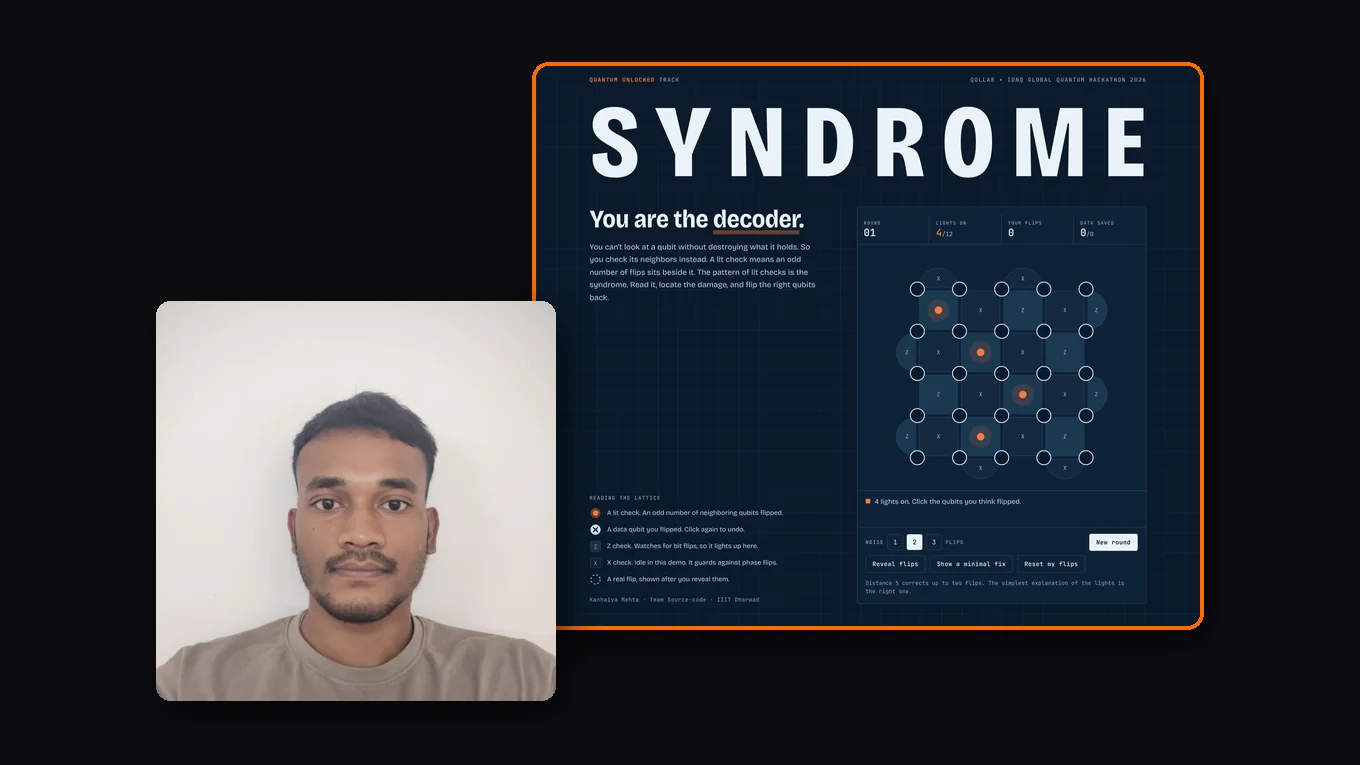
In Syndrome, the player is the decoder. You never see the qubits, only which alarm lamps lit up, and you decide what to fix. Every lamp, score and chart comes from circuit results measured in advance, so the game never makes up an outcome. In level 2, "The snap", a tiny rotation of one qubit comes out of every shot as either no error or a full flip.
His first run on IonQ's Forte 1 noise-model simulator came back with zero errors in 200 shots. He did not expect that from a circuit with 27 two-qubit gates. "For about a minute I thought I had broken physics; then I realised the compiler had just been very clever." He rewrote the circuits in IonQ's native gates, and the next run showed realistic noise.
Before this weekend, I thought quantum computing was mostly about algorithms that would be fast someday. Now I see the real race is against noise: the same surface code beat a bare qubit on IonQ's Forte noise model and lost on IBM Kingston's, and that difference is the whole story.
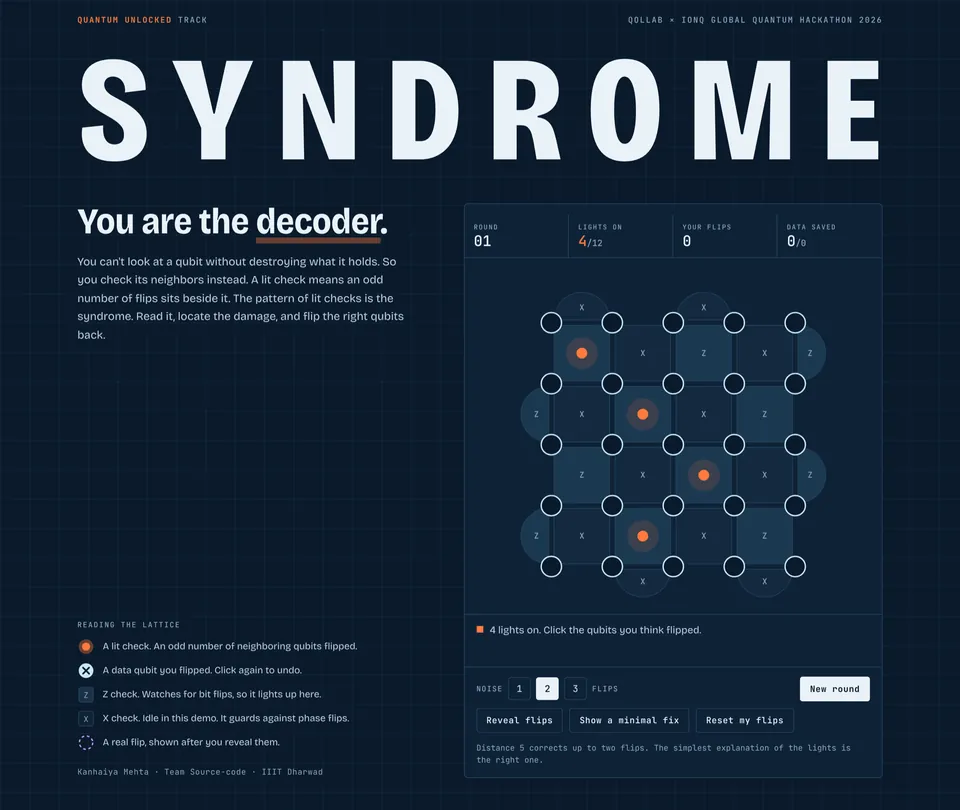 Syndrome: You Are the DecoderA puzzle game where you play a quantum computer's error-correction decoder.
3rd place: Quantum Odyssey: The Locked Museum
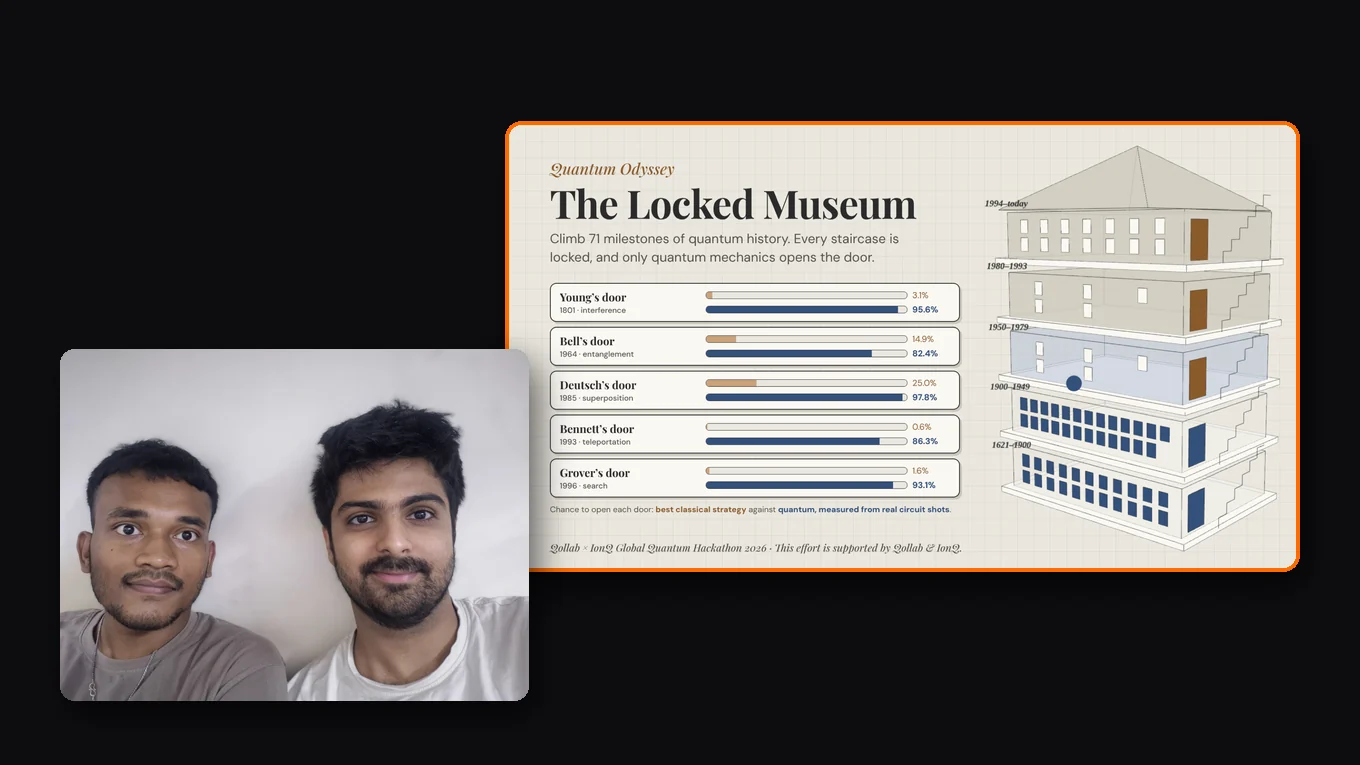
Kanhaiya placed a second time with his classmate Arnav Angarkar, also a third-year computer science student at IIIT Dharwad. Quantum Odyssey: The Locked Museum was the first project they built together.
The idea came from a complaint about quantum games where the qubit is a coin flip that a random number generator could replace. So they built a museum where only a quantum effect opens the door. The museum grew out of Kanhaiya's earlier timeline of 71 quantum milestones, from 1621 to today. It is now a five-floor tower with a locked door at the end of each floor.
Each door shows the best classical strategy's odds next to the measured quantum ones. Bennett's teleportation door opens 0.6% of the time classically and 86.3% with teleportation. At Young's door, switching on a which-path detector makes the interference pattern vanish.
Next on their list are a door where Shor's algorithm factors 15 and a quantum key distribution door where an eavesdropper trips the alarm.
Waiting on the IonQ simulator. A 200-shot run takes a few minutes, and we spent them hoping our packed 29-qubit circuit would split back into the right experiments.
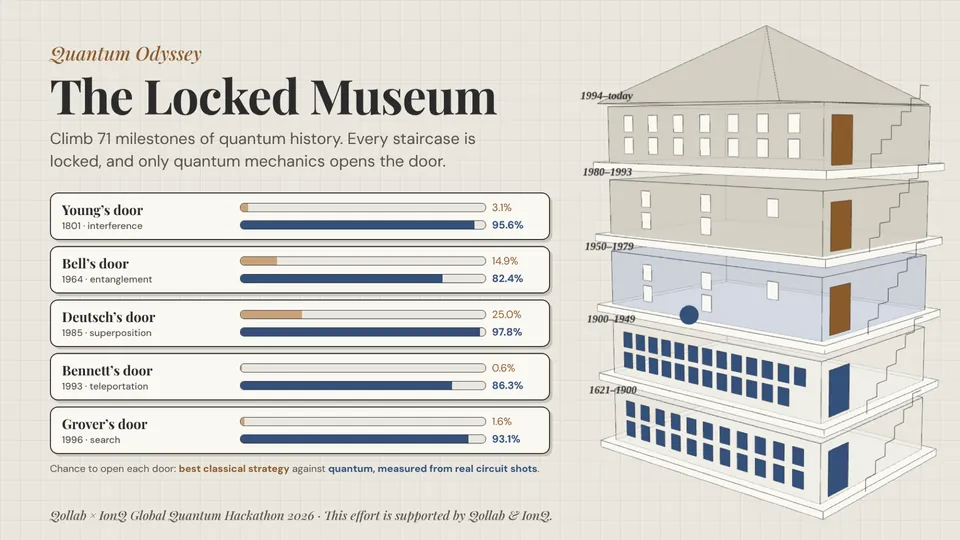 Quantum Odyssey: The Locked MuseumA museum game where every locked door opens only with a quantum effect.
Every other project from IIIT Dharwad
Like Q11 Emergency and Syndrome, OrganOS took on quantum error correction, with a demonstration of logical qubits and error recovery. Finance came up again and again, with fraud triage, two option-pricing experiments and a systemic-risk sampler.
Some builders entered more than once. Team momosapiens, sans_yuh and inavihs, entered four projects, from a music duet to a threat radar for forged quantum signatures. Kanhaiya Mehta's third entry is The Quadratic Bet.
The other 20 projects entered at the node, A to Z.
- CarbonGaurd-Q: Quantum optimization for carbon-aware supply-chain recovery.
- Custom Circuit Passport: Paste a circuit and get a "nutrition label" across Qollab's 8 IBM noise-model simulators and the IonQ Forte noise model.
- DQI Lab: Optimization by Decoding: Interactive lab for Decoded Quantum Interferometry: move the decoding radius, watch DQI improve until the decoder breaks, and see where gate noise erases its gain, verified on IonQ simulators.
- Entanglement Trap: More entanglement made you worse: play one round, then test a maximally entangled vs separable probe on two hidden channels.
- FinGuard-Q: A hybrid quantum-classical prototype for prioritizing financial fraud investigations under limited analyst time.
- Heat Equation Solver: Solving the heat equation using quantum mechanical methods and a comparison with classical computation.
- Isai: The 8/9 Duet: Isai turns quantum weirdness into music.
- Mycelium: The Trotter Garden: Mycelium is an Opus Magnum-style puzzle game where you build Trotter schedules to simulate a 7-qubit spin network, racing an exact “ghost” state.
- Network Risk Analysis with Quantum Enhanced Markov Chain Monte Carlo (QeMCMC): A hybrid quantum-classical sampler for systemic-risk policy: where classical Metropolis freezes at low temperature, quantum tunneling proposals recover bailout/widening rankings with high fidelity.
- OrganOS Logical Qubit & Quantum Error Correction: A reproducible quantum error correction demonstration exploring logical qubit encoding, syndrome measurement, logical gates, entanglement, and error recovery using Qiskit simulation.
- OrganOS Quantum Optimization Navigator: OrganOS is an 8-qubit constrained quantum path optimization prototype using a constraint-preserving mixer and Qiskit statevector simulation.
- QFrost Triage: a security scanner for quantum circuits: QFrost Triage is a static analyzer for quantum circuits, like a SAST scanner for code.
- QMPRS: Quantum Matrix Product Representation Synthesis: QMPRS is an approximate state preparation algorithm utilizing Matrix Product State (MPS) IR to mitigate circuit overhead of state preparation compared to exact approaches, adopting best practices and novel additions for performance.
- QSwipe: QSwipe gives your thumb a portfolio.
- Quantum Illumination Radar: Qiskit simulation of quantum illumination radar: entangled Bell-pair probes vs classical probes for detecting a faint drone in noise.
- QuantumRoute Rescue: Hybrid Quantum–Classical Delivery Recovery: QuantumRoute Rescue helps recover delivery plans after unexpected delays while protecting customer deadlines.
- QuatumEdge: QAE vs Monte Carlo: A reproducible quantum option-pricing experiment that separates estimation error from financial discretization and measures the circuit cost behind theoretical quantum advantage.
- Schrödinger's Detective: A detective game where quantum measurement is the mechanic: each lab test collapses the evidence, scrambling later tests.
- ShorlyNot: A Threat Radar for Quantum Digital Signatures: ShorlyNot is a live threat radar for quantum digital signatures: a statistical bound (Hoeffding) flags forged signatures, and a staged defense locks bank transfers S0→S4.
- The Quadratic Bet: Quantum Option Pricing, Noise Included: Prices a stock option two ways: classical Monte Carlo and quantum amplitude estimation, run as one native-gate job on IonQ.
IIIT Dharwad on Qollab
Specialty awards follow on Wed Oct 28 and global winners on Thu Oct 29, and the Hackathon 2026 results page links to every node's post.
Open any project on IIIT Dharwad's node page on Qollab to read its code, run it and fork it. You can also follow the node there. The page shows the node's numbers, its members and node team, and all 23 hackathon projects.
 Hackathon 2026
Stay in the loop.
Get the latest tutorials, demos, and project showcases straight to your inbox. No noise, just the good stuff.
Enable JavaScript to sign up.
Qollab updates only. Unsubscribe any time. Privacy Policy.