Florida International University winners: Qollab x IonQ Hackathon 2026
Three winning projects from 23 entered at the Florida International University node.
At the Florida International University node of the Qollab x IonQ Hackathon 2026, 30 teams signed up, 17 of them solo. Of the 30, 26 were on the student track and 4 on the professional track. The online build weekend ran from 7 PM ET on October 9 to 7 PM ET on October 11. In that time, 17 of the 30 teams entered 23 projects.
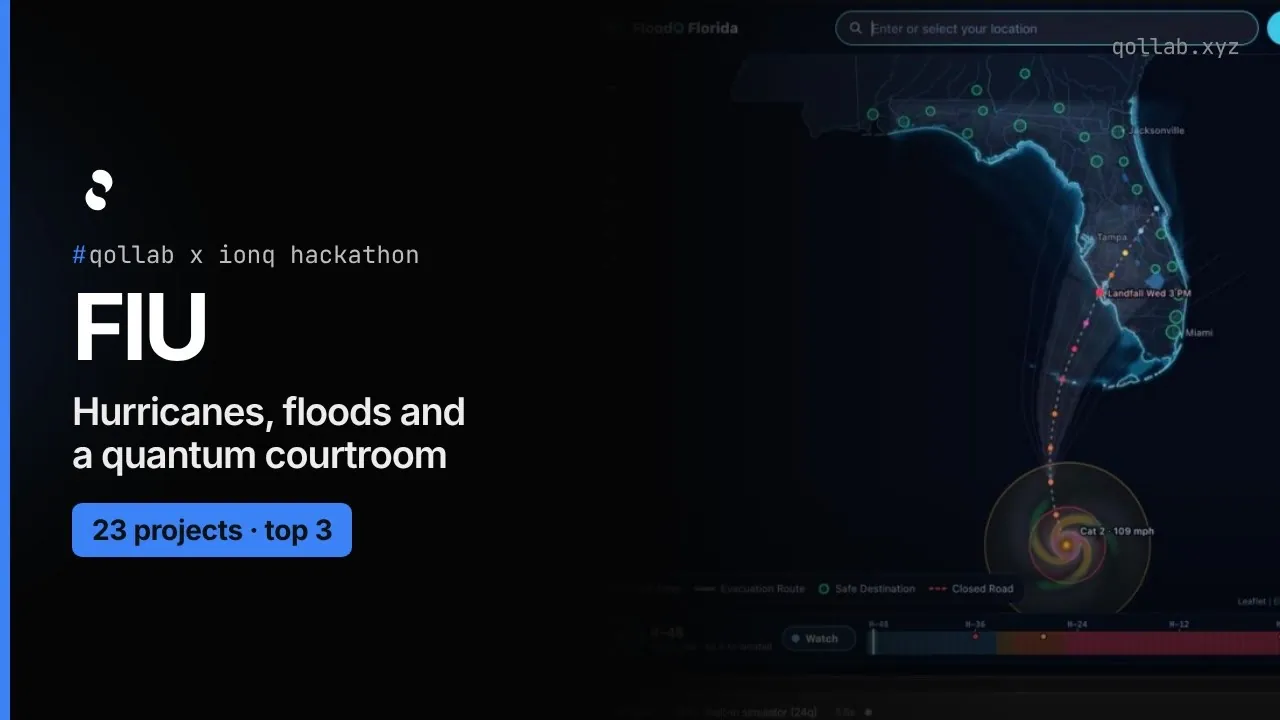
The projects range from water monitoring and organ transport to a quantum arcade and a cybersecurity arena where defenders hide trap qubits to detect attacks. Every one of them is open source on Qollab.
The Florida International University node
Adil Amaan led the node with Anwer Shees and Dr. Hasan Iqbal, a postdoctoral associate in FIU's Department of Electrical and Computer Engineering. FIU's College of Engineering and Computing put the hackathon on the university's events calendar. Most teams heard about it through the university: 23 of the 30.
FIU runs Q-STAR, a National Science Foundation Research Traineeship that prepares materials science and engineering graduate students for careers in quantum information science and engineering. Faculty in the College of Engineering and Computing work on qubit control, quantum materials and quantum machine learning. The college's courses include Introduction to Quantum Computers and Advanced Quantum Computers.
The projects were scored on novelty, technical execution, impact and documentation. The node's judging panel was Dr. William Anderson, Dr. Misak Sargsian, Dr. Alexander Mebel, Dr. Arif Sarwat and Avinash Jeewani. Dr. Satheesh Bojja Venkatakrishnan and Dr. Shamim Ara Shawkat joined it during judging.
1st place: Entanglement Court
In Entanglement Court, two quantum states give exactly the same bar chart of measurement results, but only one of them is entangled. Saurav Das built the game on his own, as team Inquisitive Equus. He is a PhD student in Electrical and Computer Engineering at FIU and had no quantum experience before the hackathon. To prepare, he went through hundreds of papers.
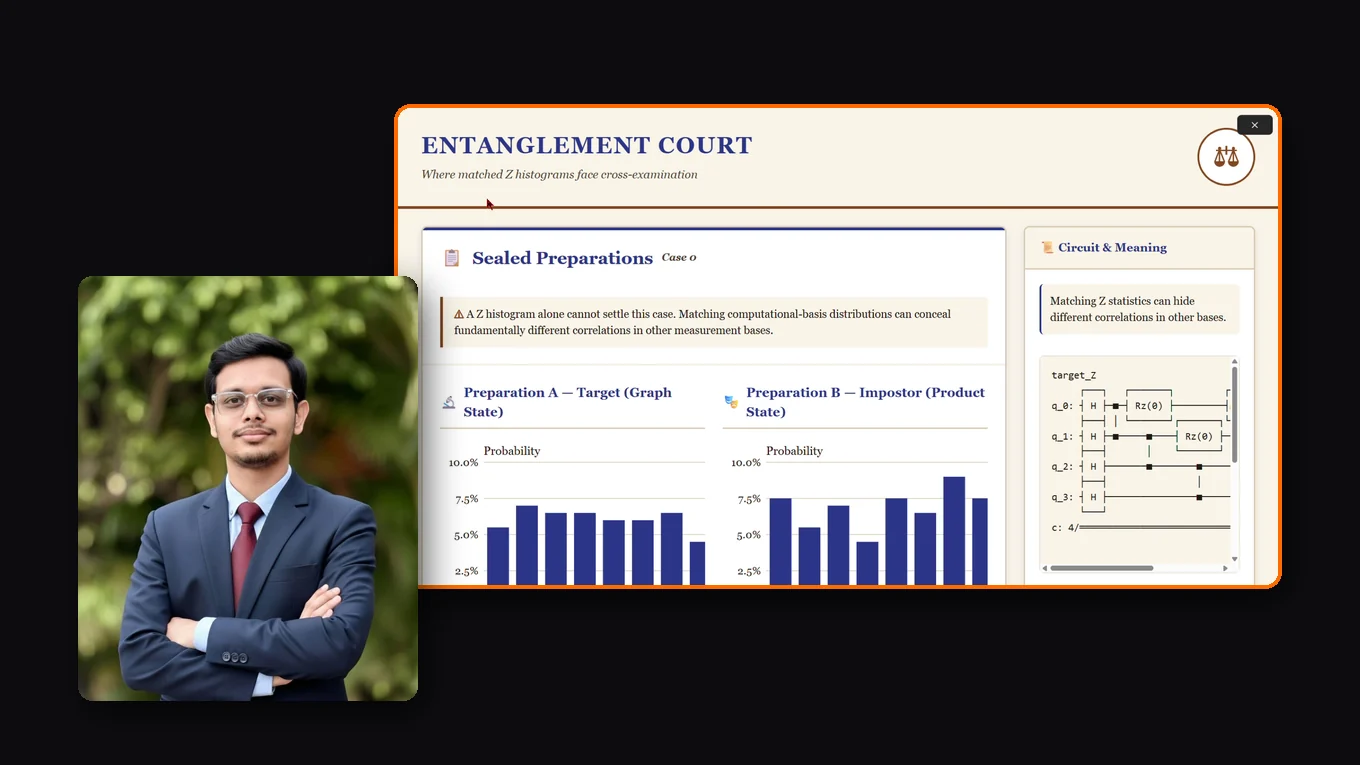
You play the judge: commit to a verdict first, then cross-examine both states in other measurement bases. The entangled state's checks sit near +1, while the impostor's hover around 0. "Insufficient evidence" is one of the verdicts, and the Evidence Stamp at the end lists every assumption the court relied on.
On Saturday, Saurav found that six of his hard test cases had run without the preparation noise they were designed to have. He built that noise into the circuit, ran the cases again and kept the flawed runs in the record, clearly labelled.
On IonQ's Aria 1 noise-model simulator, the court certified all 12 clearly entangled cases and refused all 12 borderline ones. "Strangely, I was happier about the 12 refusals."
Next, Saurav wants to take the court to IonQ hardware with measured readout-error bounds. A two-player classroom mode is on his list too, where one student prepares a convincing fake and another has to unmask it. He also entered Eyes-Free Entanglement and The Noise Tax.
Before this weekend, I thought quantum computing was a super-fast computer that tries every answer at once and will one day make today's computers obsolete. Now I see something stranger and more beautiful: a machine whose power hides in correlations that no single measurement can show you.
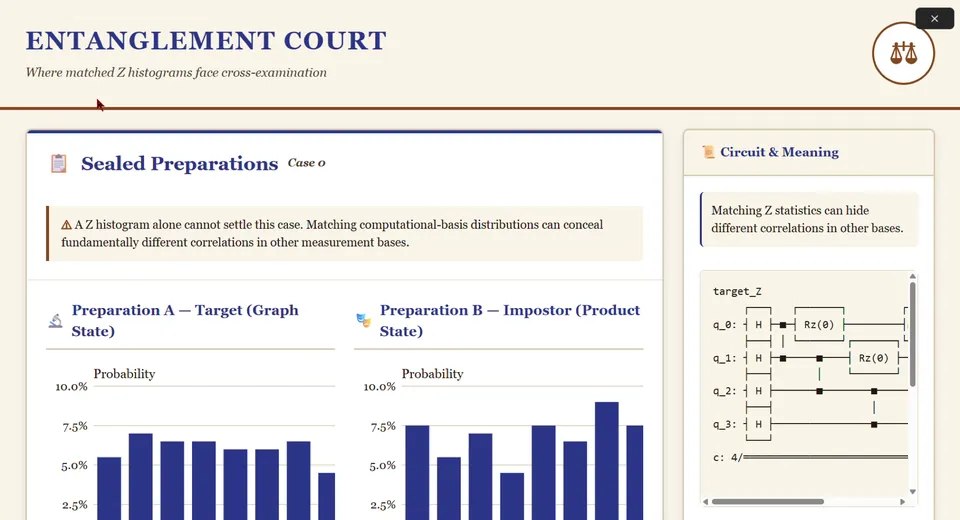 Entanglement CourtA courtroom game that certifies entanglement only when the evidence holds up.
2nd place: Spin-Photonic Qubit Entangled Route
Spin-Photonic Qubit Entangled Route models a ten-node quantum network of solid-state spin-photon qubits and finds the most reliable route through it. Sakib Sazzad built it on his own. He is a PhD candidate at the University of Central Florida, where he researches silicon-based spin-photon qubits in Dr. Wayesh Qarony's Q-Lab.
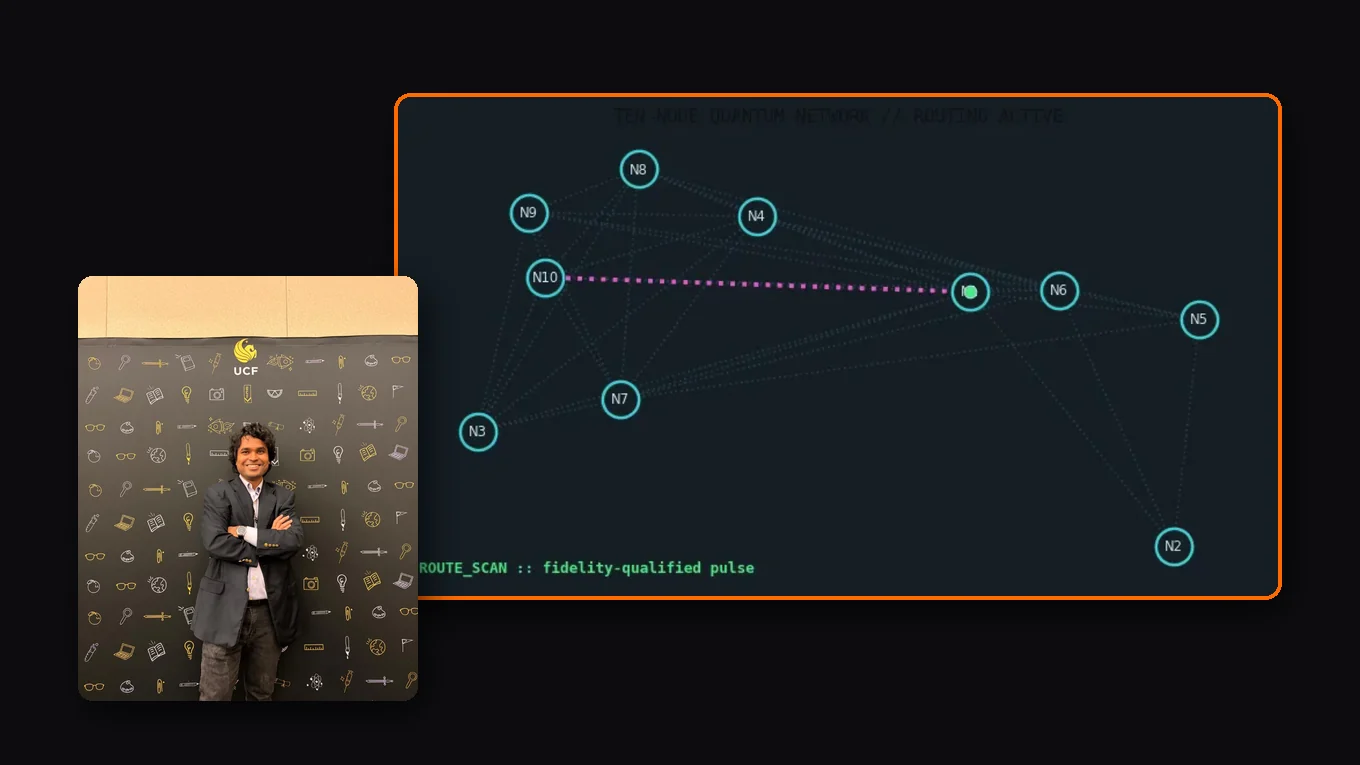
A nine-qubit Qiskit circuit measures the fidelity of raw and purified Bell pairs on IonQ's Forte 1 noise-model simulator. A transparent classical algorithm combines those numbers with fiber loss, memory decay and source efficiency to choose the route.
The hardest part was keeping quantum processing and classical routing apart. Anyone who forks the project can enter their own device's Hong-Ou-Mandel visibility and source-to-click efficiency to see how their hardware changes the route.
Next, we plan to scale the network model and validate it experimentally in our lab using real spin–photon interfaces, measured device parameters, and physical entanglement links.
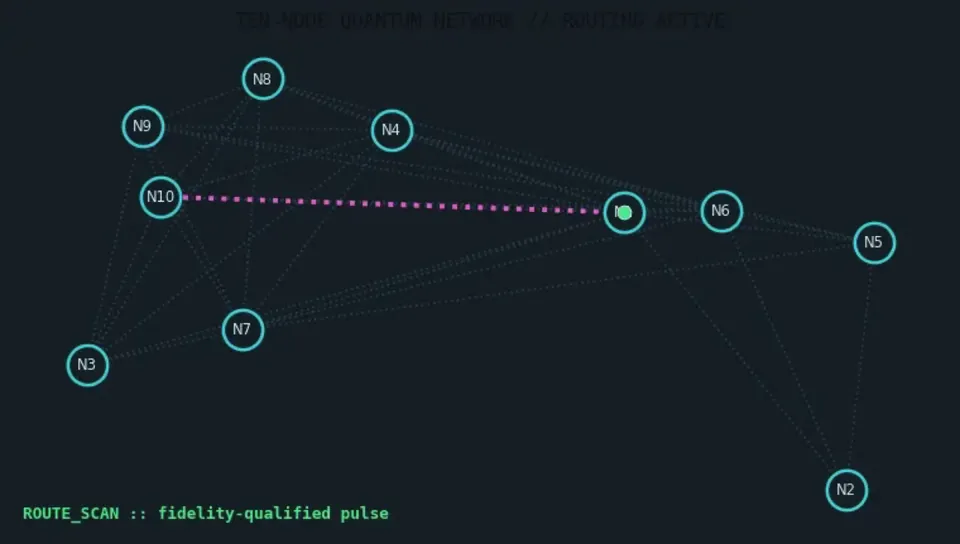 Spin-Photonic Qubit Entangled RouteA Qiskit tool that ties spin-photon qubit hardware to entanglement transport and purification.
3rd place: FloodQ Florida
FloodQ Florida looks for safer hurricane evacuation routes across Florida. Dipak Dahal and Anuragi Thapa, team QubitFIU, built it. They live and study in Florida and wanted to see how technology could help keep their communities safer. Both are PhD students in Civil and Environmental Engineering at FIU. Dipak's research explores quantum computing for civil engineering problems, and Anuragi works on computational geomechanics and machine learning.
You pick a location and see hurricane tracks with flood and wind hazards. FloodQ evaluates thousands of possible routes and shows the five leading options, ranked on modeled safety, traffic, travel time and feasibility. The route optimization uses QAOA in Qiskit, run on a simulator.
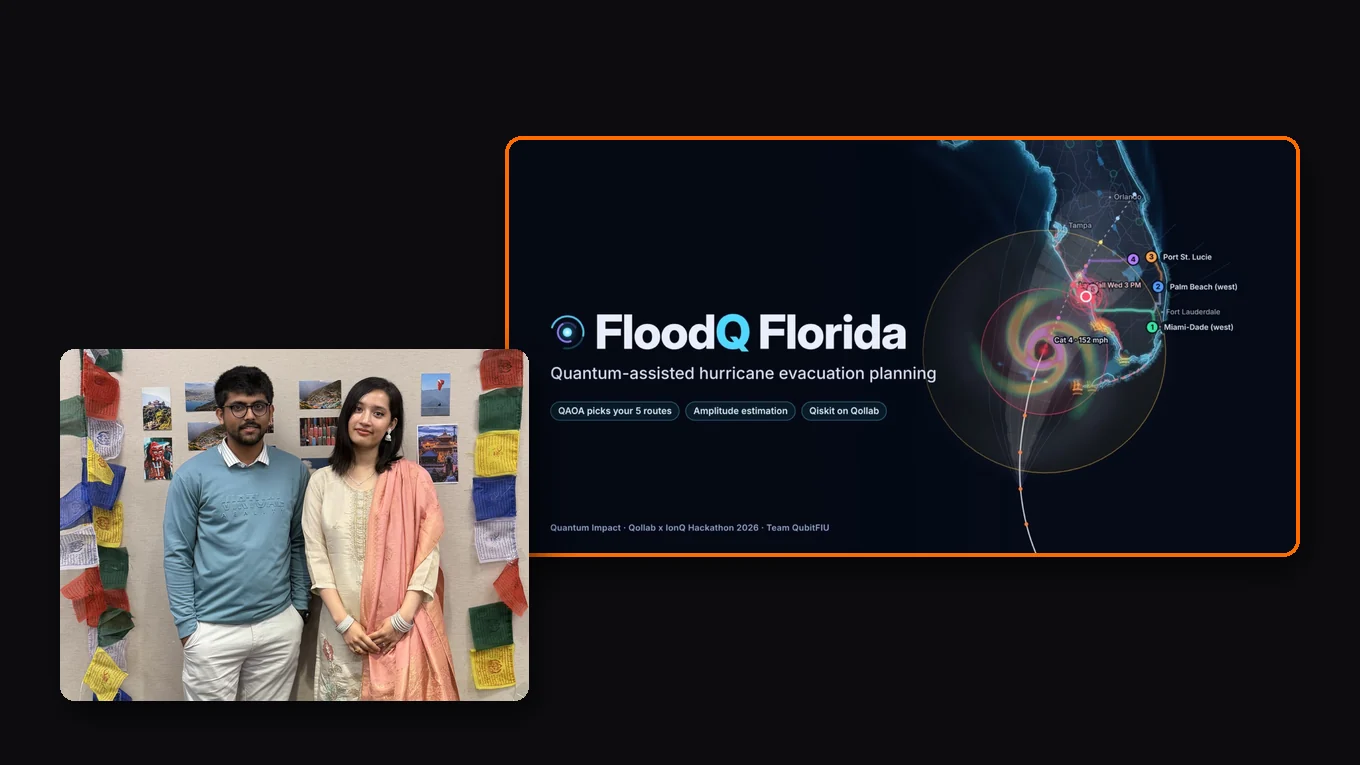
Dipak and Anuragi are both from Nepal, but they only got to know each other in the United States. By coincidence, they ended up working under the same professor, and they like to think it was destiny. Over the weekend the two debated ideas, debugged code and sometimes disagreed. Anuragi made food for Dipak when he got hungry mid-build. Once the code ran, they celebrated by dancing together.
Next, Dipak and Anuragi want to connect FloodQ to real-time weather, traffic, road-closure and flood data. Then they plan to benchmark the quantum-assisted optimization against classical methods on larger evacuation networks.
As researchers interested in computational methods and quantum computing, we wanted to take our research beyond theory and apply it to a practical problem. This hackathon strengthened our interest in exploring quantum algorithms for engineering and societal challenges.
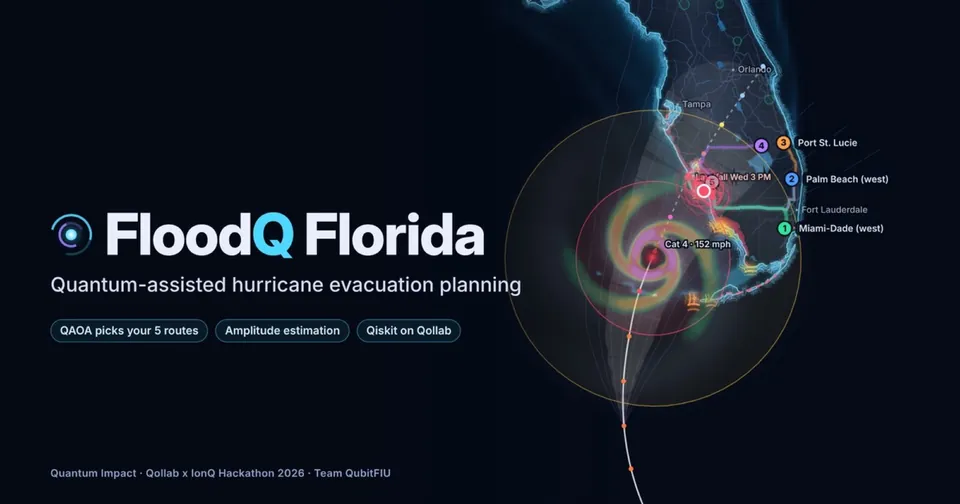 FloodQ Florida: Quantum Assisted Hurricane Evacuation PlanningAn evacuation planner that combines storm maps, road networks and quantum optimization.
Every other project from Florida International University
Several of the node's other projects deal with noise. Among them are aetar's Beat the Compiler and SWAP Tax, qdebug from ronaldhdez and jeanm, and the Qiskit game Decoder Duel.
The other 20 projects entered at the node, A to Z.
- AquaSentinel-Q | Quantum Water Resilience: A hybrid quantum-classical platform for resilient water monitoring.
- Axolotl Q: A Quantum AI Brain That Regenerates: Inspired by axolotls regrowing brain tissue, Axolotl Q tests if a quantum AI brain can recover from damage.
- Beat the Compiler: Route a circuit by hand on a heavy-hex or grid chip, race a search agent and Qiskit's router, and see what each SWAP costs in fidelity, measured on the IonQ Forte noise model.
- BENFORD GHOST: An interactive Qiskit experiment showing how a distribution can match Benford's law in plain sight yet reveal quantum-detectable structure after scaling.
- Cipherq_policy_lab
- CLOUDSHIFT: An interactive Qiskit optimizer for assigning six agents to two quantum resource pools.
- complementarity-console
- Decoder Duel: Learn quantum error correction by out-decoding the machine: a Qiskit game and lab where real circuits produce the syndromes you decode, then benchmark logical errors on the built-in simulator, IBM noise models and IonQ.
- Eyes-Free Entanglement: Hear, read and see one measured quantum result: a GHZ parity fringe as sound, a screen-reader-ready text receipt and a chart, with recorded IonQ simulator data.
- How much liquidity should a bank prefund for the weekend?: Quantum amplitude estimation of the probability that a weekend drains a bank’s prefunded Pix liquidity, using Central Bank of Brazil data, benchmarked against classical Monte Carlo at equal model evaluations.
- Meaningful Quantum Search: MQS sorts documents by similarity to a users search request.
- Q-Organ Route: Organs get lost when transport fails.
- QChat AI - Quantum Hackathon Chatbot: Free browser AI chat with a real Qiskit QAOA decision optimizer, circuit inspection, measured results and classical benchmarks.
- qdebug: qdebug helps quantum developers tell logic bugs from noise.
- QMoney - Quantum Hackathon Financial Roadmap: QMoney is a budgeting app that helps pay debts and plan where your money should go.
- QTrap Arena: Interactive quantum cybersecurity arena where attackers tamper with quantum circuits and defenders use hidden trap qubits to detect attacks.
- Quantum World: A futuristic quantum arcade featuring three interactive challenges, animations, real-time quantum probabilities, sound effects, achievements, and Qiskit verification.
- SWAP Tax: Same Noise, Different Wiring: Same circuit, same IonQ noise model, two compilations: All-to-all vs. heavy-hex routing.
- The Noise Tax: How much noise erases a quantum advantage?
- The Role of Interactions in Sustaining Spin Oscillations.: Explore how pulse errors, spin interactions, and noise affect a driven quantum spin chain.
Florida International University on Qollab
Specialty awards follow on Wed Oct 28 and global winners on Thu Oct 29, and the Hackathon 2026 results page links to every node's post.
Open any project on Florida International University's node page on Qollab to read its code, run it and fork it. You can also follow the node there. The page shows the node's numbers, its members and node team, and all 23 hackathon projects.

Stay in the loop.
Get the latest tutorials, demos, and project showcases straight to your inbox. No noise, just the good stuff.
Enable JavaScript to sign up.
Qollab updates only. Unsubscribe any time. Privacy Policy.