ACENET (Atlantic Canada) winners: Qollab x IonQ Hackathon 2026
Three winning projects from 26 entered at the ACENET (Atlantic Canada) node.
At the ACENET node of the Qollab x IonQ Hackathon 2026, 45 teams signed up, 27 of them solo. Of the 45, 34 were on the student track and 11 on the professional track. The online build weekend ran from 7 PM ET on October 9 to 7 PM ET on October 11. In that time, 15 of the 45 teams entered 26 projects.
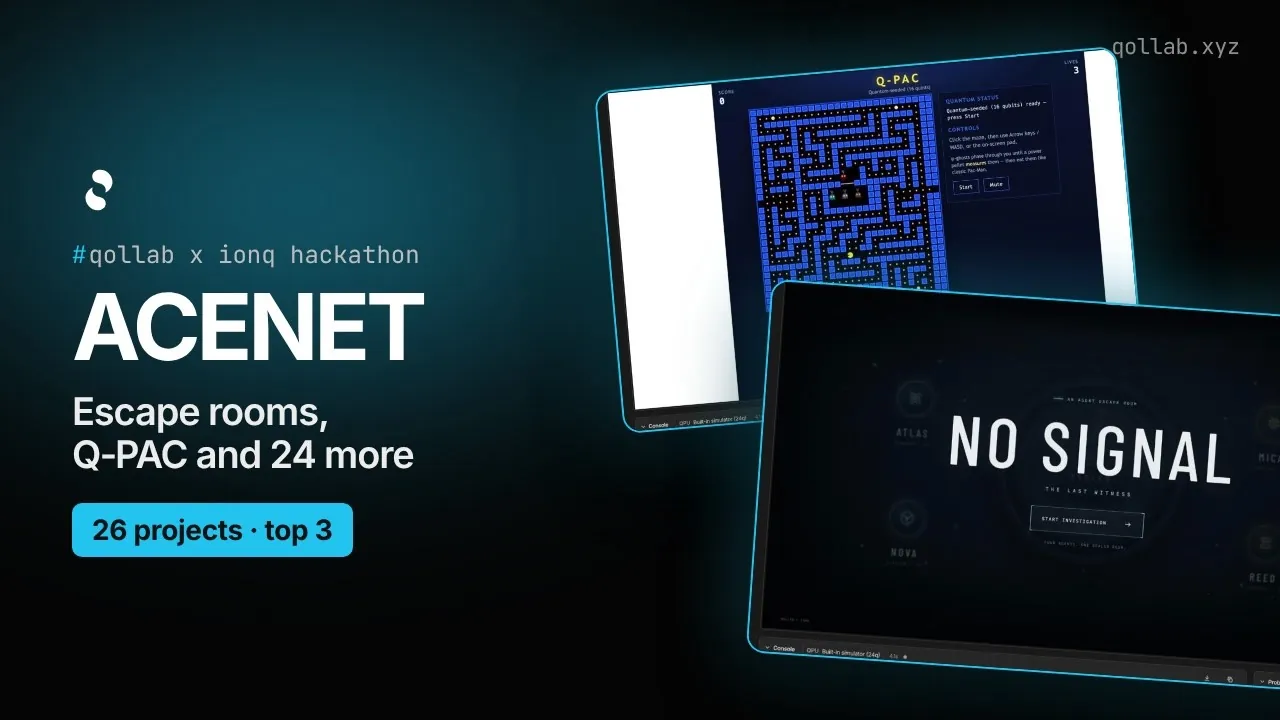
The projects range from Kubernetes workload placement and sports odds to a bomb-testing game and a quantum walk across eight St. John's Metrobus stops. All were entered over Canada's Thanksgiving weekend. Every one of them is open source on Qollab.
The ACENET node
ACENET is a research computing consortium of 15 universities and community colleges in Atlantic Canada. It signed on in September as the hackathon's Atlantic Canadian partner. Muhammad Muzammil (Muz), ACENET's Digital Research Consultant for quantum computing, led the node with Michele Fash, its Director of Business Development. Muz holds a PhD in theoretical and mathematical physics from the University of New Brunswick (UNB).
For summer 2026, ACENET secured four places in Calcul Québec's online summer program in quantum computing, one for each Atlantic province. The students got access to MonarQ, a 24-qubit superconducting quantum computer. One of the four, Muhammad Umair Akram Butt, went on to take 1st place at this node.
Dr. Stijn De Baerdemacker and Dr. Edith Leal-Sánchez scored the projects on novelty, technical execution, impact and documentation.
1st place: Q-Avoid
Q-Avoid uses quantum amplitude estimation to work out the probability that two satellites collide. Tushita Govindaraj, a final-year honours student researching how to steer large language models, and master's student Muhammad Umair Akram Butt built it as team RAI-Lab. Both study computer science at UNB.
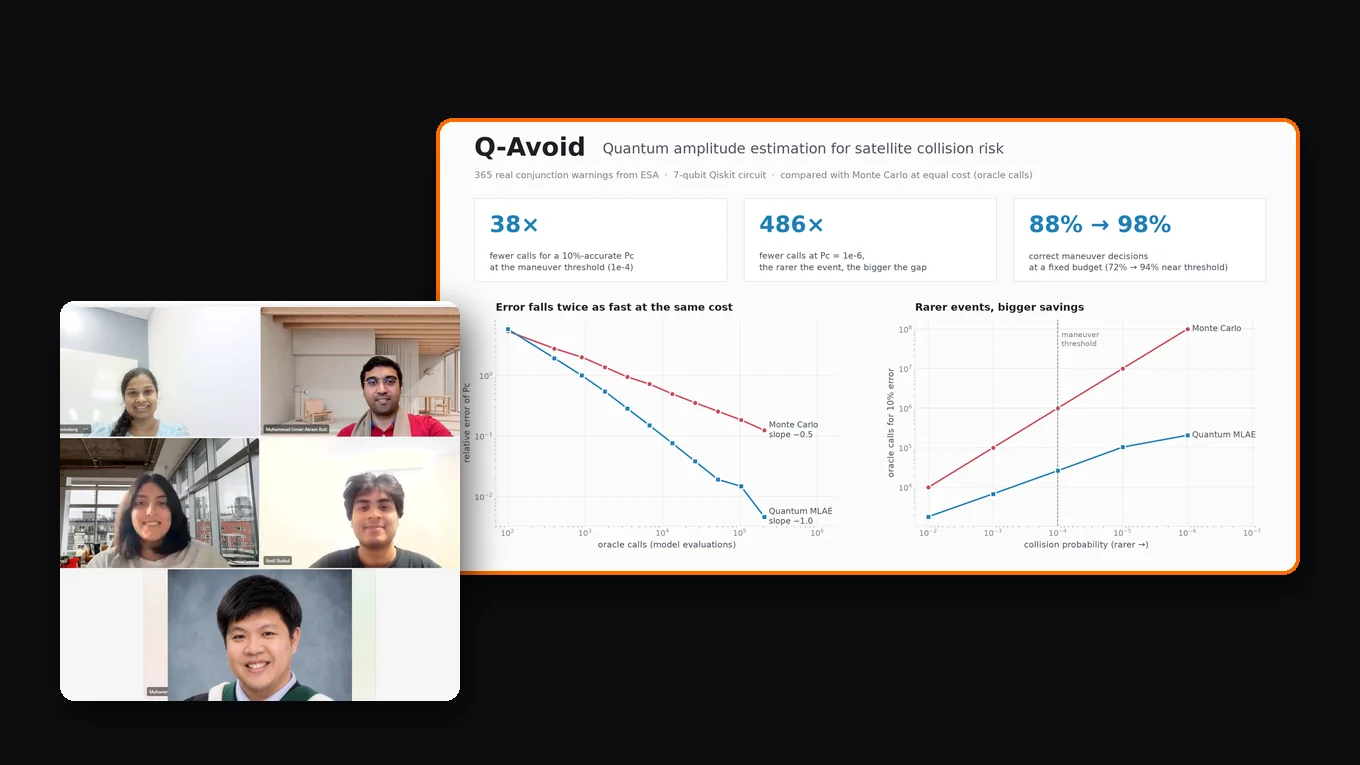
The team wanted a problem where a quantum speedup could be measured, and chose satellite collision avoidance. They link it to Atlantic Canada, where RADARSAT satellites watch the coast for sea ice, oil spills and ship traffic. The team tested Q-Avoid against classical Monte Carlo on 365 real ESA conjunction warnings.
For the same number of model evaluations, the share of correct maneuver decisions rose from 88% to 98%. Theory gives Monte Carlo error a slope of −½ against cost and amplitude estimation a slope of −1. On the ESA data, the fitted slopes came out at −0.49 and −0.99. The notebook notes that the deepest circuit needs about 8,600 two-qubit gates, which requires fault-tolerant hardware.
Almost two hours before the deadline, the team's Qiskit runs and their fast simulation disagreed. The sampler was being reseeded on every call, so 20 runs that should have been independent were the same run 20 times.
Next on their list is a hardware noise model, to find how much of the amplification survives on real devices.
Team RAI-Lab also entered ChemScope, PhaseCheck and Roost.
The first real proof came when the circuit's probability of measuring the "hit" qubit printed 3.007282e-04, and the classical reference integral printed exactly the same number, 3.007282e-04. Seven digits, identical. Up to then I'd been hoping the encoding was right; after that I knew it was. With the clock running down, I let myself enjoy it for about ten seconds and then went straight on to the benchmarks.
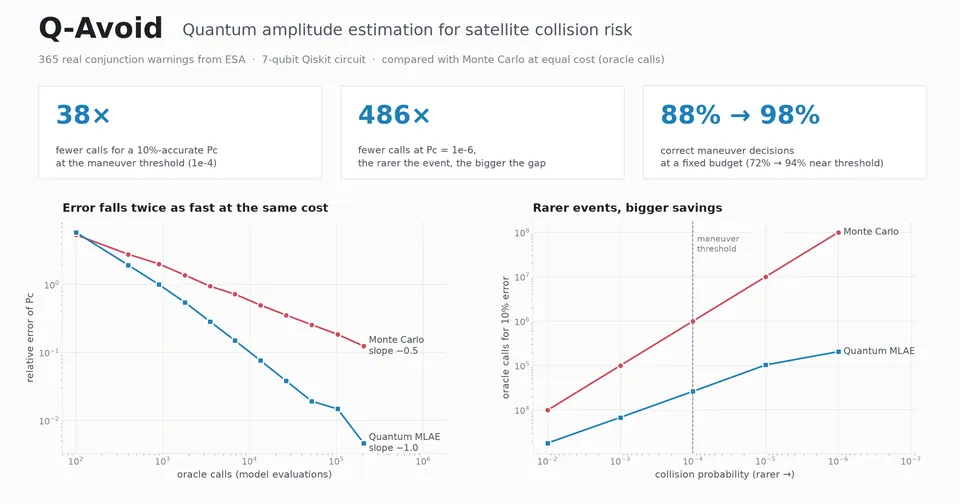 Q-AvoidUp to 486 times fewer model evaluations than Monte Carlo for one-in-a-million collision risks.
2nd place: Agent Escape Room
Agent Escape Room is a murder mystery with four AI agents, two conventional and two quantum. You inspect them and work out who framed one of them, NOVA. Salsabil Ben Halima built it on her own. She is a data engineer and a first-year master's student in computer science at the Université de Moncton, with a thesis on financial technologies.
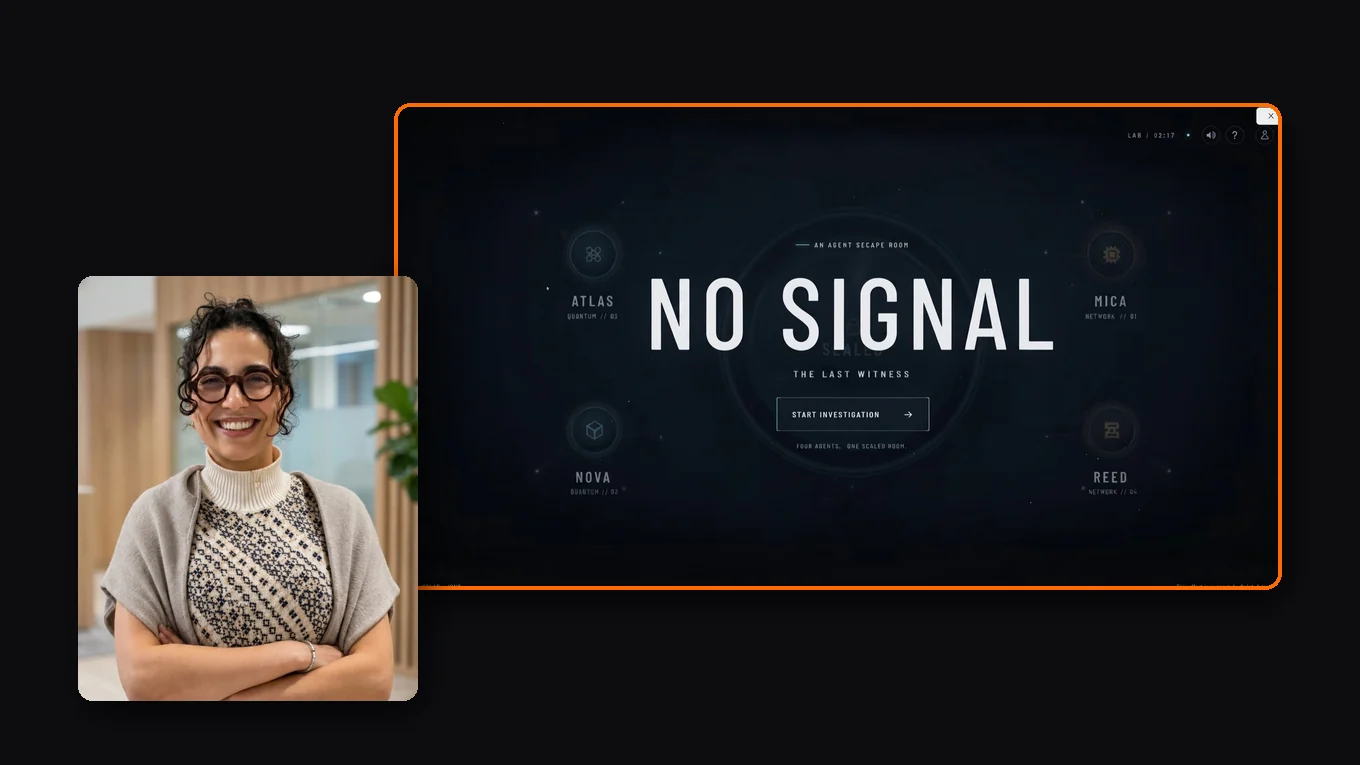
The idea came from Salsabil's love of mysteries and escape rooms, and from the attention AI agents were getting. After inspecting the agents, you repair a sabotaged Bell-state preparation and run a quantum-versus-classical challenge.
The two quantum agents receive private signals and cannot talk during a round, so they coordinate through a shared Bell state. The game compares their trained policies with the best classical strategies.
When Salsabil moved from the built-in simulator to a remote IonQ simulator, the run failed. She took a few deep breaths and traced the problem to how the circuit was submitted. She adapted it into a single-circuit job and checked the results with Qiskit.
Next, she wants to add new puzzles and harder coordination challenges, and test whether the quantum agents' advantage holds across them.
She also entered PHANTOM MARKET.
Start by making the mystery your own: change the characters, setting, and clues while keeping the coordination experiment unchanged. Once your version is working, try changing the agents’ policies or creating a new puzzle and compare the results.
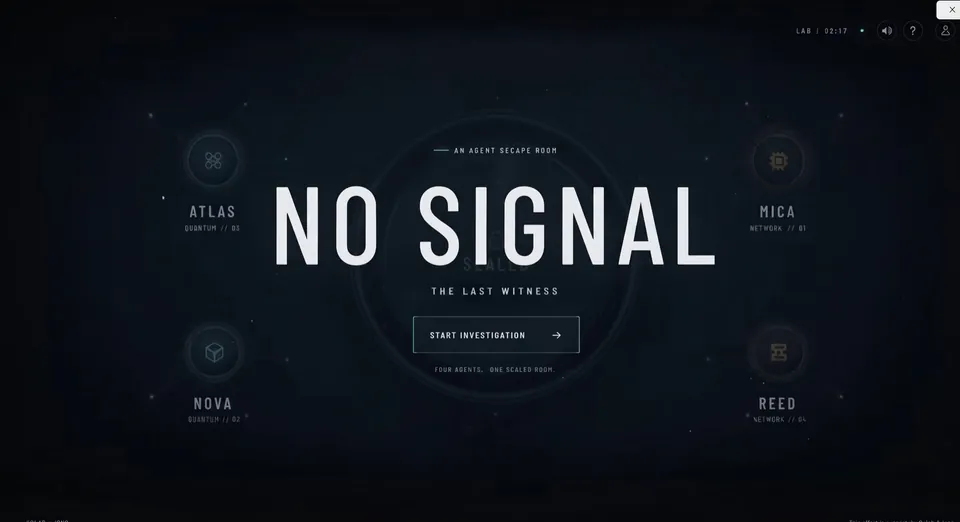 Agent Escape Room: Who killed DR. Vale?A quantum murder mystery you can play on Qollab.
3rd place: Can you hear entanglement
Can you hear entanglement turns quantum circuits into music. Amir Ayati, Ehsan Ghasempouri and Vivek Das built it as team EAD, short for Entanglement & Decoherence. They are labmates in the QuNB group at UNB. Amir is a quantum chemist and postdoctoral researcher, Ehsan is finishing a PhD in chemistry, and Vivek is a final-year PhD student in chemistry.
The idea came from the glove example often used to explain entanglement: a pair of gloves in two boxes is only correlated. The team wanted a difference you could notice, and chose music.
Time qubits count the beats and note qubits pick the notes, so a quantum state plays as a song. In the project's encoding, superposition alone sounds like a drone, and only entanglement turns it into a melody. A second measurement tells real entanglement apart from a classical copy that sounds the same.
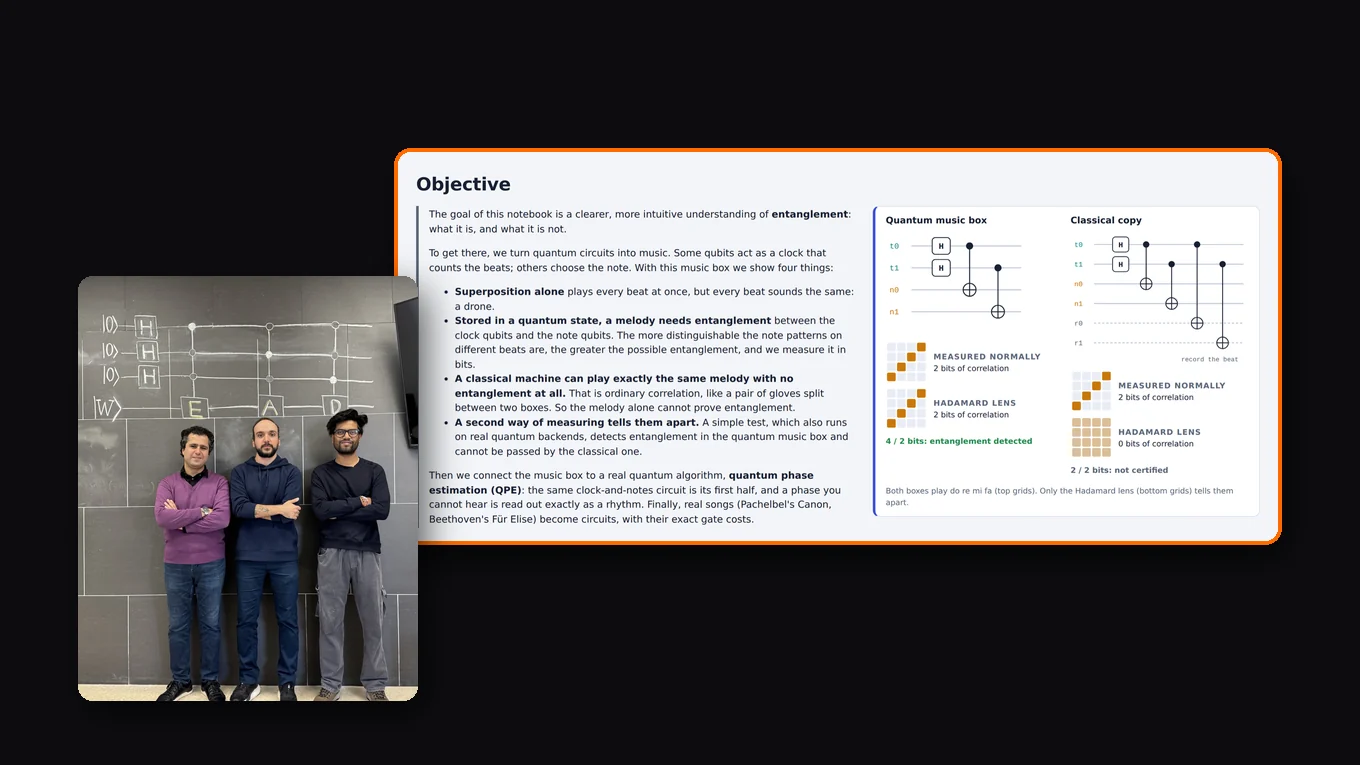
Für Elise was the hardest part: written as a simple lookup table, its opening needed almost 10,000 CNOT gates. The team cut that to 2,454 without changing a note.
Next, the team wants to do the same with pictures. Position qubits would pick a pixel and colour qubits its colour, so every edge and gradient in an image would come from entanglement.
Team EAD also entered Quantum Hokm.
Before this weekend, we thought quantum computing was complicated and visually abstract. Now we think it can be fun: something you can see, play with, and even hear.
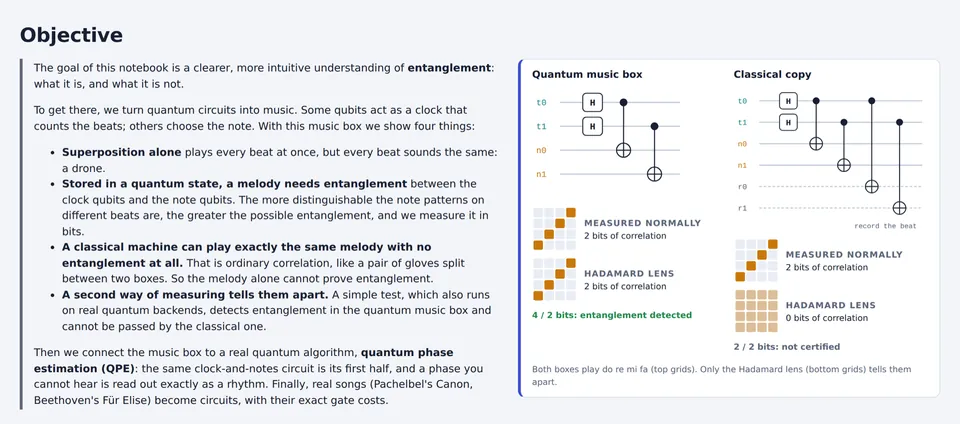 Can you hear entanglementA music lab where you play a song from a circuit and read how much entanglement it holds.
Every other project from ACENET
Three projects at the node work on biology and medicine: QDysphonia, QPhylo and Quantum Causal Discovery in Respiratory Pathologies. Others are built for learning, such as Quantum Quest, Qubit Qubes and Choose the Right Measurement. Games came up too, among them Quantum Pacman and Beat the Quantum.
The other 23 projects entered at the node, A to Z.
- Beat the Quantum: The Qollab project runs the CHSH game’s quantum core: Bell-pair circuits for all four input pairs, measured and scored, with the win rate compared to the 75% classical limit.
- ChemScope: Do quantum samples earn their place in SQD?: An audit of sample-based quantum diagonalization for stretched H6 chains.
- Choose the Right Measurement: Choose X, Y or Z measurements with a 12-shot budget.
- Deep Thermalization Lab: Build projected ensembles, compare their moments, and explore how connection width and environment size affect deep thermalization.
- Dyadic Ring Exact Synthesis: Exact synthesis of dyadic quantum unitaries using the Amy–Glaudell–Ross algorithm, with exact verification, Qiskit execution, and proof visualization.
- IMMUNE: The Self-Healing Quantum Memory: Break a quantum memory.
- PHANTOM MARKET: Detecting a Liquidity Blackout: An interactive quantum-assisted warning demo for sudden liquidity loss.
- PhaseCheck: Which errors can your measurements see?: An interactive lab that tests a circuit against a trusted reference.
- QDysphonia: QDysphonia applies quantum machine learning to voice disorder screening.
- QPhylo: protein phylogeny with QAOA normalized minimum cut: Reconstruct an eight-protein tree with Qiskit QAOA, recursive normalized cuts and constraint reinforcement.
- QPlace: Quantum-Assisted Kubernetes Pre-Drain Advisor: QPlace is a read-only Kubernetes pre-drain advisor that uses QAOA to explore workload placement under resource constraints, comparing verified quantum solutions against greedy and exact classical algorithms.
- Quantum & Monte Carlo Odds Comparison: Quantum vs Monte-Carlo modelling for estimating sports slate odds error rate when the market price is uncertain.
- Quantum Bomb Testing: Quantum bomb-testing game built on the Elitzur–Vaidman experiment.
- Quantum Bus Walk: A quantum walk vs. a classical random walk on 8 real St. John's Metrobus stops.
- Quantum Causal Discovery in Respiratory Pathologies: Quantum-enhanced MCMC samples the whole posterior over causal graphs, not one best guess.
- Quantum Hokm: A two-player card game inspired by Persian Hokm, bringing quantum measurement, interference, and entanglement into play, with an interactive guide and live circuit monitor.
- Quantum Pacman: A recreation of the classic Pac-man arcade game using quantum computing.
- Quantum Quest: Predict, run, explain: learn quantum computing with real Qiskit circuits on ideal, IBM and IonQ simulators. 21 hands-on lessons, from superposition to error correction, BB84, Bell tests and Shor's algorithm.
- Qubit Qubes: A drag and drop builder for quantum circuits.
- Roost: Roost is a cave-exploration game where you use clues to find hidden bats.
- Same Average, Different Sources: Predict whether two quantum sources with the same average state can be told apart.
- Shape Approximator: An interactive visualization comparing the difference between a classical approximation, and a quantum approximation.
- Vertex Cover Visualization
ACENET on Qollab
Specialty awards follow on Wed Oct 28 and global winners on Thu Oct 29, and the Hackathon 2026 results page links to every node's post.
Open any project on ACENET's node page on Qollab to read its code, run it and fork it. You can also follow the node there. The page shows the node's numbers, its members and node team, and all 26 hackathon projects.

Stay in the loop.
Get the latest tutorials, demos, and project showcases straight to your inbox. No noise, just the good stuff.
Enable JavaScript to sign up.
Qollab updates only. Unsubscribe any time. Privacy Policy.